

DraftKings suffered one of its sharpest stock-market declines of the year on Friday, November 6, as investors reacted to the company’s decision to accelerate spending on prediction markets despite continued growth in its established sportsbook and online casino operations.
Shares of the Boston-based sports betting company fell more than 26% during Friday’s trading, following the release of its third-quarter financial results and updated guidance for 2026 and 2027.
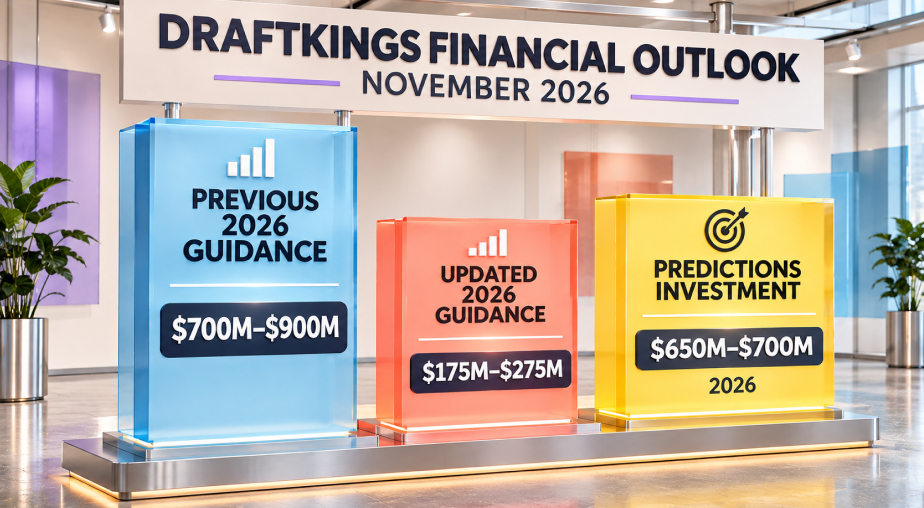
The selloff followed DraftKings’ announcement that its investment in the Predictions business would reach approximately $650 million to $700 million in 2026, substantially reducing its expected adjusted earnings before interest, taxes, depreciation, and amortization (EBITDA).
The company lowered its full-year 2026 adjusted EBITDA forecast to $175 million–$275 million, compared with the $700 million–$900 million range provided during the previous quarter.
At the same time, DraftKings reported third-quarter revenue of $1.329 billion, representing 16% growth from the corresponding period in 2025.
The contrasting figures illustrate the central issue facing the company: its existing sportsbook and iGaming operations continue to generate revenue growth, but the expansion into prediction markets is placing considerable pressure on near-term profitability.
According to the official DraftKings third-quarter earnings release, management expects its Predictions offering to become a substantial revenue contributor in 2027.
However, the market reaction indicates that investors remain concerned about the cost, timing, competitive environment, and regulatory uncertainty associated with the company’s expansion strategy.
DraftKings Shares Fall More Than 26% After Earnings Announcement
DraftKings’ November 6 stock decline followed the company’s third-quarter earnings announcement on November 5.
The results initially presented evidence of continued customer growth and improving sportsbook revenue generation.
However, the company’s revised financial outlook revealed a much larger commitment to prediction-market customer acquisition and platform development than investors had previously anticipated.
DraftKings shares traded approximately 26%–27% lower during Friday’s session, with contemporary financial reporting describing the decline as one of the company’s most severe single-day losses.
The market response was not simply a reaction to disappointing quarterly revenue.
Instead, it reflected concern about the amount of capital DraftKings intends to deploy into a developing business category whose long-term economics and regulatory boundaries remain uncertain.
The company is effectively prioritizing investment in a potential new growth market over maximizing adjusted EBITDA in the current financial year.
That decision creates a measurable difference between the performance of its established operations and its consolidated financial outlook.
Investors must now evaluate whether the potential long-term revenue generated by Predictions will justify the substantial near-term expenditure.
The November 6 MarketWatch coverage of DraftKings’ stock decline highlighted investor concerns surrounding the size of the investment, the competitive landscape, and the uncertainty of future profitability.
DraftKings Cuts 2026 Profit Outlook As Predictions Spending Accelerates
The most significant financial development was DraftKings’ reduction in its 2026 adjusted EBITDA guidance.
During its previous quarterly update, the company projected adjusted EBITDA between $700 million and $900 million.
Following the third-quarter results, the expected range fell to $175 million–$275 million.
This represents a $575 million reduction at the midpoint of the forecast.
Management attributed the revised outlook primarily to increased spending on Predictions, although additional iGaming investment and somewhat customer-friendly sports results also affected expectations for the core business.
The company’s updated figures illustrate the scale of its strategic commitment.
| Financial Metric | 2026 Guidance | 2027 Guidance |
|---|---|---|
| Total Revenue | $6.35B–$6.55B | $7.35B–$7.75B |
| Adjusted EBITDA | $175M–$275M | $800M–$1.0B |
| Core Business Adjusted EBITDA | $875M–$925M | $1.15B–$1.25B |
| Predictions Adjusted EBITDA Investment | $650M–$700M | $250M–$350M |
| Predictions Revenue | Expected To Be Immaterial | $650M–$750M |
Source: DraftKings third-quarter 2026 earnings release, November 5, 2026. Figures represent company guidance, not completed financial results.
The distinction between the core business and Predictions is important.
DraftKings expects its established operations to produce adjusted EBITDA of $875 million–$925 million in 2026.
However, the substantial investment required to expand Predictions reduces the company’s consolidated adjusted EBITDA forecast.
The company also expects Predictions revenue to remain immaterial during 2026 because customer promotions will offset much of the gross revenue generated by the offering.
That approach reflects a strategy focused on customer acquisition and market development rather than immediate profitability.
Adjusted EBITDA is a non-GAAP financial measure and should not be confused with net income, operating cash flow, or cash available to shareholders.
Third-Quarter Revenue Grows 16% Despite Investor Concerns
DraftKings’ underlying operating performance remained comparatively strong during the third quarter.
For the three months ended September 30, 2026, the company reported revenue of $1.329 billion.
That represented an increase of approximately $185 million from the $1.144 billion reported during the same quarter in 2025.
The company attributed the improvement primarily to customer engagement and a higher sportsbook net revenue margin.
Monthly Unique Payers increased approximately 13% year over year to 4.1 million.
Average revenue per Monthly Unique Payer reached $109, representing an increase of approximately 3%.
These metrics suggest that DraftKings continued attracting and retaining customers while generating more revenue per paying user.
The company’s business update also reported approximately $13.9 billion in sports consumer volume, an increase of 22% year over year.
Sports consumer volume encompasses activity across relevant sports and prediction offerings and should not automatically be treated as identical to traditional regulated sportsbook handle.
This distinction matters because DraftKings now operates across multiple product categories with different transaction structures and regulatory frameworks.
Chief Executive Officer and co-founder Jason Robins described the third quarter as an important stage in the company’s development, emphasizing the early customer engagement associated with Predictions.
According to the DraftKings third-quarter shareholder business update, more than 1.6 million customers had engaged with the Predictions offering during 2026 through the reporting period.
However, customer engagement does not necessarily translate immediately into positive earnings.
The company’s revised guidance demonstrates that attracting and retaining customers can require significant investment before the associated revenue produces an acceptable financial return.
Why DraftKings Is Investing Hundreds Of Millions In Prediction Markets
Prediction markets have become an increasingly important competitive development within the U.S. sports wagering industry.
Unlike conventional sportsbook markets, which typically involve wagers offered by licensed gambling operators, prediction markets use event-based contracts whose settlement depends on specified outcomes.
Depending on the platform and product, these contracts may relate to economic indicators, political events, sports competitions, or other measurable occurrences.
Some prediction-market operators operate within federal derivatives regulatory frameworks, while traditional sportsbooks generally function under state-level gambling laws.
The legal distinction between these categories remains contested, particularly when event contracts involve sporting outcomes.
For DraftKings, prediction markets potentially offer access to customers and product categories beyond its existing state-regulated sportsbook footprint.
The company reported that its mobile sportsbook was operating in 27 U.S. states, Washington, D.C., and Puerto Rico as of its November 2026 earnings announcement.
Those jurisdictions represented approximately 53% of the U.S. population.
Its iGaming operations were available in five U.S. states, representing approximately 11% of the population.
Prediction markets may create additional commercial opportunities, but their availability and permissible contract categories depend on applicable regulation and legal developments.
DraftKings’ investment therefore represents a strategic attempt to establish a position in an emerging market rather than a straightforward expansion of its existing sportsbook product.
The company must develop customer relationships, maintain platform infrastructure, support trading activity, and compete against established prediction-market businesses.
Those activities can require substantial expenditure before revenue becomes sufficient to offset operating and acquisition costs.
Jason Robins Projects A 20-Month Customer Payback Period
DraftKings management has presented its Predictions spending as an investment intended to generate returns over multiple years.
During the November 6 earnings call, Jason Robins said the company expected its 2026 Predictions customer cohort to achieve payback in approximately 20 months.
A customer payback period generally measures how long it takes for the financial contribution generated by acquired customers to recover the cost of acquiring them.
The calculation depends on assumptions involving customer retention, transaction activity, promotional expenditure, and contribution margins.

A projected 20-month payback period does not mean the company has already recovered its investment or that the forecast is guaranteed.
Actual results could differ if customer behavior, competition, regulation, or operating costs change.
Chief Financial Officer Alan Ellingson explained that DraftKings expected its established sportsbook and iGaming operations to generate cash flow supporting the expansion.
Management also indicated that Predictions investment could be adjusted in response to regulatory developments.
The November 6 DraftKings earnings call transcript provides additional detail on the company’s customer acquisition assumptions, financial outlook, and investment strategy.
The challenge for DraftKings is demonstrating that the projected customer economics can be achieved while maintaining the profitability of its existing businesses.
DraftKings Forecasts Up To $750 Million In Predictions Revenue For 2027
Despite the reduction in its 2026 earnings outlook, DraftKings expects Predictions to become a substantial revenue contributor in 2027.
The company introduced a 2027 Predictions revenue forecast of $650 million–$750 million.
It also expects adjusted EBITDA investment in the segment to decline to $250 million–$350 million.
At the midpoint, the planned investment would fall from approximately $675 million in 2026 to $300 million in 2027.
Management expects customers acquired during the initial expansion period to contribute additional gross profit as the business matures.
The company projects total 2027 revenue between $7.35 billion and $7.75 billion.
Its consolidated adjusted EBITDA forecast ranges from $800 million to $1 billion.
For the core business alone, DraftKings expects adjusted EBITDA of $1.15 billion–$1.25 billion.
These projections suggest that management anticipates continued improvement in the established sportsbook and online casino operations while Predictions gradually reduces its drag on consolidated earnings.
However, the 2027 forecast remains dependent on future customer activity, market conditions, competitive behavior, and regulatory developments.
The stock-market reaction suggests that investors are assigning considerable importance to whether DraftKings can deliver those projected results without another substantial increase in spending.
Prediction Markets Create New Competition For Traditional Sportsbooks
DraftKings’ expansion also reflects broader changes in the competitive environment surrounding U.S. sports wagering.
Traditional sportsbooks compete through pricing, market selection, platform functionality, customer service, promotional terms, and brand recognition.
Prediction-market platforms introduce another type of product structure.
Rather than relying exclusively on sportsbook-style odds, event contracts can be traded according to prices reflecting market participants’ expectations about specified outcomes.
However, the existence of an event contract does not make it equivalent to a traditional sportsbook wager.
Contract specifications, settlement rules, trading costs, liquidity, market access, and regulatory protections can differ substantially.
For consumers accustomed to conventional 1X2 soccer markets, the distinction is particularly relevant.
A traditional 1X2 market generally offers three possible outcomes: a home victory, a draw, or an away victory.
An event-contract platform may use different contract definitions, pricing conventions, and settlement conditions.
Even where two products concern the same sporting event, their prices should not be compared without accounting for the relevant contract terms and costs.
For operators, prediction markets could create competition for customer attention and sports-related transaction volume.
However, it remains uncertain how much of that activity will represent new demand rather than spending shifted from existing sportsbook products.
The distinction will be important when assessing the long-term effect of prediction markets on the U.S. sports betting industry.
Regulatory Uncertainty Remains A Major Financial Risk
Regulation is one of the most important uncertainties surrounding the expansion of sports-related prediction markets.
The Commodity Futures Trading Commission oversees designated contract markets and other activities within its statutory jurisdiction.
State gaming regulators, meanwhile, supervise licensed sports betting under their respective laws.
Disagreements have emerged over whether certain sports-related event contracts should be treated as federally regulated derivatives or gambling products subject to state restrictions.
Those disputes involve questions about federal authority, state law, contract classification, consumer protection, and the permissible scope of event-based trading.
A platform’s federal regulatory status does not, by itself, establish that every proposed contract is lawful in every jurisdiction.
Similarly, a state enforcement action does not automatically determine the legal status of all prediction-market products nationwide.
DraftKings must consider these uncertainties when allocating capital to its Predictions business.
A change in the regulatory treatment of sports-related contracts could influence the addressable market, customer acquisition economics, or the types of products the company can offer.
Management acknowledged this issue during the earnings call, indicating that future Predictions investment would respond to regulatory developments.
For consumers, the relevant safeguards also differ across product categories.
Users should examine the applicable platform rules, eligibility requirements, contract settlement terms, and available consumer protections rather than assuming that prediction markets operate under identical rules to licensed sportsbooks.
What The DraftKings Selloff Means For The U.S. Betting Industry
The sharp decline in DraftKings shares illustrates the financial pressure associated with entering a competitive market while maintaining an established gambling business.
DraftKings is not abandoning traditional sports betting.
Its financial disclosures indicate that sportsbook and iGaming operations remain central to the company’s revenue and adjusted EBITDA expectations.
However, management is allocating a substantial portion of the financial contribution from those businesses toward Predictions expansion.
This creates an important distinction between operating performance and investment strategy.
A sportsbook operator can report increasing revenue, growing customer engagement, and improving core profitability while simultaneously reducing its consolidated earnings forecast because of spending on a new business.
The development also raises questions for other gambling operators evaluating prediction-market opportunities.
Companies must consider whether acquiring new customers justifies the associated promotional expenditure, platform costs, and regulatory exposure.
They must also determine whether event-contract products complement existing sportsbook operations or compete with them for customer spending.
The answer may vary according to the operator’s geographic footprint, customer base, technology infrastructure, and regulatory circumstances.
For investors and industry analysts, the most useful measurements will extend beyond customer registrations or headline trading volume.
Customer retention, contribution margins, acquisition costs, sustainable revenue, and the timing of profitability will be central to evaluating whether prediction-market expansion creates long-term value.
DraftKings Faces A Critical Test Of Its 2027 Growth Strategy
DraftKings enters the final months of 2026 with a substantially different financial outlook than it presented earlier in the year.
The company continues to report growth in its core operations, including higher quarterly revenue and increased customer engagement.
However, its decision to invest $650 million–$700 million in Predictions has reduced near-term adjusted EBITDA expectations and triggered a significant stock-market reaction.
The company’s 2027 forecast presents a potential path toward improved consolidated profitability.
Management expects Predictions revenue of up to $750 million, lower investment requirements, and continued earnings growth in the established sportsbook and iGaming businesses.
Those expectations remain forecasts rather than achieved results.
The next phase of the company’s development will depend on whether its Predictions customer base generates sufficient recurring revenue, whether acquisition costs decline as anticipated, and how federal and state regulatory disputes evolve.
The November 6 stock selloff demonstrates that investors are increasingly examining the financial consequences of prediction-market expansion rather than focusing exclusively on its potential audience.
For the wider U.S. betting industry, DraftKings’ experience provides an important example of the trade-offs between entering an emerging market and preserving short-term profitability.
The company has established a measurable financial commitment to Predictions. Its challenge in 2027 will be demonstrating that the investment can produce sustainable commercial returns while maintaining the strength of its existing sportsbook business.