

The regulated U.S. online casino industry generated approximately $1.02 billion in gross gaming revenue during September 2026, marking the third consecutive month above the billion-dollar threshold and reinforcing the commercial importance of internet casino gaming in the American gambling market.
The latest figures cover seven states where regulated real-money online casino gaming is operational: Pennsylvania, Michigan, New Jersey, Connecticut, West Virginia, Delaware, and Rhode Island.
According to Sports Betting Dime’s October 30 national revenue analysis, September revenue increased 12.9% compared with approximately $902.5 million in September 2025.
That represents an annual increase of roughly $116.7 million.
The milestone follows similarly strong performances in July and August, when combined online casino revenue also exceeded $1 billion.
However, the headline figure reveals only part of the industry’s financial position.
Although online casino revenue continues to grow, the pace of annual expansion has moderated. Established markets are generating substantial revenue without the benefit of new states joining the regulated iGaming sector.
This creates a more complicated outlook for casino operators, state governments, technology suppliers, and investors.
The central question is no longer simply whether U.S. online casinos can generate billion-dollar months. It is whether existing markets can sustain meaningful growth as competition increases, promotional strategies evolve, and regulatory scrutiny intensifies.
September 2026 Online Casino Revenue Reaches $1.02 Billion
September’s performance extends a significant period of sustained revenue generation for the regulated U.S. online casino industry.
Combined revenue reached approximately $1.02 billion, maintaining the level achieved in July and August.
The three consecutive months above $1 billion demonstrate that the industry’s recent performance is not dependent on a single unusually strong reporting period.
Instead, the figures reflect continued activity across established regulated markets.
The September results also represent the seventh month of 2026 in which national online casino revenue exceeded $1 billion, according to the same gross-revenue aggregation.
The industry’s cumulative revenue reached approximately $9.09 billion through the first nine months of 2026.
This puts the sector on a substantially larger annual revenue base than in previous years.
However, national comparisons require an important methodological distinction.
Some state regulators publish gross gaming revenue before promotional deductions, while others emphasize adjusted gross revenue after certain deductions.
The $1.02 billion national estimate uses a gross-revenue approach intended to make the seven state markets more comparable.
It should not be confused with a simple addition of every state’s taxable or adjusted revenue figure.
The American Gaming Association’s commercial gaming revenue tracker provides a separate national reporting framework and identifies moderating annual growth as an important characteristic of the mature U.S. iGaming market.
The distinction matters because two reports can describe the same underlying gambling activity while presenting different revenue totals.
For September, the available industry aggregation shows continued growth, but not the rapid percentage increases associated with the earlier expansion of regulated online casino gaming.
Online Casino Revenue By State In September 2026
The seven regulated markets reported positive year-over-year gross gaming revenue growth during September.
Pennsylvania, Michigan, and New Jersey remained the largest contributors, accounting for most of the national total.
| State | September 2025 Revenue | September 2026 Revenue | Annual Growth |
|---|---|---|---|
| Pennsylvania | $286.7 million | $316.8 million | 10.5% |
| Michigan | $259.1 million | $300.2 million | 15.9% |
| New Jersey | $243.1 million | $274.8 million | 13.0% |
| Connecticut | $62.9 million | $67.0 million | 6.5% |
| West Virginia | $34.2 million | $39.5 million | 15.5% |
| Delaware | $11.6 million | $15.0 million | 29.3% |
| Rhode Island | $4.9 million | $5.9 million | 20.4% |
| National Total | $902.5 million | Approximately $1.02 billion | 12.9% |
Source: Sports Betting Dime, October 30, 2026. Gross gaming revenue figures are rounded. State tax-reporting methodologies may differ.
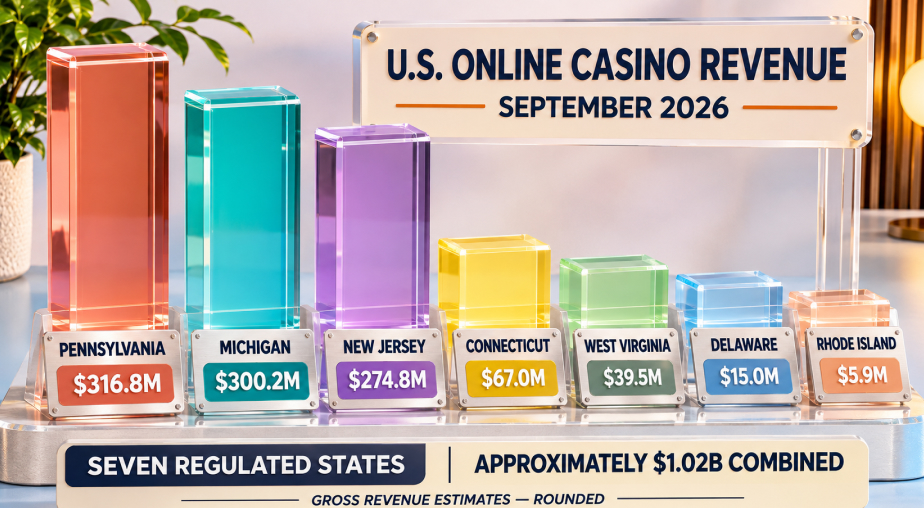
Pennsylvania generated the largest reported gross revenue total at $316.8 million.
Michigan followed with $300.2 million, while New Jersey produced $274.8 million.
Together, those three states generated approximately $891.8 million, representing about 87% of the reported national market.
That concentration demonstrates the extent to which U.S. online casino revenue depends on a small number of established jurisdictions.
The remaining four states contributed approximately $127.4 million combined.
Their smaller absolute revenue totals do not necessarily indicate weaker market performance.
Population size, licensing structure, the number of available operators, and the maturity of each state’s regulatory framework all influence revenue potential.
Delaware, for example, recorded the highest percentage growth in the table at 29.3%, but its total revenue remained substantially below that of Pennsylvania or Michigan.
This illustrates why both percentage growth and absolute revenue should be considered when comparing online casino markets.
Pennsylvania Leads The U.S. Online Casino Market
Pennsylvania remained the largest contributor to the national online casino revenue estimate in September, generating approximately $316.8 million before the promotional adjustments used in certain industry comparisons.
The Pennsylvania Gaming Control Board separately reported $249.3 million in September internet casino gaming revenue under its official reporting framework.
The regulator recorded $197.4 million from online slots, $49.7 million from online table games, and $2.3 million from online poker.
The difference between the $316.8 million gross estimate and the $249.3 million regulatory figure reflects the distinction between gross and adjusted reporting methods.
These figures should not be added together or treated as separate revenue streams.
According to the Pennsylvania Gaming Control Board’s September 2026 report, officially reported internet casino revenue increased 6.82% from approximately $233.4 million in September 2025.
The regulator also reported approximately $114.9 million in tax revenue from internet gaming during the month.
Pennsylvania’s market includes multiple licensed casino operators and their associated online gaming platforms.
Hollywood Casino at Penn National Race Course generated approximately $99 million in reported September iGaming revenue, while Valley Forge Casino Resort produced about $69.8 million.
Rivers Casino Philadelphia followed with approximately $38.5 million.
These results demonstrate that Pennsylvania’s online casino sector is supported by several major licensed operations rather than a single platform.
The state’s performance also illustrates the importance of online slots, which generated substantially more revenue than online table games or poker.
For industry analysts, Pennsylvania offers an example of how a mature regulated market can continue producing substantial revenue even as its annual percentage growth becomes more moderate.
Michigan Online Casinos Generate $300.2 Million
Michigan remained one of the country’s largest online casino markets, reporting $300.2 million in September 2026 iGaming gross receipts.
The Michigan Gaming Control Board released the figures on October 22.
The regulator also reported approximately $288.15 million in adjusted iGaming gross receipts.
Compared with September 2025, adjusted iGaming receipts increased 18.4%.
However, adjusted receipts declined 0.9% compared with August 2026.
That combination is important.
Michigan’s online casino market remains considerably larger than it was one year earlier, but its monthly performance does not necessarily increase continuously.
The state also recorded $55.5 million in online sports betting gross receipts during September, bringing combined online gambling gross receipts to approximately $355.7 million.
Online casino revenue and sports betting revenue are separate categories and should not be combined when calculating national iGaming-only performance.

According to the Michigan Gaming Control Board’s September revenue announcement, operators paid approximately $60.6 million in state iGaming taxes and fees during the month.
The three commercial casinos in Detroit also reported approximately $13.5 million in city wagering taxes and municipal services fees attributable to iGaming.
Michigan’s regulated market includes commercial and tribal operators.
As of September, 15 operators were authorized to offer internet casino gaming, while 13 offered online sports betting.
This market structure provides competition across multiple platforms, but operators must continue complying with state licensing, reporting, technical security, and consumer-protection requirements.
Michigan’s results therefore demonstrate both the revenue potential and regulatory complexity of a large online casino market.
New Jersey generated approximately $274.8 million in internet gaming win during September 2026, an increase of 13% from $243.1 million one year earlier.
The figures were released on October 19 by the New Jersey Division of Gaming Enforcement.
New Jersey remains particularly important to the U.S. iGaming industry because it was among the first states to establish a regulated online casino market in 2013.
Its continued growth demonstrates that online casino revenue can increase even after a market has operated for more than a decade.
The state’s September results also reveal a contrast between online and land-based casino performance.
Atlantic City’s nine casino hotels generated approximately $227.8 million in physical casino win during September, a decline of 1.3% compared with the previous year.
Internet gaming, meanwhile, increased 13%.
The two figures do not establish that online gambling caused the decline in land-based casino revenue. They do, however, demonstrate that different gambling channels can experience different growth patterns during the same reporting period.
The New Jersey Division of Gaming Enforcement’s September 2026 financial release provides the official monthly comparisons.
New Jersey’s results also highlight an important question for policymakers considering online casino legalization: whether digital gaming creates additional economic activity, redirects existing gambling spending, or produces a combination of both.
The answer depends on market conditions and cannot be determined from monthly revenue totals alone.
Why U.S. iGaming Growth Is Slowing Despite Record Revenue
The September results present an apparent contradiction.
U.S. online casinos are generating more revenue than in previous years, but the percentage rate of growth is moderating.
These developments are not mutually exclusive.
As an industry becomes larger, maintaining the same percentage growth requires increasingly substantial additions to revenue.
For example, a 20% increase on a $500 million monthly market represents $100 million in additional revenue.
The same percentage increase on a $1 billion market requires $200 million.
Consequently, a mature industry can continue adding significant revenue while reporting lower annual growth percentages.
The American Gaming Association reported that August 2026 iGaming revenue increased 12.3% year over year, noting that growth was moderating without new states entering the regulated market.
September’s reported 12.9% increase is consistent with that broader pattern, although it represents a slight acceleration compared with August rather than another month-to-month decline in the annual growth rate.
Several factors may contribute to the longer-term moderation.
First, the largest regulated markets already have established customer bases, making it more difficult to sustain the rapid adoption rates associated with early legalization.
Second, competition among licensed operators can influence promotional spending, customer retention, and platform development.
Third, online casino expansion remains geographically limited. Only seven states currently permit regulated real-money online casino gaming.
Without additional state launches, nationwide growth depends primarily on activity within existing markets.
Finally, revenue can fluctuate because of game outcomes, promotional accounting, customer activity, and seasonal patterns.
A single month’s performance should therefore not be treated as definitive evidence of a permanent change in industry growth.
Smaller States Continue Posting Strong Percentage Gains
While Pennsylvania, Michigan, and New Jersey dominate national revenue, smaller regulated markets remain important to the industry’s overall performance.
Connecticut generated approximately $67 million in September online casino revenue, increasing 6.5% from the previous year.
West Virginia reached approximately $39.5 million, representing 15.5% annual growth.
Delaware recorded approximately $15 million, an increase of 29.3%, while Rhode Island generated approximately $5.9 million, up 20.4%.
Delaware’s percentage growth was the strongest among the seven markets.
However, the state’s smaller revenue base means that a comparatively modest dollar increase can produce a large percentage change.
The same principle applies to Rhode Island.
These results illustrate why regulators and analysts should avoid ranking gambling markets exclusively by growth percentages.
A state generating $300 million per month has a different market scale from one generating $6 million, even if the smaller state reports faster annual growth.
The Legal Sports Report online casino revenue tracker provides additional context about how revenue and tax collections have developed across regulated U.S. jurisdictions.
The geographic concentration of the industry also means that national performance remains sensitive to developments in a few major states.
Changes to taxation, promotional rules, licensing requirements, or consumer-protection obligations in Pennsylvania, Michigan, or New Jersey could have a disproportionate effect on national results.
How Online Casino Revenue Differs From Sports Betting Handle
The $1.02 billion September figure represents online casino gross gaming revenue, not the total amount wagered by customers.
This distinction is particularly important because casino and sportsbook financial reports use different measurements.
Sports betting handle refers to the total value of wagers accepted during a reporting period.
Sportsbook revenue generally represents the amount operators retain after paying winning wagers, subject to the reporting methodology.
Online casino gross gaming revenue similarly reflects the difference between gambling activity and winnings returned to players, rather than the total value of all bets placed.
Adjusted gross revenue may then account for qualifying promotional deductions or other adjustments permitted under state rules.
These distinctions affect comparisons between states and between gambling products.
For example, Michigan’s September report separately identifies gross and adjusted receipts.
Pennsylvania’s official report presents an iGaming revenue figure that differs from the gross-revenue estimate used in some national comparisons.
Readers should therefore verify whether a reported amount represents gross gaming revenue, adjusted revenue, taxable revenue, or wagering volume.
The same caution applies to tax collections.
A state reporting $100 million in gaming revenue does not necessarily collect $100 million in gambling taxes.
Tax obligations depend on the applicable rates, deductions, and regulatory structure.
What Billion-Dollar Months Mean For Casino Operators And State Governments
Sustained monthly online casino revenue above $1 billion has implications for both the private gambling industry and public finances.
For licensed operators, the figures demonstrate the commercial scale of regulated digital casino gaming.
However, gross revenue does not represent net profit.
Operators must account for gambling taxes, platform technology, game suppliers, employee compensation, payment processing, compliance operations, marketing, and customer support.
The cost of acquiring and retaining customers can also affect profitability.
For state governments, online casino gaming creates a taxable activity that can generate recurring public revenue.
Pennsylvania’s approximately $114.9 million in September iGaming taxes illustrates the potential scale of these collections in a major market.
Michigan’s approximately $60.6 million in state iGaming taxes and fees provides another example.
However, the financial benefits must be considered alongside the costs and responsibilities of gambling regulation.
These include licensing oversight, enforcement against unauthorized operators, financial monitoring, and responsible gambling programs.
Revenue growth should not be interpreted as evidence that gambling-related harm has declined.
Regulators must assess consumer protection independently from industry financial performance.
This becomes particularly important as online casino platforms introduce increasingly sophisticated personalization, promotional systems, and customer engagement features.
Will More U.S. States Legalize Online Casinos?
The September results may strengthen interest in online casino legislation among policymakers examining potential new sources of tax revenue.
However, commercial performance in existing states does not guarantee that other jurisdictions will authorize internet casino gaming.
Legalization remains a state-level political and regulatory decision.
Lawmakers must consider issues including consumer protection, taxation, market competition, relationships with tribal gaming interests, and potential effects on existing land-based casinos.
Some states may view online casino authorization as an opportunity to bring gambling activity into a regulated framework.
Others may prioritize concerns about accessibility, problem gambling, or competition with established gambling facilities.
These debates can produce different outcomes even among states with similar populations or economic conditions.
The fact that seven states currently generate approximately $1 billion in monthly gross revenue demonstrates the industry’s scale, but it does not establish how much additional revenue legalization would generate elsewhere.
Projected revenue depends on the number of operators, eligible population, tax structure, consumer participation, and the extent to which activity shifts from existing gambling channels.
Any future expansion would also require clear rules governing customer identity verification, age restrictions, geolocation, anti-money-laundering controls, and responsible gambling safeguards.
What The September Results Signal For The Rest Of 2026
The final quarter of 2026 will provide additional evidence about whether the regulated U.S. online casino industry can sustain its billion-dollar monthly performance.
Through September, the seven legal markets had generated approximately $9.09 billion under the gross-revenue aggregation used in the latest industry reporting.
That establishes a substantial revenue base entering October, November, and December.
However, the September figures do not guarantee another record quarter.
Monthly gambling revenue can fluctuate, and the timing of promotional campaigns, changes in player activity, and regulatory developments may influence results.
The more important long-term indicator will be whether the industry continues generating positive annual growth while maintaining effective regulatory controls.
Pennsylvania, Michigan, and New Jersey will remain central to that assessment because they account for the overwhelming majority of national online casino revenue.
Smaller markets will also provide useful evidence about how regulatory structures and market maturity affect performance.
For casino operators, the emerging challenge is sustaining revenue growth without relying excessively on promotional spending or customer engagement practices that create additional consumer-protection risks.
For policymakers, the challenge is evaluating the financial benefits of regulated online gaming alongside its broader social and regulatory implications.
September’s third consecutive billion-dollar month confirms that legal online casinos have become a substantial component of the U.S. gambling industry.
The next phase of market development will be defined less by crossing the billion-dollar threshold and more by the sustainability, profitability, transparency, and regulatory oversight of the revenue generated.