

DraftKings is facing heightened scrutiny from state gambling regulators and federal lawmakers as questions intensify over sportsbook VIP rewards, personalized marketing, artificial intelligence, and the effectiveness of responsible gambling safeguards.
The latest developments involve Louisiana, Ohio, New York, and Congress, with different authorities examining whether online sportsbooks adequately protect customers who display potentially harmful betting behavior. The concerns extend beyond DraftKings to competitors including FanDuel, BetMGM, Caesars, and Fanatics, as well as prediction-market platforms Kalshi and Polymarket.
On October 15, the Louisiana Gaming Control Board declined to immediately renew DraftKings’ five-year license and instead granted the operator a temporary four-month permit. The following day, Ohio regulators proposed a rule restricting direct sportsbook marketing for 48 hours after customers activate or modify responsible gambling controls.
Meanwhile, on October 22, U.S. Senator Richard Blumenthal and Representatives Paul Tonko and Valerie Foushee requested detailed information about VIP programs from six gambling and prediction-market companies. Their questions address customer losses, promotional incentives, account monitoring, and the use of artificial intelligence.
The developments gained renewed attention following ProPublica’s October 30 reporting on sportsbook oversight, which connected recent regulatory actions to investigations of personalized gambling promotions.
None of these developments establishes that DraftKings has violated gambling regulations. The Louisiana review remains an administrative licensing matter, Ohio’s proposed rule has not been adopted, and the congressional letters are information requests rather than enforcement findings.
Why DraftKings’ VIP Program Is Facing Increased Scrutiny
VIP programs are a longstanding feature of the gambling industry. Online sportsbooks use them to provide selected customers with additional services, loyalty rewards, personalized promotions, and access to account representatives.
The regulatory concern is not simply that VIP programs exist. It is whether their incentives can encourage continued gambling among customers already displaying warning signs of financial or behavioral harm.
A sportsbook may evaluate wagering activity, account history, engagement, and other information when determining eligibility for loyalty benefits. These practices create questions about how companies distinguish ordinary customer engagement from behavior that may warrant protective intervention.
In September 2026, ProPublica journalist Jake Pearson published an investigation describing a ten-week experiment involving a DraftKings account. Pearson deliberately engaged in betting patterns associated with elevated gambling risk, including chasing losses, placing frequent wagers, and making increasingly large bets.
According to his account, he received an invitation to pursue VIP status shortly after losing approximately $1,800 in one night. He was subsequently accepted into the program after several weeks of activity.
The investigation also described promotional communications that continued after Pearson activated certain responsible gambling settings.
These findings concern one journalist’s documented experience, not a representative sample of all DraftKings customers. Nevertheless, they raise a broader question: Should promotional eligibility be reduced or suspended when an operator detects signs that a customer may be struggling to control their gambling?
DraftKings disputes the suggestion that its safeguards are inadequate. Its chief responsible gaming officer, Lori Kalani, has defended the company’s monitoring system and cautioned against drawing broad conclusions from a single customer’s experience.
The distinction matters. Investigative reporting can identify issues regulators may wish to examine, but regulatory violations require separate evidence and legal assessment.
Louisiana Grants DraftKings A Temporary Four-Month Permit
One of the most consequential developments occurred in Baton Rouge on October 15, 2026, when the Louisiana Gaming Control Board considered DraftKings’ license renewal.
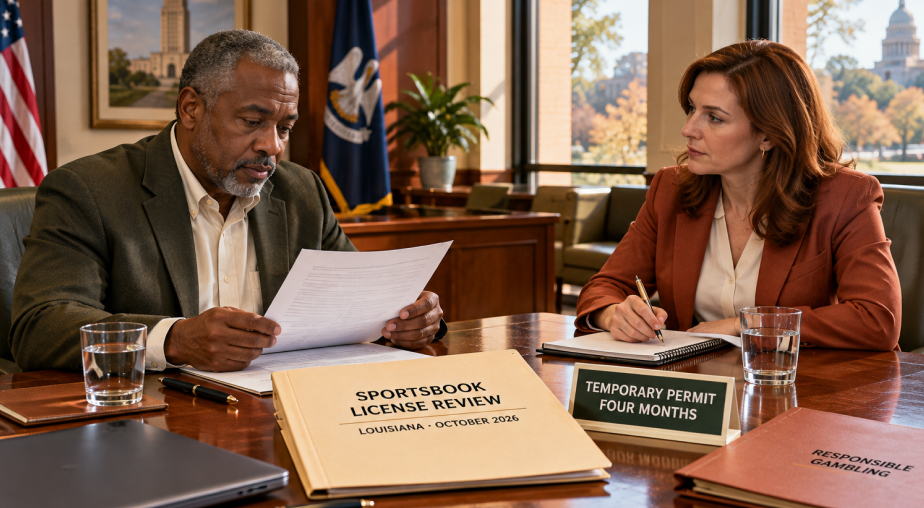
Rather than immediately granting another five-year license, the board approved a temporary permit lasting four months while officials reviewed issues raised by investigative reporting and other licensing documentation.
Board chairman Christopher Hebert acknowledged the seriousness of the allegations but emphasized that journalism alone does not establish a regulatory violation.
The temporary permit allows the company to continue operating under regulatory oversight while the review proceeds. It is not equivalent to a license suspension, revocation, or formal finding of misconduct.
During the board’s meeting, DraftKings executives addressed questions about artificial intelligence, customer monitoring, and account interventions.
Paul Liberman, a DraftKings co-founder and president of operations, denied that the company uses artificial intelligence to target customers who lose money.
Kalani also discussed account closures associated with responsible gambling concerns. She told Louisiana regulators that DraftKings had closed 175 accounts in the state during 2026 for suspected problematic gambling behavior.
That figure provides evidence of account-level interventions, but it cannot independently establish how effective the company’s safeguards are. Assessing effectiveness would require additional information about the total customer population, the criteria used to identify risky behavior, the number of customers reviewed, and the outcomes of those reviews.
The Louisiana Gaming Control Board’s October 15 meeting recording provides the official context for the licensing discussion.
The next regulatory question is whether Louisiana’s review results in a conventional license renewal, additional conditions, or further action. As of October 30, no final adverse finding arising from this review has been established.
Ohio Proposes A 48-Hour Pause On Sportsbook Promotions
Ohio is approaching the issue through a proposed change to its sports betting regulations.
On October 16, 2026, the Ohio Casino Control Commission published a proposal to amend Sports Gaming Rule 3775-16-03.
The amendment would prohibit sportsbooks from sending direct marketing or promotional materials to customers for 48 hours after they activate or change certain responsible gambling controls.
The proposed restriction covers communications such as promotional push notifications and other direct digital or physical marketing. It would not prohibit customers from accessing their accounts or placing otherwise lawful wagers during the 48-hour period.
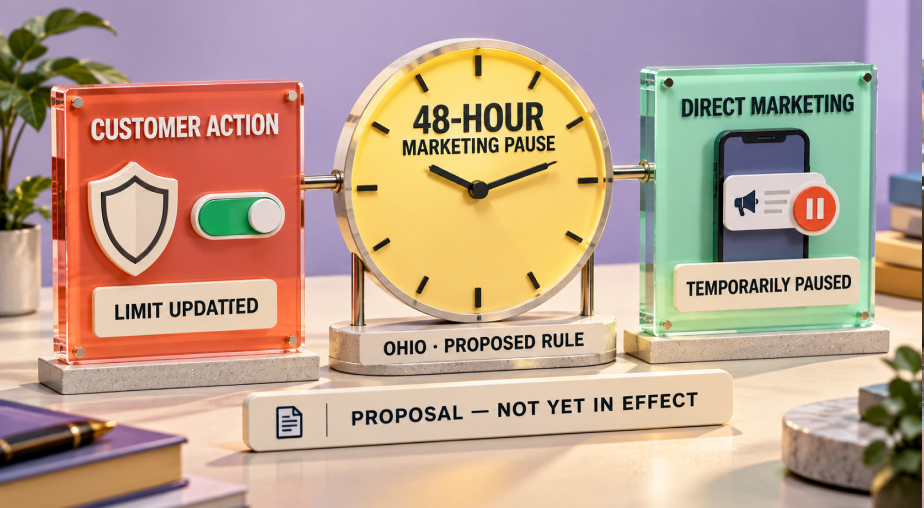
The proposal also excludes limits established during initial account creation.
This distinction reflects the policy objective: giving customers a period without direct promotional pressure after they voluntarily take steps to manage their gambling.
Andromeda Morrison, interim executive director of the Ohio Casino Control Commission, has indicated that the proposal addresses concerns about marketing messages reaching customers shortly after they engage with protective tools.
The commission’s official October 16 rulemaking notice confirms that the amendment remains a proposal and that public comments are due by 5 p.m. on October 30, 2026.
There is also a potential unintended consequence. Keith Whyte, former executive director of the National Council on Problem Gambling, has warned that customers might become reluctant to use responsible gambling tools if they believe doing so will affect their access to promotions.
That concern does not necessarily undermine the proposed restriction, but it illustrates why regulators must consider customer behavior as well as operator obligations.
Ohio’s approach may become an important example for other states evaluating whether responsible gambling settings should automatically affect marketing eligibility.
Congress Demands Information About Sportsbook VIP Rewards
Federal lawmakers are also investigating how VIP programs operate.
On October 22, 2026, Senator Richard Blumenthal of Connecticut, Representative Paul Tonko of New York, and Representative Valerie Foushee of North Carolina sent letters to six companies:
| Company | Business Category |
|---|---|
| DraftKings | Sportsbook and online gaming |
| BetMGM | Sportsbook and online gaming |
| Caesars | Sportsbook and online gaming |
| Fanatics | Sportsbook and online gaming |
| Kalshi | Prediction-market exchange |
| Polymarket | Prediction-market platform |
The letters request detailed information about customer eligibility, rewards, financial outcomes, and the relationship between promotional programs and potentially harmful gambling.
Among the questions are how many customers participate in VIP programs, what customers typically win or lose before and after enrollment, and how much revenue operators generate from VIP participants.
The lawmakers also want to know whether companies use artificial intelligence to identify customers for promotions and how their systems respond when users attempt to reduce or suspend gambling activity.
Responses are requested by November 5, 2026.
The official congressional announcement provides the questions and identifies the companies receiving the letters.
These requests do not establish that any recipient has violated the law. They are an attempt to obtain information that could inform further congressional oversight or legislative proposals.
The inclusion of prediction-market platforms is particularly notable because those companies operate under different regulatory structures from state-licensed sportsbooks.
Artificial Intelligence Becomes A Central Gambling Regulation Issue
The growing attention to VIP programs is closely connected to the use of customer data.
Modern online gambling platforms can collect extensive information about account activity, including wagering frequency, deposits, losses, session duration, and responses to promotional offers.
Some operators use automated systems to identify customers who may need responsible gambling interventions. Data analysis can also support marketing segmentation and personalized communications.
The policy challenge arises when those functions overlap.
A customer exhibiting unusual betting activity might be identified by one system as a potential responsible gambling concern while another system evaluates the same customer for loyalty benefits or promotional engagement.
That possibility raises questions about how operators coordinate their internal safeguards.
Regulators may seek to establish whether a company’s marketing systems can access risk indicators, whether protective interventions override promotional campaigns, and whether employees can manually authorize offers to customers already flagged for review.
These questions should not be confused with proof that any particular operator deliberately targets vulnerable customers.
DraftKings has stated that it does not market to customers based on indicators of potential problem gambling. Liberman has also denied using AI to target losing customers.
The important regulatory issue is therefore one of verification and accountability: what systems exist, how they operate, and whether independent oversight can confirm that customer protections function as described.
New York And Other States Examine Gambling Marketing Practices
Scrutiny is extending beyond Louisiana and Ohio.
According to October 30 reporting, investigators associated with the New York Attorney General’s Office have contacted former DraftKings employees concerning issues raised in earlier reporting about personalized marketing and artificial intelligence.
That outreach should be understood as reported investigative activity, not as a publicly announced enforcement finding.
New York gaming officials have also been considering stronger standards concerning artificial intelligence and responsible gambling.
Elsewhere, regulators in Massachusetts, Maine, and Michigan have been examining related concerns about sportsbook marketing and customer protection.
In New Jersey, Attorney General Jennifer Davenport has publicly warned that the state is monitoring reports of sportsbooks potentially disregarding consumer safeguards.
These developments suggest that regulators increasingly view marketing practices, customer data, and responsible gambling protections as interconnected compliance issues.
The questions are no longer limited to whether an operator provides a deposit-limit button or publishes a responsible gambling notice.
Authorities are examining whether the broader product experience supports those protections or undermines them through competing incentives.
For multistate sportsbook operators, this creates a complicated compliance environment. Rules governing advertising, customer monitoring, and promotional eligibility can differ significantly by jurisdiction.
A policy that satisfies one state’s requirements may not meet another state’s expectations, particularly as new regulations are proposed.
What Responsible Gambling Tools Can And Cannot Do
Most regulated sportsbooks provide tools designed to help customers manage their gambling activity.
Common options include deposit limits, wagering limits, time reminders, temporary account breaks, and self-exclusion.
These tools serve different purposes. Deposit limits restrict how much money a customer can add to an account, while wagering limits control betting activity. Time reminders provide information about session duration but may not prevent continued play.
Temporary breaks can restrict account access for a defined period. Self-exclusion generally involves stronger restrictions and may apply across multiple licensed operators within a jurisdiction.
Their effectiveness depends partly on how they interact with the rest of the platform.
For example, a customer who reduces a deposit limit may still receive ordinary promotional messages unless an operator’s rules or systems prevent them.
Similarly, an account may receive responsible gambling reminders while other features continue encouraging frequent engagement.
That does not mean the protective tools have no value. It means they should be evaluated as part of a larger system involving marketing controls, customer support, monitoring, and intervention procedures.
The Ohio Casino Control Commission’s responsible gambling resources describe available support options, including self-exclusion and assistance for individuals experiencing gambling-related harm.
Customers concerned about their gambling can also contact the National Council on Problem Gambling for information and support resources.
Responsible gambling protections should help people make informed decisions without creating additional pressure to continue wagering.
How Stronger VIP Rules Could Affect Sportsbook Operations
Changes to VIP regulation could influence how sportsbooks design loyalty programs, evaluate customers, and manage promotional spending.
One potential approach is to require more extensive reviews before granting high-value rewards. Another is to restrict marketing when customers exhibit certain risk indicators or activate protective controls.
Operators may also face demands for clearer records showing why particular customers received promotions and whether those decisions complied with internal responsible gambling policies.
These changes could create additional compliance costs, particularly for companies operating across many states.
However, they could also improve consistency between marketing departments and responsible gambling teams.
For regulators, the challenge is determining which requirements produce measurable consumer protection benefits without discouraging customers from using voluntary safeguards.
For sportsbooks, the challenge is demonstrating that customer engagement strategies do not conflict with commitments to responsible gambling.
The congressional inquiry may provide useful information if companies disclose meaningful data about VIP enrollment, customer outcomes, and promotional practices.
Such information could help policymakers evaluate whether current protections are adequate or whether more specific rules are needed.
What Happens Next For DraftKings And Sportsbook VIP Programs?
Several developments will determine how this issue evolves.
Louisiana’s temporary licensing arrangement leaves the DraftKings review open. Regulators must decide whether the concerns raised warrant additional action or whether the company satisfies the requirements for a longer-term renewal.
Ohio’s October 30 public comment deadline marks another procedural step. The proposed 48-hour marketing restriction must still proceed through the state’s rulemaking process before it can become enforceable.
At the federal level, the November 5 deadline for responses to the congressional VIP-program letters could provide additional insight into how major operators evaluate customers and distribute rewards.
Other state regulators may also announce inquiries, guidance, or rulemaking initiatives concerning AI-assisted marketing and responsible gambling.
None of these outcomes is predetermined.
DraftKings remains a regulated sportsbook operator, and the current reporting does not establish that its VIP program is unlawful.
Nevertheless, the combination of investigative reporting, state licensing scrutiny, proposed advertising restrictions, and congressional information requests demonstrates a significant shift in regulatory attention.
The central question is increasingly whether sportsbooks can show that their responsible gambling systems remain effective when operating alongside sophisticated marketing and loyalty programs.
For the U.S. betting industry, the long-term implications may extend beyond VIP rewards to the wider use of customer data, automated risk assessments, promotional targeting, and the standards regulators expect licensed operators to meet.