

Utah filed criminal charges against prediction-market operator Kalshi and co-founders Tarek Mansour and Luana Lopes Lara on October 28, 2026, escalating a dispute over whether federally regulated sports event contracts are subject to state gambling laws.
Utah Attorney General Derek Brown brought the case in Salt Lake County, alleging that Kalshi promoted illegal online gambling and collected transaction fees from sports-related contracts offered to Utah residents. The prosecution names KalshiEX LLC, chief executive officer Tarek Mansour, and chief operating officer Luana Lopes Lara.
The case includes 14 criminal counts: 13 felonies and one misdemeanor. Prosecutors rely partly on an undercover investigation in which a state agent reportedly placed 12 sports-related transactions through Kalshi during September 2026.
Kalshi rejects the allegations and argues that its exchange operates under federal oversight from the Commodity Futures Trading Commission (CFTC). The charges arrived just one day after the CFTC filed a federal lawsuit challenging Utah’s efforts to enforce state gambling restrictions against federally registered prediction markets.
According to Reuters’ October 28 report on the Utah prosecution, the filing represents a significant escalation in the conflict between state gambling authorities and federal derivatives regulators. investing.com
The distinction between an allegation and an established violation is essential. Kalshi and its founders have been charged, not convicted, and the criminal proceeding does not resolve the broader federal-versus-state jurisdictional dispute.
Utah Files 14 Criminal Charges Against Kalshi And Its Co-Founders
The October 28 filing targets KalshiEX LLC and the company’s two founders individually, bringing corporate conduct and executive responsibility into the same criminal proceeding.
Utah prosecutors allege that the platform allowed residents to participate in sports event contracts that function as prohibited gambling under state law. They also allege that the company generated revenue from facilitating those transactions.
The reported charges include:
| Criminal Charge | Number Of Counts | Classification |
|---|---|---|
| Online gambling promotion | 12 | Third-degree felony |
| Pattern of unlawful activity | 1 | Second-degree felony |
| General gambling promotion | 1 | Class A misdemeanor |
| Total | 14 | 13 felonies, 1 misdemeanor |
The case was filed in Utah’s Third District Court in Salt Lake County. Authorities issued summonses to Mansour and Lopes Lara rather than arrest warrants, according to reporting by The Salt Lake Tribune.
Utah’s criminal allegations are separate from the civil enforcement case the state filed earlier in October. They also differ from federal proceedings addressing whether the Commodity Exchange Act prevents states from regulating federally registered event-contract exchanges.
Brown has maintained that Utah’s gambling prohibition applies regardless of whether a company describes its products as wagers, trades, or event contracts.
Kalshi disputes that interpretation. Its position is that federally regulated financial contracts cannot automatically be treated as unlawful gambling products under individual state laws.
The disagreement matters because the criminal charges require prosecutors to establish more than the existence of a controversial financial product. They must prove the relevant statutory elements and overcome any applicable defenses.
How Utah’s Undercover Investigation Led To The Charges
The prosecution relies heavily on an investigation conducted by Scott Eggerman, an investigator with the Utah Attorney General’s Office.
According to charging documents described by local reporters, Eggerman created an undercover Kalshi account on September 13, 2026, using information identifying the account holder as a Utah resident.
The registration reportedly included a Utah residential address, local telephone number, and debit card connected to a Utah financial institution.
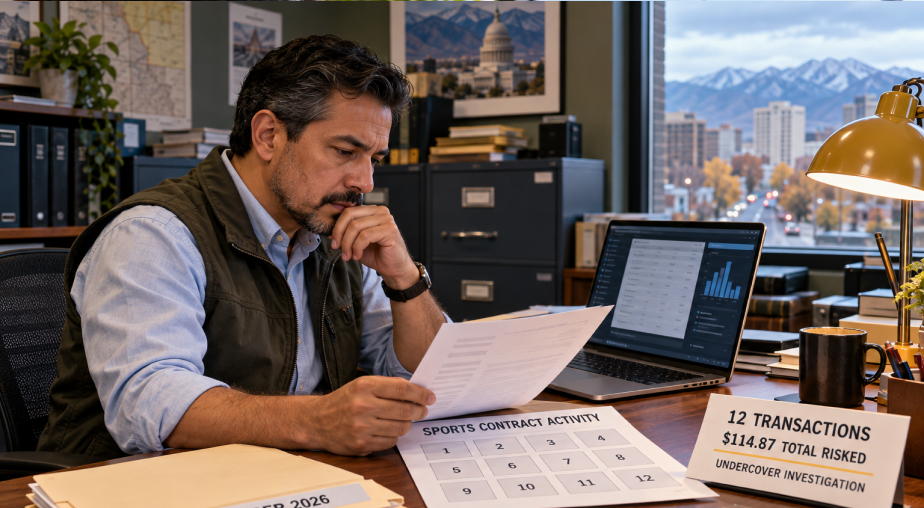
Investigators say the platform requested location confirmation before allowing the account to trade. The agent subsequently conducted transactions while physically located in Utah, including activity associated with Salt Lake and Davis counties.
Over approximately two weeks, the investigator placed 12 sports-related transactions.
Transactions
12
Total Risked
$114.87
Reported Net Loss
$25.10
Figures attributed to Utah’s undercover investigation, not Kalshi’s statewide trading activity.
The contracts involved professional football, college football, baseball, soccer, and hockey. Examples included the University of Utah’s September 19 football game against Utah State and the Utah Mammoth’s September 26 NHL matchup against the Colorado Avalanche.
Investigators also recorded fees associated with the transactions. According to the charging documents, those fees ranged from approximately three cents to 78 cents per transaction.
The state considers the transactions evidence that Kalshi made sports-related contracts available to Utah residents and received compensation from that activity.
The relatively small amount risked by the investigator does not necessarily limit the significance of the case. Prosecutors are using the transactions to establish how the platform allegedly operated within Utah, rather than to demonstrate a particular volume of statewide gambling.
The Salt Lake Tribune’s examination of the charging documents provides additional detail about the account registration, sporting events, transaction amounts, and allegations. sltrib.com
However, the transactions remain evidence presented by prosecutors. Whether they establish criminal liability will depend on the court’s evaluation of the charges, applicable law, and defense arguments.
Why Utah Considers Sports Prediction Contracts Illegal Gambling
Utah has one of the country’s most restrictive gambling frameworks. Unlike states that license commercial sportsbooks or casinos, Utah generally prohibits gambling rather than maintaining a regulated sports betting industry.
That difference shapes the state’s position toward prediction markets.
On Kalshi, participants can trade event contracts whose settlement depends on whether a specified outcome occurs. Some contracts concern economic indicators, elections, weather, or other events. Others concern sports results.
Kalshi characterizes these products as financial derivatives traded on a federally regulated exchange. Utah argues that sports contracts tied to the results of games or player performances can function as gambling regardless of their financial-market structure.
The state therefore focuses on the economic substance of the activity: a customer risks money on an uncertain sporting outcome, with a financial return determined by the result.
Kalshi emphasizes a different framework. It argues that event contracts are subject to federal commodities regulation and that a patchwork of state gambling rules would interfere with the operation of federally registered exchanges.
The legal disagreement is not merely about terminology. It concerns whether federal law preempts Utah’s authority to prohibit the particular contracts at issue.
For readers comparing these products with conventional sportsbooks, the distinction between market structure and regulatory classification is important. Our earlier analysis of New York’s investigation into Kalshi sports trading records examines how another state is approaching that same boundary through subpoenas and civil regulatory oversight.
Utah’s latest filing takes the dispute further by seeking criminal accountability.
A Federal Court Had Already Rejected Kalshi’s Preemption Argument In Utah
The October criminal charges follow an important earlier decision in federal court.
In August 2026, U.S. District Judge Robert J. Shelby granted summary judgment in Utah’s favor in litigation Kalshi initiated earlier in the year.
Kalshi had argued that its registration as a federally regulated exchange prevented Utah from applying state gambling restrictions to its sports event contracts.
Judge Shelby rejected that position, concluding that federal commodities law did not displace Utah’s authority to regulate the sports-related activity at issue.
The Utah Attorney General’s summary of the federal court decision describes the ruling as confirmation that the state’s anti-gambling laws can apply to Kalshi’s sports contracts. Utah Attorney General
That decision strengthened Utah’s enforcement position, but it did not establish criminal guilt in the October prosecution.
The federal judgment addressed the relationship between federal derivatives law and state gambling restrictions. The new criminal case involves specific allegations, transactions, statutory offenses, and named defendants.
Those are separate legal questions.
A state court considering the criminal charges must still determine whether prosecutors have established the necessary elements of the offenses. Kalshi may also continue challenging the broader jurisdictional framework through appellate or related federal proceedings.
This distinction is particularly important because the litigation is developing across multiple courts and jurisdictions.
Utah’s October 20 Civil Lawsuit Adds A Separate Enforcement Front
Eight days before filing the criminal charges, Utah initiated a separate civil lawsuit against Kalshi and related entities.
The October 20 complaint alleged that the platform offered unlawful gambling to Utah residents through contracts involving sports, elections, politics, and other outcomes.
Unlike the criminal prosecution, the civil lawsuit seeks remedies directed at the company’s operations and allegedly unlawful financial gains.
Utah has alleged that activity associated with accounts in the state generated substantial revenue or transaction-related proceeds. Reporting on the civil complaint describes a disputed financial estimate ranging from approximately $30.5 million to $61.1 million for the period between February and October 2026.
Those amounts are allegations presented in litigation, not independently established profits or a court-ordered repayment.
The difference between the civil and criminal cases is important. Civil enforcement can focus on injunctions, restitution, and other remedies, while criminal proceedings require proof of charged offenses under the applicable criminal standard.
The state’s decision to pursue both tracks suggests that regulators are seeking to address ongoing operations as well as alleged past conduct.
It also raises questions about how the cases may interact. Evidence obtained in one proceeding could become relevant to another, subject to applicable procedural and evidentiary rules.
The Utah Attorney General’s official newsroom confirms the October 20 civil enforcement announcement. Utah Attorney General
The existence of multiple lawsuits does not mean that all requested remedies will be granted. Each proceeding has its own legal requirements and potential defenses.
CFTC Sues Utah One Day Before The Criminal Charges
The timing of the criminal filing is especially significant because the CFTC initiated its own lawsuit against Utah on October 27, 2026.
The federal agency argues that Utah’s attempts to restrict federally registered prediction markets interfere with Congress’s framework for regulating derivatives exchanges.
CFTC Chairman Michael S. Selig has maintained that Congress assigned the commission primary regulatory responsibility over covered event contracts.
In its October 27 announcement of the Utah lawsuit, the agency said it was seeking to prevent state enforcement actions from obstructing federally registered contract markets. CFTC
The CFTC’s position directly conflicts with Utah’s interpretation of its gambling authority.
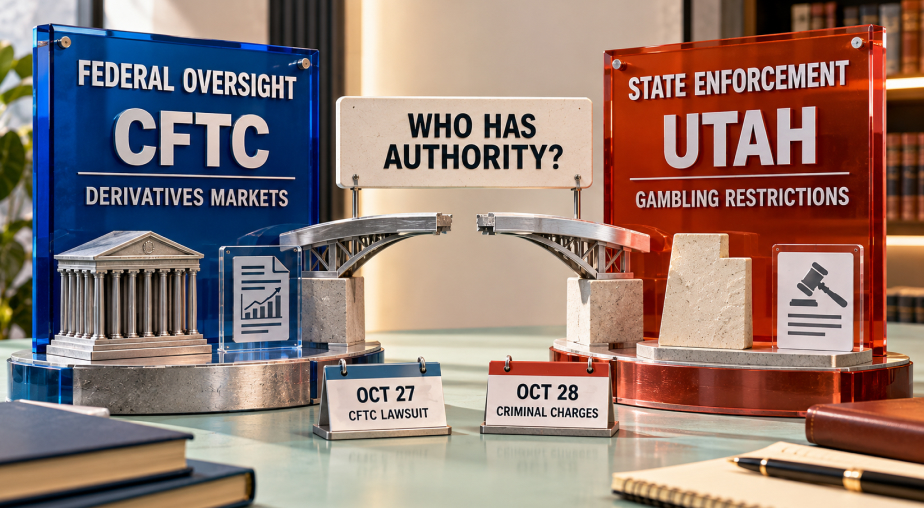
Utah maintains that federal registration does not create a blanket exemption from generally applicable state restrictions on gambling.
The CFTC argues that states cannot use gambling statutes to override the federal regulatory framework governing products lawfully listed on registered exchanges.
Neither position should be confused with a universally settled rule covering every type of prediction-market contract.
Courts have examined different products, procedural circumstances, and legal arguments, producing an evolving body of litigation rather than a single nationwide resolution.
The October 27 federal lawsuit also demonstrates that the dispute is no longer confined to Kalshi defending itself against individual state regulators. The federal regulator is actively seeking judicial protection for what it considers its jurisdiction.
That development could materially affect future enforcement cases.
Kalshi Rejects The Charges And Points To Arizona Litigation
Kalshi has strongly disputed Utah’s prosecution.
In a statement reported by the Associated Press, the company described the charges as an overreach and said it would challenge them in court.
The company also pointed to litigation in Arizona, where federal intervention previously provided temporary protection against state criminal enforcement.
Arizona’s experience is relevant because it demonstrates that criminal proceedings involving prediction markets can become entangled with federal jurisdictional litigation before the underlying charges reach trial.
In April 2026, the CFTC announced that it had sought an injunction against Arizona’s criminal and civil enforcement efforts involving federally regulated prediction markets.
The CFTC’s Arizona enforcement announcement explained the agency’s position that state criminal proceedings could interfere with federal oversight of registered derivatives exchanges. CFTC
However, a temporary injunction is not the same as a permanent ruling that every prediction-market product is lawful nationwide.
Kalshi’s reliance on Arizona therefore illustrates its defense strategy without determining the outcome of the Utah prosecution.
The legal issues may overlap, but Utah’s statutes, procedural history, and earlier federal judgment distinguish its case from proceedings elsewhere.
Why The Charges Against Kalshi’s Founders Matter
Naming Tarek Mansour and Luana Lopes Lara as defendants gives Utah’s prosecution an additional dimension.
Regulatory disputes involving companies frequently focus on licensing, operational restrictions, or financial penalties. Criminal charges against individual executives raise separate questions about personal responsibility for business conduct.
Utah’s allegations connect the company’s operations and transaction-related revenue to the responsibilities of its founders.
The prosecution will need to establish the legal and factual basis for the charges against each defendant. Holding an executive title or founding a company does not, by itself, establish criminal liability.
For the prediction-market industry, the case may increase attention to corporate governance, internal legal review, product approval procedures, and how companies respond to conflicting state and federal regulatory positions.
Executives operating across multiple jurisdictions must consider whether federal registration adequately addresses the risks associated with state enforcement.
That uncertainty is especially consequential when states pursue criminal remedies rather than only civil injunctions.
The case may also influence how companies document compliance decisions, assess new event contracts, and communicate with regulators.
These are potential industry implications, not findings that Kalshi or its executives knowingly violated the law.
What The Case Could Mean For U.S. Prediction Markets
Utah’s prosecution adds to a growing series of disputes over sports-related prediction markets across the United States.
The underlying conflict is whether event contracts tied to sporting outcomes should be treated primarily as federally regulated derivatives or as products that states may restrict under their gambling laws.
The answer could affect more than Kalshi.
Other federally registered platforms offering comparable contracts may face similar questions about where products can be offered, which authorities can investigate them, and what consumer protections apply.
Traditional licensed sportsbooks also operate within this regulatory debate.
State-regulated sportsbooks generally must satisfy jurisdiction-specific licensing, age-verification, responsible gambling, reporting, and tax requirements. Prediction-market exchanges operate under a different federal framework.
The existence of different frameworks does not automatically establish that one is more protective or that every product offered under either framework is equivalent.
It does, however, create important questions about regulatory consistency, market integrity, and consumer understanding.
The CFTC’s guidance on prediction markets and event contracts emphasizes that customers should understand contract rules, fees, potential losses, and the status of the entities offering products. CFTC
For consumers, the safest interpretation of the current dispute is that federal registration and state legality are separate questions whose relationship remains contested.
A platform’s availability in a particular location should not be treated as proof that every product is lawful there.
Likewise, a criminal filing does not establish that customers have committed offenses or that existing contracts have automatically become invalid.
What Happens Next In Utah’s Criminal Case Against Kalshi?
The immediate next stage concerns the defendants’ response to the charges in Utah’s Third District Court.
The summonses issued to Mansour and Lopes Lara require participation in the criminal process, but they do not establish guilt.
The defendants may challenge the charges through available procedural motions and jurisdictional arguments. The state will need to support its allegations with admissible evidence.
Meanwhile, the CFTC’s federal lawsuit against Utah could affect the broader enforcement environment, particularly if the federal court considers requests for preliminary or permanent relief.
The civil enforcement case filed October 20 will also continue on its own procedural track unless affected by subsequent judicial action.
Several developments will be especially important: whether a court limits or permits the criminal prosecution to proceed, how federal courts address the CFTC’s preemption arguments, and whether appellate decisions clarify the boundary between sports gambling and event-contract trading.
As of October 29, 2026, no conviction or final criminal judgment has been established in the newly filed Utah case.
The prosecution nevertheless marks an important change in the regulatory dispute. Utah is no longer relying exclusively on civil litigation or arguments about whether sports prediction contracts should be available within its borders. It is attempting to establish criminal responsibility for specific alleged transactions and business conduct.
For the wider U.S. prediction-market industry, the most consequential question is whether states can pursue criminal gambling charges against federally registered exchanges when the products involved resemble conventional sports wagers.
The outcome could influence the operating environment for prediction markets, the authority of state gambling regulators, and the extent to which federal derivatives oversight limits state enforcement.