

Voters across northeastern Indiana have rejected a proposed expansion of the state’s casino industry, defeating local gambling referendums in Allen, DeKalb, and Steuben counties during the November 3 general election.
The rejection of casino expansion in Allen, DeKalb, and Steuben counties also highlights the importance of public opinion in shaping gambling policy. While the referendum focused on land-based casino development, discussions about sportsbook regulation, operator accountability, and consumer protection remain relevant across the broader U.S. gambling industry. Readers who want to chat about bookies and explore different perspectives on sportsbook operations can find community discussions that complement the regulatory and economic issues surrounding Indiana’s casino expansion debate.
The results effectively block the development of a new inland casino under the framework established by Indiana House Enrolled Act 1038, which authorized the Indiana Gaming Commission to consider one additional casino license in northeastern Indiana, provided that voters approved casino gambling in an eligible county.
All three counties voted against the proposal. Opposition reached approximately 59.6% in Allen County, 64.6% in DeKalb County, and 58.7% in Steuben County, according to unofficial election-night results.
The outcome is particularly significant for Fort Wayne, Indiana’s second-largest city, where business organizations and local officials had promoted a potential casino as an economic development opportunity.
Supporters pointed to construction investment, employment, tourism, and tax revenue. Opponents raised concerns about gambling-related harm, neighborhood impacts, and whether a casino would deliver sufficient long-term benefits to justify its social and economic costs.
The vote also creates a regulatory obstacle for the Indiana Gaming Commission, which had been preparing to evaluate applications for a development involving at least $500 million in investment.
With all three eligible counties rejecting the proposal, the licensing process cannot proceed under the existing local-approval requirements.
The results remain subject to official canvassing and certification, but the reported margins indicate clear opposition in every participating county.
Indiana Casino Referendum Results: All Three Counties Vote No
The November 3 election gave residents of Allen, DeKalb, and Steuben counties a direct opportunity to determine whether inland casino gambling should be permitted in their communities.
Each county received Public Question No. 3, asking voters whether inland casino gambling should be permitted within that county.
Approval would not have guaranteed construction of a casino. Instead, a successful referendum would have made the county eligible for consideration under the state’s licensing process.
The unofficial results show that none of the three counties reached the required majority.
| County | Votes Against | Votes In Favor | Against |
|---|---|---|---|
| Allen | 61,310 | 41,625 | 59.6% |
| DeKalb | 7,374 | 4,043 | 64.6% |
| Steuben | 6,234 | 4,394 | 58.7% |
Source: Unofficial November 3–4 election results reported by local news organizations and election trackers. Figures are subject to certification.
Allen County, which includes Fort Wayne, recorded the largest number of votes on the question. More than 61,000 voters opposed the proposal, compared with approximately 41,600 who supported it.
DeKalb County delivered the strongest percentage opposition, with nearly two-thirds of participating voters rejecting casino gambling.
Steuben County also voted against the proposal by a substantial margin.
The results were reported by 21Alive’s northeastern Indiana election coverage, which documented the defeats across the three counties.
Because the legislation required local approval before a casino license could be awarded, the results carry consequences beyond the immediate political debate.
They prevent the proposed development from moving into the normal licensing stage under the current law.
How House Enrolled Act 1038 Created The Casino Expansion Proposal
Indiana lawmakers approved House Enrolled Act 1038 during the 2026 legislative session to establish a process for potentially adding an inland casino in northeastern Indiana.
The legislation was signed into law by Governor Mike Braun and became effective in March 2026.
Rather than authorizing multiple new gambling properties, the measure created a framework for one additional inland casino license that could be awarded in Allen, DeKalb, or Steuben County.
The legislation required local voter approval before the Indiana Gaming Commission could consider a license application for a particular county.
That requirement gave residents a direct role in determining whether the state-authorized expansion could proceed.
The Indiana Department of Revenue’s 2026 legislative summary explains the referendum requirements and associated changes to the state’s casino licensing and taxation framework.
The law also established financial and operational requirements for prospective casino developers.
A successful applicant would have been required to make a substantial investment in the casino and related facilities, with a minimum development commitment of approximately $500 million over five years.
This requirement was intended to ensure that a new license produced a significant physical development rather than a comparatively small gambling operation.
However, the legislation made that investment opportunity conditional on the outcome of the local referendums.
The November 3 results therefore represent a failure to satisfy a statutory prerequisite, rather than a decision by regulators to reject a particular operator’s application.
That distinction is important when assessing the legal and commercial implications.
Why Fort Wayne Became The Center Of Indiana’s Casino Debate
Fort Wayne was widely regarded as a major potential location for the proposed casino.
The city is the commercial and population center of Allen County, with established transportation connections, hotels, entertainment venues, and regional tourism activity.
Supporters argued that a casino could attract visitors from northeastern Indiana and neighboring markets while generating additional spending for nearby businesses.
Fort Wayne Mayor Sharon Tucker and members of the Allen County Board of Commissioners had expressed support for allowing the project to advance.
Their position emphasized the potential for private investment, job creation, and economic development.
Business organizations also participated in the campaign supporting casino authorization.
One prominent effort, Advance Fort Wayne Allen County, promoted the proposal as an opportunity to bring a major entertainment investment into the region.
Supporters considered the $500 million minimum investment requirement particularly important because it suggested a development extending beyond a conventional casino floor.
The proposed project could have included related hospitality, dining, and entertainment amenities, although no final casino design or operator had been selected.

Local reporting by the Indiana Capital Chronicle on the northeast Indiana casino referendum documented the competing arguments before Election Day.
The final Allen County result demonstrates that support from business leaders and elected officials did not translate into majority voter approval.
Approximately three in five participating voters opposed casino authorization.
The result also illustrates the difference between support for regional economic development and support for a particular form of development.
Residents can favor new jobs and investment while remaining unconvinced that a casino is the appropriate vehicle for delivering those benefits.
Why Casino Expansion Opponents Mobilized Across Northeastern Indiana
Opposition to the proposed casino development reflected several concerns.
Some residents questioned whether casino revenue would generate enough new economic activity to offset potential social costs.
Others raised concerns about problem gambling, household financial stress, public safety, and the possibility that gambling-related spending would be diverted from existing local businesses.
These arguments were especially relevant because the referendum concerned a permanent gambling facility rather than a temporary event or limited entertainment proposal.
Opponents also questioned the long-term implications of making casino gambling part of the region’s economic development strategy.
A casino can create direct employment and generate tax revenue, but the broader economic effects depend on factors including visitor spending, competition, operating costs, and the share of revenue originating from existing local consumers.
These effects are not uniform across communities.
For example, a destination casino attracting substantial out-of-state spending may have a different economic profile from a facility whose customers primarily come from nearby neighborhoods.
The three county results do not establish which specific concern motivated every voter.
However, the consistent rejection across Allen, DeKalb, and Steuben counties shows that the proposal failed to secure majority support in communities with different population sizes and economic characteristics.
The November 3 Indiana Capital Chronicle election report described the competing economic development and consumer-protection arguments surrounding the vote.
For regulators and lawmakers, the results underscore the importance of public acceptance when considering gambling expansion.
A project may satisfy financial investment criteria and still fail if residents do not support introducing a new gambling facility into their community.
What The Vote Means For The Indiana Gaming Commission
The Indiana Gaming Commission was responsible for overseeing the potential licensing process established by House Enrolled Act 1038.
Before the election, the commission had outlined a schedule allowing eligible casino operators to submit applications following the November 3 vote.
Under that schedule, applications were expected by December 1, 2026, with a final licensing decision targeted for April 15, 2027.
However, the schedule depended on at least one eligible county approving the referendum.
The commission’s March 26, 2026 meeting minutes specifically explained that applications could not be accepted for a county where the local referendum failed.
Because all three counties voted against casino authorization, there is no eligible location for the proposed new license under the existing framework.
That means the commission cannot simply select the county with the narrowest rejection margin or award the license to an interested operator despite the election results.
The statutory requirement for voter approval remains controlling.
The legislation also restricts repeat referendums in counties that reject casino authorization, further limiting the possibility of restarting the same process through another immediate local vote.
Any future attempt to revive the project would likely require legislative changes or a different legally authorized development framework.
This outcome does not revoke existing Indiana casino licenses or prohibit casino gambling throughout the state.
It specifically affects the proposed additional inland casino license associated with the three northeastern counties.
The $500 Million Casino Investment That Will Not Proceed Under The Current Plan
The proposed development carried a minimum investment requirement of approximately $500 million.
That amount represented the capital commitment a successful casino operator would have needed to make over a five-year period.
It was not a confirmed construction contract, guaranteed public investment, or revenue already available to local governments.
Before the election, economic development discussions considered the potential benefits of a large casino and hospitality complex.
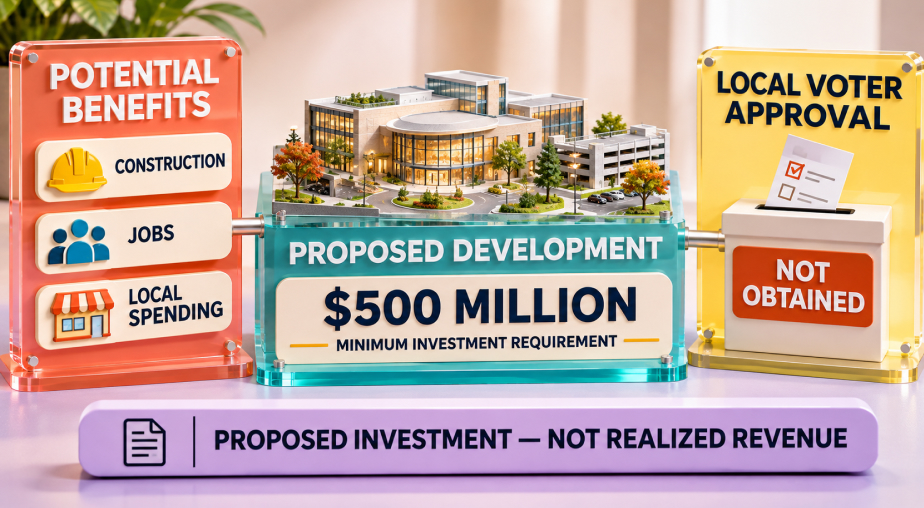
Those benefits could have included construction employment, permanent casino jobs, supplier contracts, hotel activity, and additional visitor spending.
However, projected benefits should be distinguished from verified economic outcomes.
The actual number of jobs, wages, visitors, and tax receipts would have depended on the selected operator, final project design, location, and performance after opening.
The proposed casino also would have entered an established regional gambling market.
Existing Indiana casinos, along with properties in neighboring states, already compete for customers.
A new casino might have attracted additional visitors to northeastern Indiana, but it could also have redirected spending from existing gambling facilities.
That distinction matters when interpreting economic impact projections.
New gambling revenue at one property does not necessarily represent an equivalent increase in total regional economic activity.
The rejection of the referendums removes the immediate prospect of the proposed development, but it does not establish that the region has permanently lost $500 million in otherwise committed investment.
No operator had received final authorization to construct the project.
Indiana’s Existing Casino Market Remains Substantial
The failed northeastern Indiana expansion comes at a time when the state already maintains a significant regulated gambling industry.
According to the Indiana Gaming Commission’s fiscal year 2026 annual report, statewide casino revenue reached approximately $2.32 billion during the fiscal year.
The commission reported $582.9 million in casino wagering taxes and another $47.7 million in supplemental wagering taxes.
The report also identified approximately $942 million in gaming revenue from the northern Indiana casino market.
These figures demonstrate that the proposed northeastern Indiana casino would have entered a mature and competitive industry rather than establishing the state’s first regulated casino operation.
<box></box>
The commission’s annual report also recorded approximately $5.77 billion in sports betting handle during fiscal year 2026, with online wagering accounting for about 98% of total sports wagers.
Sportsbook handle represents the total amount wagered, not the amount retained by operators as revenue.
The distinction is important because Indiana’s casino and sports betting markets operate under different licensing structures.
The November 3 referendums concerned a new physical casino, not the continuation of existing online sports betting.
Their defeat does not prohibit residents from using otherwise lawful, state-regulated sports betting services.
Similarly, the vote does not establish a new statewide policy concerning online casino legalization.
The referendum addressed a specific proposed casino license and its potential location.
How Indiana’s Casino Vote Differs From Online Gambling Regulation
The northeastern Indiana referendum provides an example of how gambling expansion decisions can differ depending on the product and legal framework.
A physical casino requires a location, construction approvals, local infrastructure, employees, and ongoing regulatory supervision.
Its effects are concentrated partly in the surrounding community.
That gives local governments and residents a direct interest in issues such as traffic, land use, public services, employment, and neighborhood development.
Online sports betting operates differently.
Although licensed operators must comply with state laws and geolocation requirements, customers can access authorized platforms without visiting a physical sportsbook.
Indiana already permits regulated online sports betting, subject to applicable eligibility and licensing requirements.
Online casino gaming, often called iGaming, involves another regulatory category.
The defeat of a land-based casino referendum does not automatically determine whether lawmakers will support or oppose future online casino legislation.
The policy questions overlap, particularly regarding consumer protection and tax revenue, but the legal proposals are not interchangeable.
For readers following gambling regulation, the Indiana vote demonstrates why it is necessary to distinguish between retail casino licenses, online sportsbook authorization, and potential online casino expansion.
Each may require different legislative procedures, regulatory approvals, and public consultation.
What Happens Next After The November 3 Casino Referendums?
The immediate next step is the certification of the election results.
County election officials must complete the required canvassing and transmit certified results through the procedures established under Indiana law.
Once the results are official, the Indiana Gaming Commission will have a definitive record confirming that none of the three eligible counties approved casino authorization.
Under House Enrolled Act 1038, that prevents the commission from awarding the proposed license in Allen, DeKalb, or Steuben County.
The December 2026 application deadline and April 2027 licensing timetable consequently have no approved county location to which they can apply.
Lawmakers could revisit the broader issue in a future legislative session, but any new proposal would need to account for the restrictions established by the existing law and the results of the local votes.
There is no verified replacement casino location or approved alternative licensing plan as of November 4, 2026.
The election also leaves existing Indiana casinos and sportsbooks operating under their current regulatory arrangements.
For gambling industry observers, the outcome provides an important reminder that legislative authorization alone does not guarantee market expansion.
Even when a state creates a licensing opportunity, local approval requirements can determine whether the project reaches the development stage.
In northeastern Indiana, voters exercised that authority decisively.
The longer-term question is whether state lawmakers pursue a different casino expansion strategy or allow the current market structure to remain unchanged.
For now, the November 3 results have closed the path to a new inland casino in Allen, DeKalb, or Steuben County under the 2026 legislation.