

New York is moving toward tighter oversight of mobile sports betting, with regulators advancing proposals that would restrict artificial intelligence in personalized gambling promotions and require sportsbooks to identify customers showing signs of potential gambling harm.
On October 9, 2026, the New York State Gaming Commission unanimously advanced two proposed responsible-gambling regulations. The measures would introduce more specific customer-monitoring obligations and limit how gambling businesses use automated systems to encourage additional wagering.
The proposals arrive nearly five years after New York launched statewide mobile sports wagering in January 2022. Since then, the state has developed one of the largest regulated sports betting markets in the United States, bringing questions about consumer protection, advertising and operator accountability into sharper focus.
Commission Chair Brian O’Dwyer has emphasized that licensed gambling businesses must demonstrate a meaningful commitment to protecting customers. The proposals also follow increased scrutiny of sportsbook marketing practices and the effectiveness of existing responsible-gambling systems.
Importantly, the proposed requirements are not yet final regulations. They are proceeding through a public-comment process, and their ultimate wording and implementation will depend on subsequent regulatory decisions.
For bettors, operators and industry analysts, the development represents a potential shift from general responsible-gambling commitments toward measurable intervention requirements and restrictions on automated promotional targeting.
The New York State Gaming Commission’s proposed rules provide the regulatory background, while the October 9 announcement was also examined in ProPublica’s reporting on New York sports betting protections.
New York Gaming Commission Advances Two Sports Betting Proposals
The New York State Gaming Commission advanced the measures on October 9 following several months of regulatory development.
The proposals focus on two related but distinct concerns.
The first concerns the use of artificial intelligence and automated customer profiling in gambling marketing. Regulators want to restrict systems that analyze individual customers to deliver personalized promotions, suggested wagers or wagering amounts intended to increase gambling activity.
The second concerns identifying customers whose behavior may indicate gambling-related harm. Mobile sportsbooks would face more specific obligations to monitor certain account activities, conduct reviews and provide appropriate interventions.
The two proposals are designed to work together.
One addresses how operators may attempt to increase customer engagement. The other addresses what operators must do when customer activity raises potential concerns.
New York Governor Kathy Hochul had already outlined related consumer-protection priorities on March 30, 2026, including stronger safeguards against underage gambling and technology-driven efforts to identify customers who may need assistance.
The governor’s March 2026 responsible-gambling announcement described the administration’s concerns about gambling access, AI-driven targeting and the responsibilities of licensed operators.
The October advancement marks another step in that regulatory process rather than the introduction of an entirely new policy debate.
A 60-day public-comment period is intended to provide industry representatives, consumer advocates and other stakeholders an opportunity to respond before the commission considers final action.
Proposed AI Restrictions Target Personalized Sportsbook Promotions
One of the most significant elements is the proposed restriction on artificial intelligence used to influence gambling activity.
Modern sportsbook platforms can collect extensive information about account activity, including deposits, wagering frequency, preferred sports, promotional interactions and other customer behaviors.
Operators may use data analytics for several legitimate purposes, such as fraud detection, account security, compliance monitoring and understanding operational performance.

However, regulators are increasingly examining whether similar technologies can be used to identify customers who may respond to targeted offers encouraging further wagering.
New York’s proposed restrictions focus on this promotional use of technology.
The proposal would restrict gambling licensees and relevant parties acting on their behalf from using AI-powered systems and automated profiling to personalize offers or recommend wagers in ways designed to increase betting activity.
The scope is broader than a prohibition on a particular chatbot or generative-AI application.
It potentially reaches algorithmic decision-making, machine learning and other systems that process customer information to determine which gambling promotions or wagering suggestions an individual receives.
The distinction matters because an operator could use automated profiling without displaying an obvious AI interface to the customer.
A promotional message may look like ordinary sportsbook advertising even when a complex customer-classification system determines its timing or content.
The proposed restrictions would therefore focus on the underlying decision process, not simply the appearance of the advertisement.
The commission’s draft responsible-gambling regulation, Part 5404, sets out the initial framework for restricting AI-powered promotional targeting and improving customer protections.
Why AI-Based Customer Profiling Raises Regulatory Questions
The regulatory concern is not that every use of artificial intelligence in gambling is inherently harmful.
AI systems can support account-security reviews, suspicious-activity detection and the identification of potentially harmful gambling behavior.
The concern arises when customer data is used to increase gambling engagement without sufficient attention to the individual’s circumstances.
For example, an automated system might identify that a customer frequently returns to a betting application after losing wagers.
If that information is used to deliver increasingly personalized promotions, regulators may question whether the marketing system is encouraging behavior associated with financial harm.
The same data could instead be used to identify a customer who may benefit from responsible-gambling information or additional safeguards.
This creates a central regulatory distinction: technology used to identify potential harm is different from technology used to intensify wagering activity.
The proposed rules would require operators to consider how automated systems are designed, what information they process and what outcomes they are intended to produce.
That could affect sportsbook marketing departments, customer relationship management systems, third-party technology vendors and affiliate arrangements.
A platform’s compliance obligations may not end with the software it develops internally.
If an external vendor processes customer information or determines promotional offers on the operator’s behalf, the regulator may also examine those arrangements.
This is why the proposal has implications beyond consumer-facing sportsbook applications.
It could reshape the technical and contractual responsibilities behind gambling marketing.
Sportsbooks Could Be Required To Identify At-Risk Customers
The second proposal would establish more detailed requirements for identifying and supporting customers whose account activity suggests potential gambling-related harm.
Under the draft framework, licensed mobile sportsbook operators would be required to maintain systems that flag specified account behaviors for review.
These reviews would not automatically establish that a customer has a gambling disorder.
Instead, they would identify circumstances requiring further examination.
The operator would assess the available information and determine whether the customer’s behavior indicates a potential problem.
If a customer is identified as at risk, the operator would be expected to provide appropriate responsible-gambling information and follow the applicable intervention procedures.
The framework also calls for each licensed mobile sportsbook to designate a dedicated responsible-gambling lead.
That individual would oversee relevant customer-protection responsibilities, including the handling of identified at-risk customers and access to assistance resources.
This represents a more structured approach than relying solely on general responsible-gambling messages displayed within an application.
The regulator’s objective is to establish identifiable responsibilities, documented processes and measurable responses.
The distinction between automated alerts and human review is particularly important.
A system may identify unusual account behavior, but a subsequent review is necessary to interpret the available evidence and determine an appropriate response.
What Betting Activity Could Trigger A Responsible-Gambling Review?
New York’s draft regulation identifies several account behaviors that would trigger additional scrutiny.
Some involve large deposits or high wagering volume. Others involve repeated changes to responsible-gambling settings, interrupted self-exclusion attempts or changes in account activity.
The distinction is significant because gambling-related harm cannot be assessed through financial volume alone.
A customer with substantial financial resources may place large wagers without exhibiting the same circumstances as someone experiencing financial distress from smaller amounts.
Likewise, a customer placing relatively modest wagers may still experience significant harm.
The proposed framework therefore combines financial thresholds with behavioral indicators.
| Proposed Review Trigger | Threshold Or Behavior |
|---|---|
| Large daily deposits | More than $10,000 within 24 hours |
| Large cumulative deposits | More than $100,000 within 90 days |
| High account turnover | More than $1 million within 90 days |
| Incomplete self-exclusion requests | Three or more within 30 days |
| Repeated withdrawal cancellations | Three within 10 days |
| Increased account activity | Weekly login time rises by at least 50% against the specified comparison period |
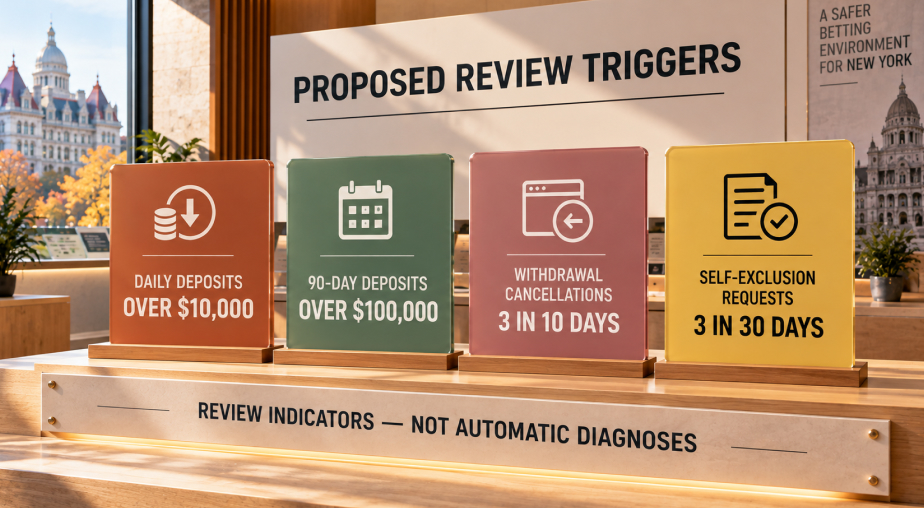
These examples come from the commission’s published draft and should not be interpreted as automatic findings of problem gambling.
They are proposed triggers for due diligence.
The draft also identifies repeated increases to responsible-gambling limits, additional cooling-off requests, certain account-balance patterns and the use of multiple funding sources.
Some of these indicators are more directly connected to customer behavior than to the absolute amount wagered.
That broader approach reflects an important limitation of financial thresholds: account activity can raise concerns even when it does not involve exceptionally large sums.
The New York State Gaming Commission’s draft rulemaking document provides the proposed criteria and definitions.
The final thresholds and procedures may change during the rulemaking process.
A Dedicated Responsible-Gambling Lead Would Oversee Interventions
The proposed requirement for a dedicated responsible-gambling lead would create a clearer point of accountability within each licensed mobile sportsbook.
The role would involve maintaining relevant records, overseeing the identification of potentially at-risk customers and ensuring appropriate responsible-gambling resources are available.
The draft also contemplates restrictions on direct advertising to customers identified as at risk.
This is an important connection between the two proposals.
Restricting AI-driven promotions addresses one potential source of pressure to gamble. Limiting promotional contact with identified at-risk customers addresses the treatment of individuals whose account activity has already raised concerns.
The draft describes a phased intervention process.
An initial intervention could involve contacting a customer with information about deposit limits, time limits, loss limits, cooling-off periods, self-exclusion and account closure.
A subsequent stage could require the customer to view an approved responsible-gambling educational video before continuing to wager.
A more advanced intervention could involve direct contact from the operator’s responsible-gambling lead.
These measures would create a documented process for responding to concerning behavior.
However, the effectiveness of the system would depend on how operators interpret alerts, conduct reviews and implement interventions.
A regulatory requirement to contact customers does not necessarily establish that the intervention will prevent harm.
That outcome would require separate evaluation using appropriate evidence.
How The Proposals Compare With New Jersey’s Approach
New York’s proposals are also relevant because they reflect regulatory ideas already used in neighboring New Jersey.
New Jersey has developed requirements for identifying potentially at-risk gambling customers through specified account activity and behavioral indicators.
New York’s approach would bring similar concepts into its mobile sports wagering framework, while adding its own proposed restrictions on automated promotional targeting.
This comparison illustrates how U.S. gambling regulation can evolve through state-level experimentation.
Sports betting is regulated primarily through individual state frameworks, meaning consumer-protection requirements can differ across jurisdictions.
An operator active in both New York and New Jersey may therefore need to account for different reporting requirements, promotional restrictions and customer-intervention procedures.
For multi-state sportsbook businesses, those differences create compliance challenges.
Customer-monitoring systems must identify the rules applicable to a particular jurisdiction rather than assuming that a single national policy satisfies every state’s requirements.
New York’s proposals also raise questions about the consistency of customer protection across different gambling products.
A person may interact with sports betting, casino gaming and other regulated wagering services, each subject to its own requirements.
The proposed AI restrictions would reach several categories of regulated gambling activity, while the specific at-risk customer intervention framework focuses on mobile sports wagering.
That difference in scope is important when assessing how the rules might affect the wider gambling industry.
What The Changes Could Mean For DraftKings, FanDuel And Other Operators
New York’s regulated mobile sports betting market includes major national operators such as DraftKings and FanDuel, alongside other licensed platforms.
If the proposed rules are adopted, affected businesses would need to examine how their promotional systems, customer databases and responsible-gambling procedures align with the new requirements.
The operational implications could extend across several departments.
Marketing teams may need to review how customer segments are created and how promotional offers are selected.
Technology teams may need to document the algorithms and automated systems used to process customer information.
Compliance teams would need procedures for responding to review triggers and recording interventions.
Customer-support and responsible-gambling personnel could also face additional responsibilities when interacting with customers identified as potentially at risk.
These changes could require coordination with outside technology providers.
For example, an operator using a third-party customer engagement platform would need to understand whether that platform relies on automated profiling to customize gambling promotions.
However, the proposals do not establish that every current promotional system used by every New York sportsbook violates existing law.
Nor do they prove that any particular operator has engaged in unlawful conduct.
Recent investigations and public reporting have raised questions about sportsbook practices, but allegations, regulatory inquiries and confirmed violations must be distinguished.
The broader issue is whether regulators should require more explicit safeguards before potentially harmful customer-targeting practices develop.
How The Rules Could Affect Sports Betting Markets And Odds
The proposed regulations primarily concern customer protection and promotional practices rather than the mathematical pricing of sporting events.
They would not, by themselves, change how American odds, decimal odds or fractional odds are calculated.
Nor would they automatically remove standard moneyline, spread or totals markets from licensed sportsbooks.
However, restrictions on personalized wager recommendations could affect how customers encounter certain betting products.
For example, a sportsbook might continue offering a particular market while facing limits on using automated customer profiling to recommend that market to a specific individual.
This distinction separates market availability from promotional distribution.
The odds themselves describe the price of an outcome.
The recommendation system determines whether, when and how a customer is encouraged to consider that outcome.
New York has separately examined the integrity risks associated with certain player proposition wagers and same-game parlay products.
Our earlier analysis of New York player prop betting scrutiny explains how regulators can assess individual betting markets based on integrity concerns and product structure.
The October responsible-gambling proposals address a different question: how licensed operators interact with customers and respond to potentially harmful activity.
Together, the two regulatory discussions demonstrate that sportsbook oversight extends beyond simply determining which sporting events may be offered for wagering.
Why Consumer Data Transparency Matters
The proposals also raise broader questions about transparency in the use of customer data.
Mobile sportsbook applications can record substantial information about account activity.
Some of that information is necessary for regulatory compliance, payment processing, fraud prevention and account security.
Other data may be used for product development or marketing.
The regulatory challenge is determining when the use of customer information supports legitimate operations and when it creates unacceptable consumer risks.
An operator may be able to identify a customer who has increased wagering activity significantly over a short period.
That observation could support a responsible-gambling review.
But using the same behavioral pattern to deliver increasingly aggressive promotional offers could create a different risk profile.
The distinction becomes more difficult when automated systems perform multiple functions.
A customer analytics platform might support marketing, fraud monitoring and risk management simultaneously.
Clear documentation and oversight are therefore important.
Regulators may need to understand what information is collected, which systems process it, how automated decisions are made and what safeguards prevent inappropriate uses.
For consumers, transparency also involves understanding available account controls and the procedures for obtaining assistance.
New York’s existing mobile sports wagering law includes responsible-gambling obligations, while the proposed regulations would add more detailed requirements if finalized.
What Responsible-Gambling Protections Already Exist In New York?
New York’s proposed rules would build on an existing regulatory framework rather than establish consumer protection from the beginning.
Licensed mobile sportsbooks are already subject to requirements involving age verification, responsible-gambling information, account controls and advertising standards.
The minimum legal age for sports wagering in New York is 21.
Operators must also comply with restrictions designed to prevent gambling participation by prohibited individuals and customers who have voluntarily excluded themselves.
Existing advertising rules prohibit misleading claims about gambling and representations that wagering guarantees financial or personal success.
They also restrict promotions that encourage customers to chase losses or suggest that gambling is free of financial risk when money can be lost.
The New York Gaming Commission’s advertising restrictions establish important boundaries for how licensed gambling businesses communicate with consumers.
The October proposals would add a more detailed framework for monitoring customer behavior and restricting certain automated promotional practices.
That difference matters because responsible-gambling protections can exist at several levels.
Some rules address how gambling products are advertised.
Others concern access, account verification, financial controls and intervention when concerning activity is identified.
The new proposals concentrate on the relationship between operators and individual customers after an account has been established.
Why Some Consumer Advocates Want Stronger Measures
Although the proposed rules have attracted attention as potential consumer-protection reforms, some advocates question whether the measures would go far enough.
One concern involves the reliance on specified financial thresholds.
A customer could experience substantial gambling-related harm without depositing $10,000 in a single day or wagering $1 million over 90 days.
Financial circumstances differ significantly between individuals, making it difficult to establish a universal threshold for harmful activity.
Consumer advocates have therefore emphasized the importance of behavioral indicators and timely intervention.
Another concern involves how sportsbooks evaluate customers after an automated system flags their activity.
A requirement to conduct due diligence may be meaningful only if the review process is sufficiently rigorous and supported by appropriate staff training.
The commission’s proposed framework attempts to address these issues through multiple behavioral triggers and designated responsible-gambling personnel.
However, the final effectiveness of the rules would depend on implementation, regulatory oversight and evidence gathered after adoption.
Industry representatives may also raise questions about technical feasibility, compliance costs, data handling and how broadly the AI restrictions should apply.
These are legitimate subjects for the public-comment process, provided that consumer protection remains central to the regulatory analysis.
New York’s 60-Day Comment Period Will Shape The Final Rules
The New York State Gaming Commission advanced the two proposals on October 9, 2026, initiating a public-comment period expected to last 60 days.
The process provides an opportunity for licensed operators, technology providers, public-health organizations, responsible-gambling specialists and members of the public to examine the proposed requirements.
Comments may address the definitions of automated profiling, the scope of promotional restrictions, the thresholds used to trigger customer reviews and the responsibilities of designated compliance personnel.
The commission may consider those submissions before deciding whether to adopt, amend or further review the regulations.
As of October 16, 2026, the proposals have not completed that process.
There is no basis for treating every provision in the draft as an already enforceable requirement.
The final regulatory language may differ from the versions currently under discussion.
Readers following the rulemaking can consult the New York Gaming Commission’s official proposed-rules page for regulatory documents and updates.
What To Watch As New York Tightens Sportsbook Oversight
The next phase of New York’s regulatory debate will center on whether the proposed safeguards become enforceable requirements and how they are implemented across licensed gambling businesses.
Several developments will be particularly important.
The first is the final definition of prohibited AI-driven promotional activity. A narrow rule could focus primarily on explicitly personalized offers, while a broader approach could affect more types of automated customer engagement.
The second is the structure of responsible-gambling reviews.
The effectiveness of the proposed system will depend on how operators identify concerning activity, assess customer circumstances and provide appropriate interventions.
The third is regulatory accountability.
Clear recordkeeping requirements and meaningful oversight could help determine whether customer-protection procedures are being followed consistently.
The fourth is the relationship between New York’s requirements and those adopted by other U.S. jurisdictions.
If more states establish detailed rules for AI marketing and behavioral monitoring, multi-state sportsbooks may face growing pressure to develop consistent consumer-protection systems.
For bettors, the immediate development is not a change in sportsbook odds or a new wagering opportunity.
It is a potential change in how licensed operators may use customer information and how they must respond when gambling activity raises concerns.
New York’s October 2026 proposals represent an effort to make responsible-gambling protections more specific, measurable and accountable. Whether they deliver meaningful improvements will depend on the final regulations, operator compliance and evidence of how the safeguards perform in practice.