

Detroit’s three commercial casinos generated $103.55 million in aggregate gaming revenue during September 2026, according to figures released by the Michigan Gaming Control Board (MGCB) on October 13, 2026.
The report covers MGM Grand Detroit, MotorCity Casino and Hollywood Casino at Greektown, three established gambling properties operating within Michigan’s regulated commercial casino market.
Slot machines and table games accounted for $102.78 million of the monthly total, while retail sports betting contributed approximately $769,771 in qualified adjusted gross receipts.
The figures present an interesting contrast. Traditional casino gaming revenue increased 4.7% compared with September 2025, but declined 5.6% from August 2026. Meanwhile, the city’s retail sportsbooks recorded a significant increase in wagering volume without a corresponding increase in adjusted betting revenue.
For readers following casino news, gambling regulation and sportsbook economics, the report offers more than a monthly revenue headline. It illustrates how casino performance, betting activity, operator market share and public tax contributions can move in different directions.
The Michigan Gaming Control Board’s September 2026 revenue report provides the official figures behind these developments.
Detroit’s September Casino Revenue Reaches $103.55 Million
The Michigan Gaming Control Board reported combined September aggregate revenue of $103.55 million across Detroit’s three licensed commercial casinos.
The overwhelming majority came from slot machines and table games.
These activities generated $102.78 million, representing approximately 99.3% of the combined reported total. Retail sports betting accounted for the remaining portion, contributing approximately $769,771 in qualified adjusted gross receipts.
That distinction is important because the overall figure combines two different regulatory revenue measures.
Casino gaming revenue reflects the amount retained from slot and table-game activity under the state’s reporting framework.
Retail sportsbook qualified adjusted gross receipts reflect a separate calculation that accounts for applicable adjustments under Michigan’s reporting rules.
The two measures should not be treated as identical accounting categories simply because they appear together in the aggregate headline.
The official September report also showed that casino gaming revenue increased from the corresponding month in 2025.
However, the decline from August demonstrates that annual growth and monthly contraction can occur simultaneously.
A market can outperform its previous year’s comparable period while still recording lower revenue than the immediately preceding month.
This is why a single percentage rarely provides a complete picture of casino performance.
MGM Grand Detroit Maintains The Largest Market Share
MGM Grand Detroit remained the city’s largest commercial casino by September slot and table-game revenue.
The property generated $48.84 million, representing a 6.5% increase from September 2025.
MotorCity Casino followed with $32.60 million, up 12.7% year over year.
Hollywood Casino at Greektown reported $21.34 million, an 8.8% decline compared with the same month in 2025.
The regulator reported overall September market shares of 47% for MGM, 32% for MotorCity and 21% for Hollywood Casino at Greektown.
| Detroit Casino | September Slot And Table Revenue | Year-Over-Year Change | Reported Market Share |
|---|---|---|---|
| MGM Grand Detroit | $48.84 million | +6.5% | 47% |
| MotorCity Casino | $32.60 million | +12.7% | 32% |
| Hollywood Casino at Greektown | $21.34 million | −8.8% | 21% |
| Total | $102.78 million | +4.7% | 100% |
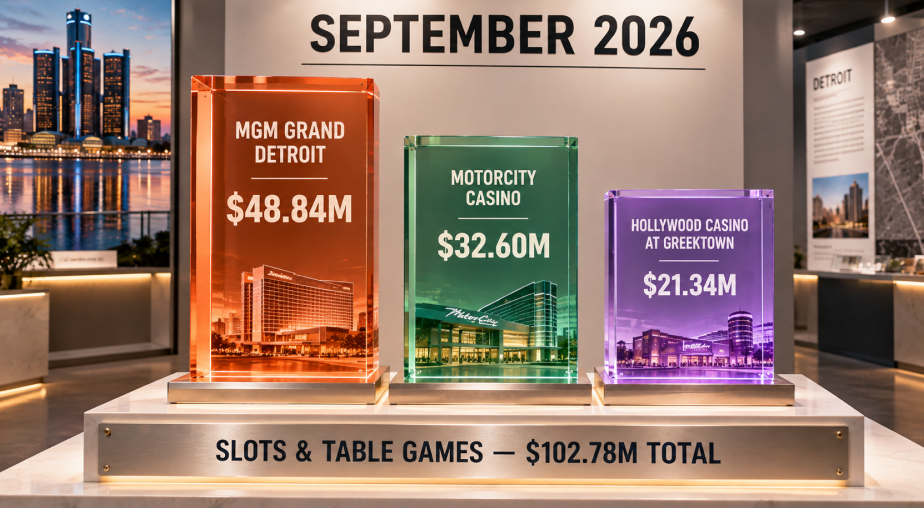
The figures reveal different operating trajectories within the same city.
MGM retained its leading position and recorded positive annual growth.
MotorCity achieved the strongest percentage increase of the three properties, suggesting that its September performance improved more rapidly than its competitors on a year-over-year basis.
Hollywood Casino at Greektown moved in the opposite direction, reporting a decline despite growth across the combined Detroit market.
However, these differences do not establish why individual casinos gained or lost revenue.
Customer visitation, gaming mix, hold percentages, promotional activity and other operational factors can influence monthly performance. The published aggregate figures do not provide enough information to attribute the changes to any single cause.
MotorCity Casino Records The Strongest Annual Growth
MotorCity Casino’s 12.7% annual increase stands out as one of the report’s most notable developments.
Its September slot and table-game revenue reached $32.60 million, compared with a lower total during September 2025.
The growth rate exceeded MGM Grand Detroit’s 6.5% increase and contrasted with Hollywood Casino at Greektown’s 8.8% decline.
A stronger annual growth percentage does not necessarily mean MotorCity generated more revenue than MGM.
MGM’s September total remained substantially higher.
Instead, the comparison shows that the properties are growing at different rates from different starting points.
This distinction is useful when interpreting casino-industry headlines.
Market leadership, percentage growth and absolute revenue are separate indicators.
A smaller operator can post faster growth without overtaking a larger competitor.
Similarly, a property can retain the highest market share even when another operator records stronger percentage gains.
For Detroit, September’s figures suggest a competitive market in which individual casino performance is not moving uniformly.
The MGCB’s casino revenue and wagering tax records provide historical reporting that can help readers compare these monthly changes with longer-term patterns.
September Revenue Rises Annually But Falls From August
Detroit’s September slot and table-game revenue increased 4.7% compared with September 2025.
At the same time, it declined 5.6% from August 2026.
These movements may appear contradictory, but they measure different periods.
The annual comparison indicates that the market generated more casino gaming revenue than it did during the corresponding month one year earlier.
The monthly comparison indicates that September revenue was lower than August’s.
The MGCB’s August report recorded $108.86 million in slot and table-game revenue, compared with September’s $102.78 million.
That represents a decrease of approximately $6.08 million.
The official August 2026 casino revenue release also reported $109.72 million in total aggregate revenue when retail sportsbook qualified adjusted gross receipts were included.
The September aggregate total of $103.55 million was therefore lower than the previous month’s combined figure.
However, a month-to-month decline does not automatically indicate a deterioration in the underlying business.
Casino revenue can fluctuate because of calendar effects, visitation patterns, game outcomes and other factors.
A stronger comparison examines multiple months and equivalent periods across years.
The regulator reported that Detroit’s combined slot and table-game revenue increased 2.3% year over year during January through September 2026.
That nine-month figure provides broader context for September’s performance.
Rather than relying exclusively on one month’s growth or decline, the year-to-date comparison suggests that Detroit’s regulated casino market has generated modest positive growth over the first three quarters of 2026.
Retail Sports Betting Handle Climbs To $12.39 Million
Detroit’s retail sportsbooks reported $12.39 million in wagering handle during September 2026.
Handle represents the amount wagered by customers, not the amount earned by sportsbooks.
The distinction matters because betting volume and sportsbook revenue can move in different directions.
In August, Detroit’s retail sportsbooks reported a handle of $7.21 million.
September’s $12.39 million therefore represented an increase of approximately $5.18 million, or roughly 71.8%.
That increase in activity was not matched by higher adjusted sportsbook revenue.

September retail sports betting qualified adjusted gross receipts totaled $769,771, down 10.9% from August.
This contrast demonstrates why betting handle should not be confused with sportsbook profitability.
A sportsbook can process more wagers while retaining a smaller share of the amount wagered.
Actual outcomes, customer winnings, market mix and applicable accounting adjustments can all affect reported receipts.
September also coincided with the return of the NFL regular season, including games involving the Detroit Lions.
That timing provides relevant sports-market context, although the MGCB’s aggregate figures do not establish how much of the handle increase came specifically from NFL wagering.
It would therefore be inaccurate to attribute the entire increase to football without sport-specific betting data.
Retail Sportsbook Revenue Varies Sharply Between Detroit Casinos
The September sports betting results also revealed substantial differences among Detroit’s three casinos.
MotorCity Casino reported $602,755 in qualified adjusted gross receipts, accounting for the largest positive contribution.
Hollywood Casino at Greektown generated $215,281.
MGM Grand Detroit reported negative qualified adjusted gross receipts of $48,265.
These individual results combine to produce the city’s approximately $769,771 retail sports betting total.
| Detroit Casino | September Retail Sports Betting QAGR |
|---|---|
| MGM Grand Detroit | −$48,265 |
| MotorCity Casino | $602,755 |
| Hollywood Casino at Greektown | $215,281 |
| Combined Total | $769,771 |
MGM’s negative figure is particularly useful for understanding sportsbook reporting.
A negative monthly adjusted revenue result does not mean the casino as a whole operated at a loss.
It refers specifically to the reported retail sports betting measure for that period.
MGM continued to generate substantial positive revenue from its slot machines and table games.
The figures also demonstrate why sportsbook revenue should not be used interchangeably with casino gaming revenue.
A property can lead the overall casino market while recording weaker sportsbook results during an individual month.
Similarly, MotorCity’s strong sportsbook performance does not establish that its betting operation will generate the same revenue every month.
Sports betting outcomes can create considerable short-term variation.
The MGCB’s official September report noted that combined retail sportsbook qualified adjusted gross receipts increased 3.0% compared with September 2025 but declined 10.9% from August 2026.
That combination reinforces the importance of distinguishing annual performance from short-term fluctuations.
What Is The Difference Between Casino Revenue, Handle And Hold?
The September figures provide an opportunity to explain three commonly misunderstood gambling-industry terms.
Casino gaming revenue generally refers to the amount retained by the operator from gambling activity before many business expenses are deducted.
It is not the same as total customer wagers, net corporate profit or cash available to shareholders.
For example, a slot machine can process substantial wagering volume while returning a large portion of that money to players through payouts.
The remaining amount contributes to gaming revenue under the applicable accounting framework.
Sports betting handle refers to the total amount wagered over a reporting period.
Detroit’s $12.39 million September retail handle therefore describes betting activity rather than sportsbook earnings.
Sportsbook hold is generally calculated by dividing gross gaming revenue by handle.
For Detroit’s September retail market, the reported $784,762 in gross receipts divided by the $12.39 million handle produces an approximate gross hold of 6.3%.
This is a calculated market-level ratio, not a quoted betting price or guaranteed operator margin.
It also differs from qualified adjusted gross receipts, which totaled $769,771 after applicable adjustments.
Understanding these measures helps prevent misleading interpretations of gambling-industry reports.
A market with increasing handle is not necessarily generating proportionally higher revenue.
A market with higher revenue is not necessarily experiencing a comparable increase in the number of customers.
And a casino’s reported gaming revenue is not equivalent to its final accounting profit after operating expenses, taxes and other costs.
These distinctions are also important in the broader discussion of sportsbook market structure. For example, our analysis of player prop betting scrutiny in New York examines how regulation, market design and risk controls can influence the types of wagering products operators offer.
Detroit Casinos Generate Millions In State And City Taxes
Detroit’s commercial casino industry also contributes significant tax revenue to Michigan and the City of Detroit.
According to the September MGCB report, the three casinos paid $8.3 million in state gaming taxes associated with slot and table-game activity.
That compared with $8.0 million during September 2025.
The casinos also reported submitting $12.7 million in wagering taxes and development agreement payments to the City of Detroit.
These amounts demonstrate how regulated gambling activity contributes to public revenue.
However, the state and city figures are not identical types of payments.
The city’s reported amount includes development agreement payments alongside wagering taxes.
That distinction matters when comparing Detroit’s tax receipts with figures published by other gambling jurisdictions.
Retail sports betting generated additional payments.
For September, the casinos paid $30,922 in state taxes and submitted $37,793 in wagering taxes to the City of Detroit based on retail sportsbook activity.
Michigan’s commercial casino tax structure is governed by state law and the agreements applicable to Detroit’s licensed properties.
The MGCB explains that slot and table-game adjusted gross receipts are subject to a combined wagering tax allocation of 19%, consisting of an 8.1% state share and a 10.9% city share, with separate development agreement payments also applicable.
Retail sports betting operates under a different tax framework.
These rules help explain why the same reported gambling revenue can produce different categories of public payments.
They also illustrate why regulatory reporting should be examined before making broad claims about how much money casinos contribute to public finances.
Michigan Renews Licenses For Detroit’s Three Commercial Casinos
September’s revenue report followed an important regulatory development.
On September 8, 2026, the Michigan Gaming Control Board voted unanimously to renew the operating licenses of MGM Grand Detroit, MotorCity Casino and Hollywood Casino at Greektown.
The decision was announced on September 9.
According to the MGCB’s casino license renewal announcement, the review considered each property’s financial standing, operational practices and compliance with responsible-gaming requirements.
The renewed licenses allow the three properties to continue operating under Michigan’s commercial casino regulatory framework.
Their next annual renewal review is scheduled for September 2027.
MGCB Executive Director Henry Williams emphasized the regulator’s focus on integrity, patron protection and responsible gaming during the renewal announcement.
The timing is relevant because financial performance and regulatory compliance are separate requirements.
Generating substantial gaming revenue does not eliminate an operator’s obligation to meet licensing standards.
Regulators also evaluate operational controls, consumer safeguards and adherence to applicable gaming laws.
For casino-industry readers, the September renewal provides useful context for the subsequent revenue figures.
Detroit’s three properties continue operating within an established licensing system that includes recurring regulatory oversight.
That distinguishes regulated commercial casino activity from unlicensed gambling services that may not provide equivalent protections.
How Detroit’s Results Compare With Michigan’s Online Gambling Market
Detroit’s commercial casino revenue should also be distinguished from Michigan’s statewide online gambling activity.
The September $103.55 million figure covers the three Detroit commercial casinos and their retail sportsbook operations.
It does not represent the total revenue generated by all online casino platforms or mobile sportsbooks operating in Michigan.
Online casino gaming, mobile sports betting and Detroit’s land-based casino operations are reported through different regulatory categories.
This distinction is particularly important when reviewing headlines about Michigan’s gambling industry.
A statewide online gaming report can include activity from licensed internet gaming operators that is not part of the Detroit commercial casino monthly revenue total.
Combining these categories without checking the reporting definitions can lead to inaccurate market comparisons or double counting.
Michigan’s online gambling framework also involves licensing, consumer protection, identity verification and responsible-gaming obligations.
The existence of both retail and digital channels means analysts need to identify exactly which segment is being measured.
For example, a change in Detroit’s retail sports betting handle does not establish that statewide mobile sports betting activity moved in the same direction.
Likewise, growth in online casino revenue does not automatically mean Detroit’s physical casino properties are losing customers.
The two markets can be influenced by different consumer behaviors and operating conditions.
The official Michigan Gaming Control Board publishes separate regulatory updates and revenue information that help distinguish these categories.
What September’s Results Reveal About Detroit’s Casino Market
Several broader observations emerge from Detroit’s September 2026 results.
First, the city’s traditional casino gaming market continued to demonstrate year-over-year growth.
Slot and table-game revenue increased 4.7% compared with September 2025, while the nine-month total remained 2.3% above the comparable 2025 period.
Those figures indicate positive annual performance without suggesting that every month or every property experienced growth.
Second, the competitive balance among Detroit’s three casinos remained uneven.
MGM Grand Detroit retained the largest market share, MotorCity posted the strongest annual percentage growth, and Hollywood Casino at Greektown experienced a decline.
That variation illustrates why citywide revenue growth should not be interpreted as uniform improvement across every operator.
Third, retail sports betting demonstrated a substantial difference between wagering volume and adjusted revenue.
Handle increased sharply from August, while qualified adjusted gross receipts declined.
The figures show that greater betting activity does not necessarily translate into stronger short-term operator earnings.
Fourth, the revenue report highlights the fiscal role of regulated gambling.
Millions of dollars in state and city payments were associated with September’s casino and sportsbook operations.
Those contributions form part of the broader public-policy discussion surrounding commercial gambling, licensing and oversight.
Finally, the report reinforces the importance of precise terminology.
Revenue, handle, gross receipts, qualified adjusted gross receipts, market share and tax payments describe different aspects of the industry.
Treating them as interchangeable can distort the economic significance of the figures.
What To Watch In Detroit’s Remaining 2026 Revenue Reports
The next monthly reports will help establish whether September’s annual growth represents a continuing pattern.
October and November figures may provide additional evidence about the performance of Detroit’s slot and table-game operations during the final quarter of 2026.
Retail sports betting will also remain worth monitoring as the NFL, college football and other major U.S. sporting competitions continue.
However, the existence of a busy sports calendar does not guarantee higher sportsbook revenue.
Wagering volume, event outcomes, promotional adjustments and the distribution of bets can produce different results from month to month.
The competitive positions of MGM Grand Detroit, MotorCity Casino and Hollywood Casino at Greektown will provide another important measure.
MotorCity’s strong September growth could become more significant if it continues over several reporting periods.
Conversely, Hollywood Casino at Greektown’s September decline requires additional monthly data before drawing conclusions about its longer-term direction.
The most useful comparisons will remain those based on consistent reporting periods and clearly defined revenue measures.
September’s figures establish that Detroit’s commercial casinos generated $103.55 million in aggregate revenue, recorded positive annual growth in traditional casino gaming and contributed substantial public tax revenue.
They also show that the three properties experienced different results and that retail sportsbook activity followed a separate pattern from slot and table-game performance.
For readers following U.S. casino news, the central lesson is that gambling-market growth cannot be reduced to a single revenue figure. Understanding the underlying segments, regulatory definitions and reporting periods provides a much clearer picture of how Detroit’s casino industry is performing.