Understanding betting odds is one of the most important foundations of sports betting education. Whether a sportsbook displays American odds such as +150, decimal odds such as 2.50, or fractional odds such as 3/2, the numbers communicate two essential pieces of information: the potential payout for a successful selection and the probability implied by the price.
The three formats may look different, but they can represent exactly the same outcome at exactly the same price.
For example, +150 American odds, 2.50 decimal odds and 3/2 fractional odds are mathematically equivalent. Each represents a 40% implied probability and produces $150 in net profit on a successful $100 stake, for a total return of $250.
This distinction is particularly useful when comparing U.S. sportsbooks with international soccer markets, where decimal odds are widely used and three-way 1X2 pricing includes the possibility of a draw.
The mathematics also explains why an outcome with a shorter price is not necessarily a better selection. A higher implied probability generally comes with a smaller potential profit relative to the stake.
As the DraftKings Sportsbook guide to reading odds explains, American, decimal and fractional formats use different conventions to express the same underlying relationship between risk and potential return.
For beginners, the objective is not to predict results from the appearance of the numbers. It is to understand what the price means, how payouts are calculated, and why sportsbook margins matter.
All prices and financial calculations in this guide are hypothetical educational examples, not live betting lines or recommendations.
What Are Betting Odds And What Do They Represent?
Betting odds express the price assigned to a particular outcome in a sporting event.
They serve two related purposes.
First, they determine the potential payout if a selection is successful.
Second, they can be converted into an implied probability, which represents the break-even success rate associated with that price.
Consider a hypothetical soccer match between a home team and an away team.
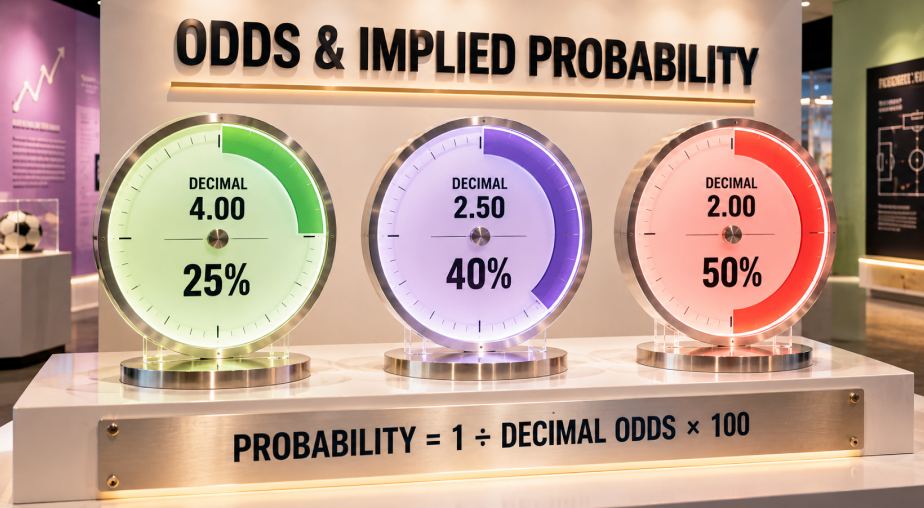
If the home victory is listed at decimal odds of 2.00, the price implies a 50% probability before accounting for the wider market’s margin.
At decimal odds of 4.00, the implied probability is 25%.
The second selection offers a larger potential payout because its quoted probability is lower.
However, odds should not be interpreted as objective guarantees about what will happen.
Sportsbooks establish prices using statistical models, market information, risk management and other considerations. Their quoted probabilities also generally incorporate an operating margin.
The distinction between a quoted probability and an outcome’s actual probability is fundamental.
An event priced at a 40% implied probability does not have to occur exactly four times in every ten opportunities. The percentage describes the mathematical break-even threshold associated with the price, not a promise about a small sample of results.
The Smarkets explanation of betting odds provides a useful introduction to the relationship between probability, prices and potential returns.
How American Betting Odds Work
American odds, sometimes called moneyline odds, are the most familiar format in the United States.
They are expressed as positive or negative numbers, typically with a plus or minus sign.
The format uses $100 as a reference point, although the actual stake can be larger or smaller.
A positive number describes the potential net profit on a $100 stake.
A negative number describes the stake required to generate $100 in net profit.
This distinction explains why +150 and −150 do not mean the same thing.
At +150, a successful $100 stake produces $150 in profit, plus the original $100 stake.
At −150, a successful $150 stake produces $100 in profit, plus the original $150 stake.
Positive odds are generally associated with less-favored outcomes, while negative odds are generally associated with favorites. However, the sign primarily communicates the price rather than providing a complete assessment of team strength.
Understanding Positive American Odds
Suppose a hypothetical soccer team is listed at +200.
A successful $100 stake would generate $200 in net profit.
The total return would be $300, including the original stake.
For a smaller $20 stake, the net profit would be $40 and the total return would be $60.
The calculation is:
Net profit = Stake × (Positive American odds ÷ 100)
For +200 with a $20 stake:
$20 × (200 ÷ 100) = $40 profit.
The formula scales proportionally, so the $100 reference does not require anyone to use that exact stake.
Understanding Negative American Odds
Negative American odds work in the opposite direction.
Suppose an outcome is priced at −200.
The price means that a $200 stake would generate $100 in net profit if successful.
A $20 stake would generate $10 in profit.
The calculation is:
Net profit = Stake × (100 ÷ Absolute value of negative odds)
For −200 with a $20 stake:
$20 × (100 ÷ 200) = $10 profit.
The total return would be $30, including the original $20 stake.
A common beginner mistake is to interpret −200 as a potential loss of $200 regardless of the amount staked.
That is incorrect.
The negative sign is part of the pricing convention. The amount at risk is determined by the actual stake and the applicable market rules.
How Decimal Betting Odds Work
Decimal odds are commonly used in European soccer markets, Australia, Canada and many international betting platforms.
They are often easier to calculate because the displayed number represents the total potential return for each unit staked.
Unlike fractional odds, decimal odds include the return of the original stake in the quoted multiplier.
For example, decimal odds of 2.50 mean that a successful $10 stake produces a total return of $25.
The net profit is $15.
The formula is:
Total return = Stake × Decimal odds
To calculate net profit:
Net profit = Total return − Stake
Consider another hypothetical example at decimal odds of 1.80.
A $20 stake would produce:
$20 × 1.80 = $36 total return.
After subtracting the original $20 stake, the net profit would be $16.
The calculation is identical regardless of the sport or market, provided the selection wins and no special settlement adjustments apply.
Decimal odds are particularly useful when comparing prices because the larger number directly indicates a larger potential return per unit staked.
For the same outcome under identical settlement rules, decimal odds of 2.20 offer a higher potential return than 2.10.
That does not mean the outcome itself has become more likely.
It means the quoted price is different.
The Smarkets guide to betting odds formats explains how decimal odds simplify the relationship between stakes, payouts and probability.
How Fractional Betting Odds Work
Fractional odds are traditionally associated with British and Irish betting markets, particularly horse racing, although they also appear in soccer and other sports.
They are written as fractions such as 2/1, 5/2, 3/2 or 1/2.
The numerator represents potential net profit relative to the amount represented by the denominator.
For example, fractional odds of 3/2 mean that a successful selection produces $3 in net profit for every $2 staked.
A $20 stake would therefore produce $30 in profit.
The total return would be $50.
The formula is:
Net profit = Stake × (Numerator ÷ Denominator)
For 3/2 with a $20 stake:
$20 × (3 ÷ 2) = $30 profit.
Fractional odds of 1/2 work differently.
At that price, a successful $20 stake generates $10 in profit, for a total return of $30.
Fractional odds can appear more complicated than decimal odds because the user must distinguish between the profit represented by the fraction and the return of the original stake.
However, once the fraction is converted into a decimal multiplier, the calculation becomes straightforward.
For 3/2:
3 ÷ 2 = 1.50.
Adding 1 to include the original stake gives decimal odds of 2.50.
The same price can then be compared directly with American odds of +150.
American Vs. Decimal Vs. Fractional Odds: Conversion Table
The following table compares common equivalent prices across the three formats.
All calculations assume a successful $100 stake and are rounded where necessary.
| American Odds | Decimal Odds | Fractional Odds | Implied Probability | Net Profit On $100 |
|---|---|---|---|---|
| +300 | 4.00 | 3/1 | 25.00% | $300.00 |
| +200 | 3.00 | 2/1 | 33.33% | $200.00 |
| +150 | 2.50 | 3/2 | 40.00% | $150.00 |
| +100 | 2.00 | 1/1 | 50.00% | $100.00 |
| −110 | 1.9091 | 10/11 | 52.38% | $90.91 |
| −150 | 1.6667 | 2/3 | 60.00% | $66.67 |
| −200 | 1.50 | 1/2 | 66.67% | $50.00 |
| −300 | 1.3333 | 1/3 | 75.00% | $33.33 |
The table demonstrates an important principle: changing the odds format does not change the underlying price.
A sportsbook displaying +150 and another displaying 2.50 are quoting equivalent prices.
A sportsbook displaying +150 and another displaying 2.60 are not.
The second decimal price represents a different potential payout and implied probability.
That distinction becomes essential when comparing markets across different platforms.
How To Convert American Odds Into Decimal Odds
Converting American odds into decimal odds is useful when comparing U.S. sportsbook prices with international soccer markets.
The formula depends on whether the American odds are positive or negative.
For positive American odds:
Decimal odds = 1 + (American odds ÷ 100)
For example, converting +250:
1 + (250 ÷ 100) = 3.50.
For negative American odds, use the absolute value of the quoted number:
Decimal odds = 1 + (100 ÷ Absolute value of American odds)
For example, converting −125:
1 + (100 ÷ 125) = 1.80.
These conversions allow prices to be compared using the same numerical format.
The reverse calculation is also possible.
For decimal odds of 2.00 or higher, subtract 1 and multiply by 100.
For decimal odds below 2.00, divide 100 by the difference between the decimal odds and 1, then apply a negative sign.
The DraftKings betting odds calculator provides additional examples of equivalent prices and payout calculations across all three formats.
Rounding matters when comparing converted prices. A decimal quote displayed as 1.91 is not mathematically identical to −110, although the difference is small. Some platforms also restrict prices to particular increments.
How To Calculate Implied Probability From Betting Odds
Implied probability converts a quoted price into a percentage.
This is one of the most useful concepts in betting education because it separates the mathematical meaning of the odds from the appearance of the numbers.
For decimal odds, the formula is:
Implied probability = (1 ÷ Decimal odds) × 100
At decimal odds of 2.50:
(1 ÷ 2.50) × 100 = 40%.
At decimal odds of 1.50:
(1 ÷ 1.50) × 100 = 66.67%.
American odds require two different calculations.
For positive American odds:
Implied probability = 100 ÷ (Positive odds + 100) × 100
At +150, the result is 40%.
For negative American odds, use the absolute value:
Implied probability = Absolute odds ÷ (Absolute odds + 100) × 100
At −200, the result is 66.67%.
Fractional odds use another formula:
Implied probability = Denominator ÷ (Numerator + Denominator) × 100
At 3/2:
2 ÷ (3 + 2) × 100 = 40%.
Each formula produces the same result when the prices are mathematically equivalent.
The Smarkets implied probability guide explains how converting odds into percentages helps reveal the mathematical expectations embedded in market prices.
However, implied probability should not be confused with an independently verified forecast.
The quoted percentage represents the break-even threshold at that price, not necessarily the true likelihood of the outcome.
Why Sportsbook Odds Include A Margin
Sportsbooks generally incorporate a margin into their market prices.
This margin is often called the vigorish, vig, bookmaker margin or overround.
In a theoretical two-outcome event where both outcomes have exactly a 50% probability, fair decimal odds would be 2.00 on each side.
A sportsbook might instead quote −110 on both outcomes.
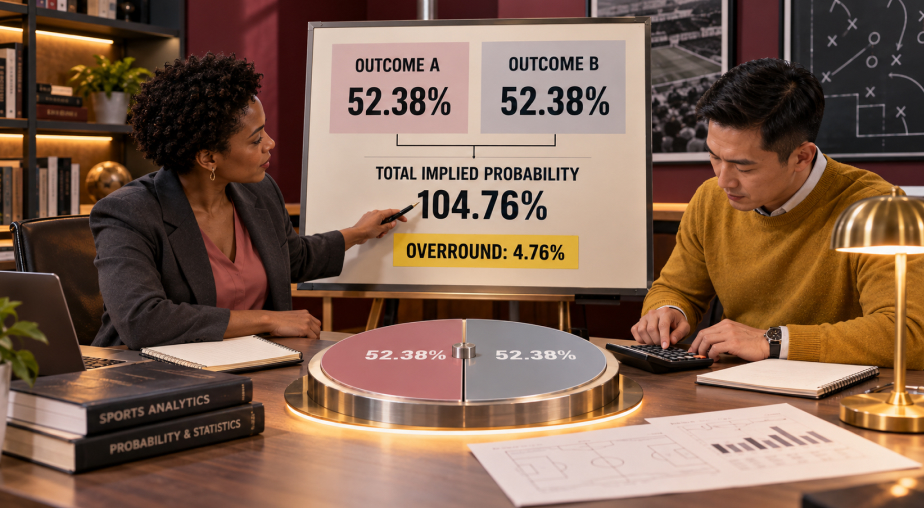
Each −110 price implies approximately 52.38%.
Adding the two implied probabilities produces:
52.38% + 52.38% = 104.76%.
The additional 4.76 percentage points represent the market’s overround.
This is not the same as saying that the sportsbook is guaranteed to retain 4.76% of every amount staked. Actual revenue depends on pricing, stake distribution, outcomes and other factors.
For a perfectly balanced two-outcome market with equal −110 prices, the theoretical hold as a proportion of total stakes is approximately 4.55%.
The distinction between overround and hold is important when analyzing market economics.
The Smarkets explanation of betting margins describes how the sum of quoted implied probabilities can exceed 100% when a margin is incorporated.
For beginners, understanding the margin explains why quoted probabilities across all possible outcomes usually do not add up to exactly 100%.
How Odds Work In Soccer 1X2 Markets
Soccer provides an especially useful example because traditional 1X2 markets contain three outcomes rather than two.
The symbols have specific meanings:
1 represents a home victory.
X represents a draw.
2 represents an away victory.
These markets generally settle according to the result after regulation time, including stoppage time, unless the operator’s rules specify otherwise.
Extra time and penalty shootouts are normally excluded from standard full-time 1X2 settlement.
Consider a hypothetical match between two fictional teams.
| 1X2 Outcome | Decimal Odds | American Equivalent | Implied Probability |
|---|---|---|---|
| 1 — Home victory | 2.00 | +100 | 50.00% |
| X — Draw | 3.50 | +250 | 28.57% |
| 2 — Away victory | 4.00 | +300 | 25.00% |
These are illustrative prices, not actual sportsbook lines.
The combined implied probability is:
50.00% + 28.57% + 25.00% = 103.57%.
The market therefore contains an overround of approximately 3.57 percentage points.
The example demonstrates why comparing only the home and away prices would be incomplete.
The draw is a separate outcome with its own probability and potential payout.
This is particularly relevant when comparing traditional soccer 1X2 markets with two-way match-winner products or prediction-market contracts.
Two products referring to the same match may settle differently if one includes draws and the other uses qualification or advancement rules.
Understanding the outcome definition is therefore just as important as understanding the displayed price.
How To Compare Odds Across Different Sportsbooks
Comparing prices requires more than identifying the largest number on a screen.
The first step is confirming that the selections refer to the same outcome.
A soccer home-win selection covering regulation time cannot be compared directly with a selection covering advancement after extra time.
The second step is converting the prices into a common format.
Decimal odds are particularly convenient because they show total return as a multiplier.
For example, suppose two hypothetical operators quote the same soccer outcome at decimal odds of 2.10 and 2.20.
A successful $20 stake at 2.10 would produce a $42 total return, including $22 in profit.
At 2.20, the same stake would produce a $44 total return, including $24 in profit.
The difference is $2 in potential profit.
That comparison is mathematically valid only if the market definitions, settlement conditions and applicable costs are equivalent.
Transaction fees, commissions, promotional restrictions and other conditions can affect the final result.
A prediction exchange may also quote a contract price rather than conventional sportsbook odds, requiring additional attention to contract settlement and trading costs.
For 1X2 analysis, the central principle is straightforward: prices should be compared only after the underlying products have been established as equivalent.
What Is The Difference Between Implied Probability And Actual Probability?
A quoted price can be converted into an exact implied probability, but the actual probability of a future sporting outcome is not directly observable.
It must be estimated.
For example, decimal odds of 2.50 imply a 40% break-even probability.
That does not establish that the outcome has precisely a 40% chance of occurring.
An independent assessment might produce a higher or lower estimate based on available evidence.
In soccer, relevant factors may include team strength, injuries, expected lineups, home advantage, rest periods, recent performances and underlying chance creation.
Even sophisticated statistical models remain uncertain.
Their estimates depend on the quality of the inputs, the assumptions used and the extent to which past performance reflects future conditions.
A model estimating a 45% probability for an outcome priced at 40% may indicate a theoretical discrepancy, but the estimate itself could be inaccurate.
That uncertainty is why a calculated difference between two percentages should not be treated as a guaranteed advantage.
The mathematics can identify the conditions under which a price would have positive expected value, but it cannot establish that those conditions actually exist without a reliable probability estimate.
Why Odds Move Before A Sporting Event
Sportsbook odds can change between the opening of a market and the beginning of an event.
Several factors may influence those movements.
A confirmed player absence can affect expectations about team performance.
A lineup announcement may reveal a different tactical approach from the one anticipated.
Weather conditions, fixture congestion, market activity and changes in available information can also influence pricing.
In soccer, the difference between an expected starting lineup and a confirmed lineup may be particularly relevant when a team relies heavily on a small number of attacking players.
However, not every price movement reflects new information about the sporting event.
Operators may adjust prices because of trading activity, exposure management or broader market conditions.
A move from decimal odds of 2.20 to 2.00 increases the implied probability from approximately 45.45% to 50%.
It does not prove that the team’s actual probability of winning increased by the same amount.
The market price has changed; the explanation for that change requires separate analysis.
Common Mistakes When Reading Betting Odds
One common mistake is confusing net profit with total return.
Decimal odds of 2.50 on a successful $20 stake produce a $50 total return, not $50 in profit. The profit is $30.
Another mistake is assuming that positive American odds indicate an impossible or exceptionally unlikely result.
Positive odds simply indicate a price above even money. A +110 outcome has an implied probability of approximately 47.62%, which is not dramatically different from 50%.
A third mistake is assuming that a negative American price guarantees a favorable outcome.
At −200, the implied probability is approximately 66.67%, meaning the price still corresponds to a substantial chance that the selection will not succeed.
Finally, beginners sometimes compare prices without checking whether the markets have identical settlement conditions.
That problem is especially important in soccer, where a full-time 1X2 selection, draw-no-bet market and tournament-qualification contract can describe different outcomes.
Understanding these differences helps prevent inaccurate comparisons.
Understanding Odds Is Part Of Responsible Betting Education
Betting odds are mathematical prices, not instructions to participate in gambling.
Learning how they work can help consumers understand the financial exposure associated with different outcomes and identify misleading assumptions about potential payouts.
It is also important to recognize that a larger potential return generally corresponds to a lower quoted probability of success.
The ability to calculate odds does not eliminate uncertainty, remove the sportsbook’s margin or establish a reliable method of producing profits.
The National Council on Problem Gambling’s Internet Responsible Gambling Standards emphasize informed decision-making, clear information, accessible safeguards and consumer understanding of gambling products.
Those principles are relevant to odds education because the financial implications of a selection should be understandable before any decision involving real money.
Participation should be limited to adults in jurisdictions where the activity is legal, with attention to applicable operator rules and personal financial limits.
For readers comparing American, decimal and fractional prices, the most important lesson is that the format changes the presentation, not the underlying economics.
+150, 2.50 and 3/2 describe the same price.
Understanding that equivalence makes it easier to interpret soccer 1X2 markets, calculate implied probabilities and distinguish between different products without mistaking a quoted price for a guaranteed sporting outcome.