
Kalshi’s protection feature is integrated into its Combo builder, where multiple selections can be combined into a single position.
The structure makes settlement rules particularly important because the final payout depends on the results of several underlying components.
For eligible Yes selections, protection can be activated before the game starts. The interface displays a shield icon to identify protected picks.
However, the presence of one protected component does not mean the entire combination is insured against every unsuccessful outcome.
If another component settles incorrectly, the combination can still settle at zero.
When a protected component resolves at a fair price between zero and one dollar, the combination’s settlement reflects that intermediate value alongside the outcomes of its other components.
For example, consider a hypothetical three-component combination in which two components settle at $1.00 and the protected component settles at $0.70.
The resulting value would be:
$1.00 × $1.00 × $0.70 = $0.70 per combination contract.
If one of the other components instead settles at zero, the overall combination would also settle at zero.
Kalshi explains this calculation in its official Combo settlement documentation.
This approach differs from treating the affected selection as if it never existed.
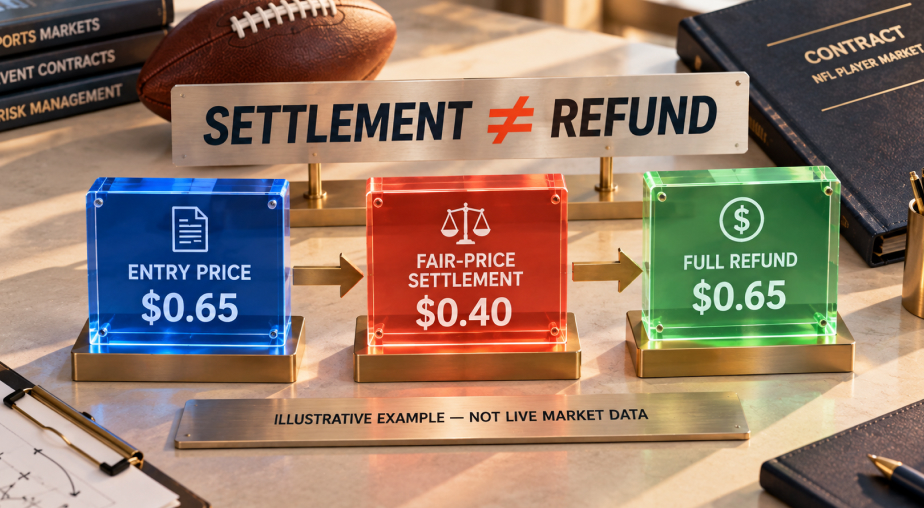
It also demonstrates why a partial settlement is not equivalent to a guaranteed return of the original purchase amount.
Traditional Sportsbooks Are Competing Through Injury Rules
Kalshi’s launch reflects a broader competitive development in the U.S. sports betting industry.
Traditional sportsbooks have increasingly introduced injury-related protections for certain player propositions, although the eligibility requirements and compensation methods vary by operator and promotion.

Some arrangements involve refunds, while others provide credits or alternative treatment when a player leaves a game under specified conditions.
The critical issue is that these products do not necessarily operate under the same rules.
One operator may define eligibility according to whether a player exits during the first half. Another may use a particular participation threshold or restrict protection to certain markets.
Kalshi’s approach differs because it uses a defined fair-price settlement rather than automatically returning the original contract cost.
This creates another dimension of product competition.
Historically, sportsbook comparisons have emphasized odds, market availability and transaction conditions.
Settlement policy is now becoming an increasingly visible factor.
An operator offering a more attractive displayed price may still provide a different overall product from a competitor with more restrictive or more flexible settlement conditions.
That makes direct price comparison less straightforward.
A meaningful comparison requires evaluating the complete contract, including the circumstances under which the original market outcome may be replaced by an alternative settlement.
Why Settlement Rules Matter More Than Promotional Labels
Terms such as protection, insurance and early exit can sound similar while describing materially different products.
For Kalshi, protection does not mean that a player leaving the game automatically causes the position to be canceled.
It does not mean that every injury qualifies.
It also does not mean that all NFL player contracts receive identical treatment.
The exchange’s official rules distinguish between standard markets and specifically designated protected contracts.
They also define the participation conditions that must occur before fair-price settlement applies.
A player who returns for a single qualifying play after halftime generally causes the protected contract to settle on actual statistics.
Similarly, a player who achieves the specified target during the first half does not need an alternative settlement.
These details are significant because small differences in contract language can materially change the final outcome.
For analytical comparisons, the relevant questions concern the actual settlement value, the triggering conditions and the price paid for the protection.
This is especially important for contracts that can settle at intermediate values rather than only zero or one dollar.
A product that appears simpler on its interface may still require careful interpretation of the underlying rules.
Soccer Markets Do Not Currently Have The Same Protection
For 1x2bettingpro.com, the most relevant distinction is that Kalshi’s new protection feature does not currently extend to soccer player markets.
Kalshi’s official documentation explicitly states that player markets in soccer, baseball, basketball and hockey do not presently have protected versions under this NFL-specific program.
Those sports continue to follow their respective market participation and settlement rules.
This prevents a direct assumption that the new NFL mechanism applies to soccer player propositions.
Soccer also introduces different participation circumstances.
A football player may leave a game before halftime and never return, while a soccer player can be substituted during either half and generally cannot re-enter under standard competition rules.
A soccer player may also remain on the bench for an entire match, enter late as a substitute or leave because of injury.
Each scenario can affect player-specific markets differently depending on the operator’s contract terms.
A protection mechanism designed around NFL first-half and second-half participation cannot automatically be transferred to soccer without adapting those rules.
The broader lesson is that settlement policies must be evaluated within the context of each sport.
Soccer 1X2 Markets Have A Different Settlement Structure
Traditional soccer 1X2 markets focus on the result of a match rather than the statistics of an individual player.
The three possible outcomes are a home victory, a draw and an away victory.
Under standard full-time 1X2 rules, settlement generally depends on the result after regulation time, including stoppage time, while excluding extra time and penalty shootouts unless otherwise specified.
An individual player’s injury or substitution does not normally change the settlement of a full-time match-result market.
That makes 1X2 structurally different from player-specific contracts.
However, soccer market comparisons still involve important settlement questions.
Operators may define match completion requirements differently. Abandoned matches, postponed fixtures, venue changes and other unusual circumstances can trigger specific rules.
Tournament markets may also distinguish between qualification, advancement and the result after 90 minutes.
These distinctions can affect whether two apparently similar products actually represent the same event.
A prediction-market contract asking whether a team will advance to the next round is not necessarily equivalent to a conventional 1X2 selection on that team’s next match.
The same applies to contracts involving a tournament winner rather than a single-game result.
The broader pricing questions are closely connected to 1×2 Betting Pro’s earlier analysis of prediction-market pricing after the Ninth Circuit ruling, where regulatory uncertainty and market structure formed part of the comparison.
Kalshi’s new NFL protection feature adds another reason to examine contract terms before interpreting price differences.
Fair-Price Settlement Raises Transparency Questions
The new feature also creates questions about how alternative settlement values are determined.
Kalshi defines the relevant fair price as the last fair price before opening kickoff, as determined by the exchange.
That value may differ from the contract’s last traded price.
For market participants, this introduces a distinction between the price at which an order was executed and the reference value used for certain settlements.
Both figures may be legitimate under the applicable rules, but they serve different purposes.
The execution price determines the initial cost of a position.
The fair-price reference determines the payout when qualifying protection conditions occur.
A transparent settlement system therefore depends on clearly communicating how the reference price is established and how disputes can be addressed.
This issue becomes more important as prediction exchanges offer products with increasingly complex settlement structures.
Consumers may understand a binary contract that pays either zero or one dollar, yet find a partial settlement less intuitive.
A contract that resolves at $0.40, for example, may represent neither a complete win nor a complete loss.
The result can only be evaluated against the original entry price and associated transaction costs.
Market Liquidity Could Affect The Value Of Protection
Protected contracts may also develop different liquidity profiles from standard contracts.
Because the protected and unprotected versions are separate markets, their available orders and trading activity do not necessarily match.
A standard contract may attract more participation, while a protected version may appeal to a narrower group of users.
That difference could influence bid-ask spreads and the ability to execute an order at a displayed price.
It could also affect how quickly prices adjust to new information about a player’s health, expected workload or game conditions.
For example, an announcement that a player is managing an injury could affect both the expected probability of achieving a statistical target and the perceived value of a participation-based settlement feature.
The two effects are related but not identical.
The market may adjust the underlying probability of the target being reached while also changing the price associated with protection.
Without verified order-book data, it would be inappropriate to claim that Kalshi’s protected contracts consistently offer better or worse liquidity than standard alternatives.
The important point is that protection introduces another variable into price formation.
The Launch Arrives During A Larger Regulatory Debate
Kalshi’s protected NFL markets have arrived during a period of substantial regulatory scrutiny.
On October 8, 2026, the NFL submitted a brief supporting New Jersey’s request for Supreme Court review of the dispute over sports prediction-market regulation.
The league raised concerns about consumer safeguards, competition integrity and the relationship between federally regulated event contracts and state gambling laws.
The Associated Press coverage of the NFL’s filing described the league’s position and the continuing disagreement between regulators and prediction-market operators.
Kalshi maintains that its event contracts operate within the federal regulatory framework overseen by the Commodity Futures Trading Commission.
The introduction of additional settlement protections does not resolve that jurisdictional dispute.
However, it shows how exchanges are continuing to develop sports-related products while the legal framework remains contested.
Consumer-facing features and regulatory obligations are separate questions.
A more flexible settlement policy may improve the treatment of certain market outcomes without determining whether the underlying contract is permissible in every jurisdiction.
Likewise, federal oversight does not eliminate the importance of clear terms, effective surveillance and appropriate consumer protections.
Settlement Design Is Becoming Part Of Sports-Market Competition
Kalshi’s protected NFL player contracts illustrate how competition between sportsbooks and prediction exchanges is evolving.
The products are no longer differentiated solely by whether they use sportsbook odds or exchange-style contract prices.
They increasingly compete through market design, settlement rules, trading flexibility and the treatment of unusual game circumstances.
Kalshi’s new feature provides an alternative settlement for certain player-participation scenarios, but it also introduces separate contract pricing and a fair-price calculation that may differ from the customer’s entry cost.
Those details make the protection meaningful without making it equivalent to a conventional refund.
For soccer 1X2 readers, the immediate impact is limited because the new protection applies to selected NFL player markets rather than soccer contracts.
The analytical significance is broader.
As sports prediction markets expand, comparing products will require a closer examination of the events being traded, the conditions under which contracts settle and the rules that govern exceptional circumstances.
Displayed prices remain important, but they cannot explain the entire product.
Settlement design is becoming a competitive feature in its own right, and Kalshi’s October 2026 NFL launch provides a clear example of why contract terms deserve the same attention as market prices.