

College football prediction markets are moving beyond game winners, point spreads, totals and national championships. A newly certified product category shows that the awards handed out after the games can now stand on their own as prediction-market events.
On October 1, 2026, LEX certified two products identified as NCAAF AWARD with the U.S. Commodity Futures Trading Commission. The CFTC designated contract market database classifies both as Event contracts and Binary Options.
That sounds like a small expansion of the college football market menu. Structurally, it is much more interesting.
A game-winner contract ultimately asks an objective question: which team won?
An award market asks traders to anticipate what a group of human voters will eventually decide after evaluating an entire season.
That difference changes almost everything about the information being priced.
Statistics still matter. So do victories, losses, injuries and individual performances. But award markets can also respond to strength of schedule, nationally televised games, positional bias, late-season performances, competing candidates and the preferences of the electorate.
The result is a prediction market where traders are not merely forecasting what athletes will do.
They are forecasting how other people will interpret what those athletes have done.
LEX Certified NCAAF Award Contracts on October 1
The October 1 certification is the latest stage in LEX’s expansion into college football.
Earlier in the season, LEX certified NCAAF WINNER, NCAAF SPREAD and NCAAF TOTAL products. Those categories resemble markets familiar to traditional sportsbooks: which team wins, whether a team covers a specified margin and whether combined scoring finishes above or below a threshold.
NCAAF AWARD is different.
The CFTC’s public listing does not identify the Heisman Trophy by name, so it would be inaccurate to state that the October 1 filing is necessarily a Heisman-specific contract. The correct description is that LEX has certified a standalone college football award product category.
The distinction matters because college football has numerous individual awards.
At the same time, the Heisman provides the clearest current example of how this kind of market differs from a conventional game contract.
Other prediction platforms are already presenting college football markets extending from individual games to the national championship and Heisman Trophy. That means the award category is no longer peripheral to the broader expansion of sports event contracts.
The Heisman Shows Why Award Markets Are Different
The Heisman Trophy is determined through voting rather than a box score.
According to the Heisman Trophy’s official balloting information, the 2026 electorate includes 870 media voters, divided into six geographical sections with 145 votes each.
Every living Heisman winner also receives a ballot. There are 60 such voters in the 2026 process.

One additional ballot comes from the fan vote.
That produces 931 total potential voters for the 2026 Heisman race.
Each elector selects three players. A first-place selection receives three points, second place receives two and third place receives one.
The eventual result therefore emerges from hundreds of individual judgments rather than a single measurable event such as a touchdown, final score or yardage total.
That makes an award prediction market partly a market about the electorate itself.
The 2026 Heisman Race Is Already Moving Quickly
The timing of the LEX certification is particularly relevant because the 2026 college football season has reached the point where early Heisman narratives are beginning to collide with conference competition.
Several players entered October with significant national attention.
Miami quarterback Darian Mensah produced an exceptionally efficient September as the Hurricanes opened the season unbeaten. Ohio State wide receiver Jeremiah Smith strengthened his national profile after catching 12 passes for 217 yards and four touchdowns against Illinois.
Two young SEC quarterbacks are also attracting attention.
Ahead of Alabama’s October 3 game at Mississippi State, Keelon Russell had completed 71% of his passes for 1,129 yards, eight touchdowns and two interceptions.
Mississippi State quarterback Kamario Taylor had completed 69% for 1,192 yards, 14 touchdowns and two interceptions, with his 14 passing touchdowns tied for the FBS lead at the time, according to an Associated Press report on the matchup.
Those numbers are useful inputs.
They are not settlement criteria.
A player can lead another candidate statistically and still lose an award vote.
That is the central analytical difference.
Performance Creates the Evidence, but Voters Create the Outcome
A traditional player-stat contract can be extremely precise.
Did a quarterback throw more than a specified number of touchdown passes?
Did a receiver exceed a yardage threshold?
Those questions can be resolved using official statistics.
An award contract requires another step.
Performance produces evidence that voters subsequently interpret.
A 300-yard passing game against an unranked opponent may influence voters differently from the same statistical performance against a highly ranked conference rival.
A receiver producing an exceptional season also faces a historical positional question because quarterbacks have frequently dominated Heisman voting.
Team performance can matter as well even though the Heisman is an individual award.
None of those variables mechanically determines the winner.
They affect the electorate’s perception of the candidates.
That makes award markets fundamentally different from statistical props.
A Prediction Market Is Trying to Price Collective Judgment
The CFTC explains prediction markets as event-contract markets where prices can reflect participants’ perceived likelihood of an outcome.
In a simple binary structure, participants can take positions associated with Yes or No outcomes, with settlement determined when the underlying event is resolved.
For an award market, the underlying event may ultimately be objective: one person is officially declared the winner.
The path toward that result, however, is subjective.
That creates two analytical layers.
The first asks:
How well is the athlete performing?
The second asks:
How are voters likely to evaluate that performance relative to everyone else?
A trader can therefore evaluate the football correctly but evaluate the electorate incorrectly.
That possibility is much less important in a market based entirely on a final score.
One Saturday Can Reprice an Entire Award Race
Award markets also have unusually long information cycles.
A game-winner contract normally reaches settlement within hours.
A season-long award market can remain open while months of information accumulate.

For the 2026 Heisman, the official timeline extends into December.
Ballots are scheduled to be distributed on December 3. Online voting opens December 5. Ballots are due at 5 p.m. ET on December 7, with the finalists announced that evening.
The winner is scheduled to be announced during the Heisman ceremony on December 12.
Between early October and that deadline, each major performance can change perceptions.
An outstanding game against a ranked opponent may strengthen a player’s candidacy. An injury can reduce future opportunities. A poor performance in a nationally watched matchup can weaken a narrative. A rival candidate can simultaneously produce a breakout performance elsewhere.
That continual repricing is familiar to anyone who understands why odds move as new information arrives.
Award markets simply stretch that information process across an entire season.
The 2026 Fan Vote Adds Another Observable Signal
The Heisman has also changed its fan-voting structure for 2026.
The Heisman Trophy Trust launched its 2026 fan vote in September with a season-long system developed in partnership with the Carnegie Mellon Sports Analytics Center.
Fans can rank three players on a 3-2-1 ballot throughout the season.
The system gives greater weight to votes cast later in the year, when candidates have accumulated more evidence and conference races have developed further.
The aggregated fan results eventually become one official ballot in the Heisman tabulation.
That one ballot represents only a small fraction of the 931 potential votes.
But the public voting process creates something prediction markets often value: another observable information stream.
The challenge is interpreting it correctly.
Fan popularity is not the same thing as media-voter preference.
A player dominating public voting does not automatically imply that hundreds of media electors and former Heisman winners will rank the candidates identically.
Award Markets Can Be Vulnerable to Narrative Overreaction
College football is especially susceptible to rapid changes in public perception.
A player can move from relative obscurity to national prominence after one major Saturday.
That makes award markets vulnerable to a familiar analytical mistake: treating the latest performance as though it contains all the information that matters.
A four-touchdown game is important.
It does not erase the rest of the season.
Likewise, one disappointing game does not automatically eliminate a candidate when months of football remain.
This is where award markets intersect with the broader problem of confusing short-term momentum with long-term probability.
The strongest analysis should distinguish between information that genuinely changes a candidate’s season-long profile and information that merely generates temporary attention.
Award Markets Also Create a Liquidity Challenge
The expansion into awards can fragment trading activity.
A college football game might attract participants to a relatively concentrated set of markets: winner, spread and total.
An award category can potentially create contracts for numerous candidates across multiple trophies.
Every additional contract divides attention and capital.
The CFTC notes that more complex prediction-market structures can attract fewer participants and consequently have lower liquidity.
That matters because a displayed market price is not automatically equivalent to an efficiently tradable price.
Participants still have to consider bid-ask spreads, available depth, fees and the amount of liquidity available at the price they see.
A heavily followed Heisman contract may attract substantial attention.
A contract involving a less prominent college football award or a long-shot candidate may behave very differently.
Market breadth does not guarantee market depth.
Settlement Should Be Easier Than Forecasting
One interesting feature of award contracts is that settlement can actually be simpler than pricing.
Before the award is announced, participants have to interpret statistics, schedules, team success, media attention and voter behavior.
Once the official award organization announces a winner, the result can be straightforward—provided the contract rules clearly identify the relevant award, season and official verification source.
That distinction matters.
The subjective component exists primarily in determining who voters will choose, not necessarily in determining who was officially chosen.
Clear contract language remains essential.
An NCAAF award market should identify exactly which award is involved, which season applies and what official source determines settlement.
Certification Does Not Identify a Favorite
The October 1 CFTC listing should also not be confused with a forecast.
LEX’s certification of NCAAF AWARD products does not indicate who is likely to win the Heisman or any other college football award.
It does not establish that any particular player represents attractive value.
And it does not mean the CFTC is endorsing a candidate or forecasting an award result.
The filing establishes the regulatory status of the listed product.
Market participants still determine prices through trading activity, and those prices can change substantially as the season develops.
That separation is important when discussing early October award markets, because much of the 2026 college football season remains unresolved.
College Football Prediction Markets Now Cover Multiple Layers of the Season
The broader development is how quickly college football prediction markets are expanding.
Game winners answer one question.
Spreads answer another.
Totals price expected scoring.
Championship contracts extend the horizon across an entire season.
Award contracts introduce individual performance and human judgment.
That creates a progression from:
game result → game margin → scoring → season achievement → individual award.
Each layer requires a different information model.
A participant analyzing Alabama–Mississippi State on October 3 might care primarily about which team performs better that afternoon.
Someone analyzing the award implications of the same game has a much longer horizon.
Keelon Russell and Kamario Taylor can compete against each other on one field while simultaneously being evaluated against Darian Mensah, Jeremiah Smith and numerous other candidates playing elsewhere.
The game ends Saturday.
The award race continues.
Human Voting Makes Award Markets a Different Prediction Problem
The October 1 NCAAF AWARD certifications illustrate another stage in the transformation of college football into a much broader prediction-market ecosystem.
The important change is not simply that another contract category exists.
It is what the market is being asked to predict.
Game markets price competition between teams.
Stat markets price measurable player performance.
Award markets price the eventual judgment of an electorate.
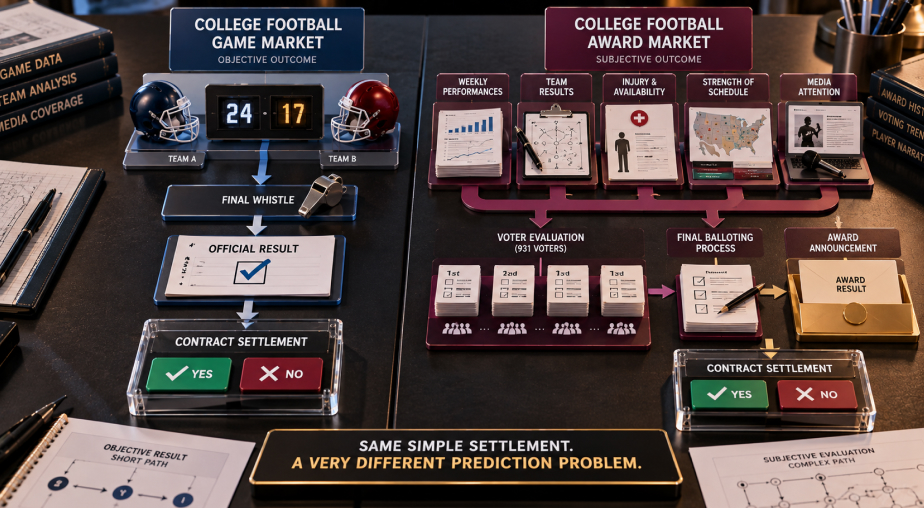
That means statistics, team success, major games, injuries and late-season performances all matter, but none individually determines settlement.
For the Heisman, hundreds of media members and former winners will eventually transform those inputs into ranked ballots before the December 12 announcement.
The market’s task is to anticipate that collective decision before it happens.
That makes college football awards an unusually revealing prediction-market product: the final answer may be binary, but the path toward that answer is deeply human.