

The first full weekend of the 2026 NFL regular season produced a new benchmark for the U.S. prediction-market industry.
Prediction platforms generated at least $5.83 billion in trading volume during the opening NFL weekend, according to Aldrin Research data reported by Barron’s. Kalshi dominated the activity, recording approximately $4.89 billion across Saturday, September 12 and Sunday, September 13.
The numbers were extraordinary even by the rapidly expanding standards of event-contract trading.
Kalshi recorded approximately $2.43 billion on Saturday, followed by a new single-day record of roughly $2.46 billion on Sunday.
But the size of those numbers requires careful interpretation.
This was not $5.83 billion of conventional sportsbook handle. Prediction-market volume is calculated differently, contracts can change hands repeatedly before settlement, and multi-leg combo products can generate substantial notional volume even when considerably less money is actually committed to the positions.
That distinction becomes particularly important because combo contracts were responsible for a large portion of Kalshi’s record weekend.
The opening NFL slate therefore demonstrated more than growing interest in sports prediction markets. It showed how the industry’s headline volume figures are increasingly being shaped by liquidity, repeated trading, complex multi-leg contracts and the mechanics used to measure activity.
Prediction Markets Generated at Least $5.83 Billion
The scale of the weekend was unprecedented.
According to Barron’s reporting on the NFL trading record, prediction markets recorded at least $5.83 billion in total trading volume during the NFL’s opening weekend.
Kalshi accounted for roughly $4.89 billion of that figure.
Other platforms also experienced significant activity, including DraftKings Predictions, Novig, ProphetX, Crypto.com and Underdog.
Polymarket was also active, although incomplete Sunday data complicated the total industry measurement.
The $5.83 billion figure should therefore be treated as a minimum reported total rather than an exact measurement of every sports event contract traded across every platform.
Even with that limitation, it represents an important milestone.
Prediction markets have moved from relatively specialized political and economic products into a sports category capable of generating billions of dollars in reported notional activity during a single weekend.
Kalshi Set Consecutive Daily Records
Kalshi’s individual performance illustrates how quickly the market has accelerated.
On Saturday, September 12, approximately $2.43 billion traded on the platform.
One day later, Sunday trading reached approximately $2.46 billion, setting another single-day record.
The records arrived only days after earlier highs had been established.
That pattern suggests the NFL did not simply create a temporary increase in activity. Football is providing prediction exchanges with a recurring event structure capable of concentrating enormous trading activity into predictable weekly windows.
Sunday is especially important.
Most NFL games occur within a relatively compact period, creating simultaneous interest across game outcomes, totals, player-related contracts and multi-leg combinations.
Prediction exchanges can therefore experience a rapid concentration of orders around the same sporting calendar.
That is fundamentally different from a long-duration political contract that might remain open for months.
Football markets repeatedly open, move and settle within days or hours.
Sports and Combos Accounted for 91% of Trading
The composition of the weekend matters even more than the headline total.
Barron’s reported that approximately 91% of prediction-market trading during the weekend was concentrated in sports and combo products.
That demonstrates how thoroughly sports have changed the industry’s activity profile.
Prediction markets were historically associated with elections, economic indicators and major public events.
Sports now provide something those categories cannot: a continuous stream of short-duration events.
Every NFL weekend creates another cycle.
A game begins with pregame expectations.
Injuries and lineup information can move probabilities.
The game resolves the underlying event.
The market settles.
Days later, another slate begins.
That repeated cycle can generate far more transactions than an event contract that remains unresolved for several months.
Combo Contracts Drove Kalshi’s Record Weekend
The most revealing number may be 61%.
According to analysis of Kalshi’s NFL Week 1 activity, multi-leg combo contracts represented approximately 61% of Kalshi’s $4.89 billion weekend volume.
Those contracts function conceptually much like sportsbook parlays by combining several outcomes into a single position.
The weekend generated approximately 2.16 million combinations across 19.49 million individual legs.
The median combination contained roughly six legs.
Even more striking, combinations containing 11 or more legs represented 47% of parlay-style volume.
That changes how the $4.89 billion number should be understood.
Kalshi’s record was not driven primarily by simple yes-or-no contracts on which NFL team would win.
Complex combinations were a major engine.
Player Markets Became Important Inside Combos
NFL player outcomes were another significant component.
According to the same weekend analysis, player propositions represented approximately 12% of Sunday’s straight football trading.
But their importance increased dramatically inside multi-leg products.
Player propositions represented approximately 44% of football combo legs.
That difference shows how customers are using prediction-market products differently depending on format.
A trader may not concentrate a large share of straight-market activity on individual player statistics.
Once combinations are available, however, player outcomes can become building blocks within larger positions involving team results, totals and other events.
That resembles a pattern already familiar to sportsbooks through same-game parlays.
It also introduces additional pricing complexity because individual outcomes within the same game are not always independent.
$5.83 Billion Is Not $5.83 Billion of Sportsbook Handle
This is the most important distinction in the entire story.
Prediction-market trading volume and sportsbook handle are not equivalent metrics.
Sportsbook handle generally represents the amount customers wager with the operator.
Prediction exchanges measure trading activity in event contracts.
A contract can change hands multiple times before the event settles.
Each transaction can contribute to reported volume.
That means the same underlying economic exposure can generate multiple trades.
Combo products create an additional complication.
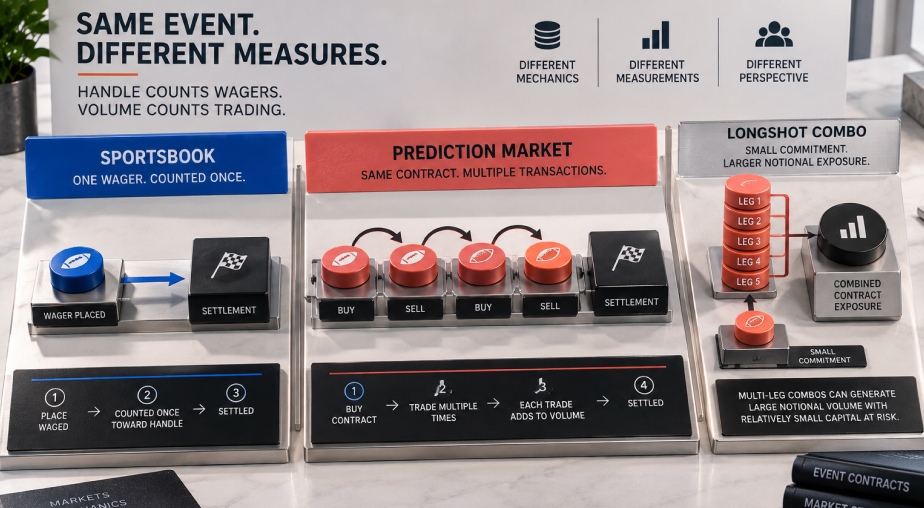
The Event Horizon analysis cited by Dimers notes that Kalshi reports notional volume, which counts both sides of trades. A longshot combination can also trade for a very small contract price while generating a much larger notional amount.
As a result, a prediction market reporting billions of dollars in volume should not automatically be interpreted as customers risking billions of dollars in the same sense as sportsbook handle.
The two systems measure activity differently.
Notional Volume Can Make Longshot Combos Look Enormous
Consider a simplified example.
Imagine a multi-leg contract with a very low probability of success.
Because the outcome is unlikely, the contract might trade for only a few cents.
A customer therefore commits only a small amount of capital to acquire exposure.
But the contract can still represent a larger notional payout if the event occurs.
If large numbers of these contracts trade repeatedly, reported notional volume can increase rapidly even though the actual amount of money changing hands is considerably smaller.
This is especially relevant when combinations contain six, 11 or even more individual legs.
Long combinations naturally create low-probability outcomes.
Those contracts can therefore produce a significant gap between notional volume and actual capital committed.
That does not make the volume meaningless.
It means the metric must be interpreted correctly.

The Record Still Shows Genuine Market Growth
The measurement caveat should not obscure the underlying trend.
Prediction-market sports activity is expanding rapidly.
Kalshi recorded $388.1 million in straight NFL game trading on the first Sunday, excluding combos, according to separate market reporting.
That represented approximately 40% year-over-year growth.
Kalshi also accounted for around 76% of Sunday’s straight NFL prediction-market volume, demonstrating its dominant position among the tracked exchanges.
Other platforms nevertheless recorded their own highs.
DraftKings Predictions, Novig and ProphetX reached new activity records during the weekend.
Crypto.com and Underdog also posted major trading days.
Rothera stood out as an exception because it did not offer the same type of combo product driving activity elsewhere.
That comparison reinforces how much product design influenced the record.
Football Has Become a Liquidity Engine
NFL football has characteristics that are particularly useful for exchange-style markets.
Games occur on a predictable weekly schedule.
There is enormous national media coverage.
Information arrives continuously.
And many outcomes can be constructed around one game.
A single matchup can potentially support contracts involving the winner, scoring totals, margins, individual players, quarters, halves and combinations of several outcomes.
Each market can attract different participants.
More participants can produce more orders.
More orders can attract professional liquidity providers.
Deeper liquidity can then improve execution and potentially tighten the gap between buyers and sellers.
That feedback loop helps explain why football is becoming such an important category for prediction exchanges.
Better Liquidity Can Improve Pricing
The site’s recent analysis of how sportsbooks price favorites and underdogs explains why market margin matters when comparing prices.
Prediction exchanges approach the problem differently, but liquidity remains central.
A thin exchange can display a theoretical market price while offering very little capacity to transact near that level.
A deep market provides more orders around the current price.
That makes larger transactions easier to absorb without substantially moving the market.
Citizens JMP’s NFL Week 1 analysis provides evidence of how that process may be developing.
Across a 28-point sample of NFL moneylines and totals, Kalshi’s blended implied vig was 4.32%, compared with 4.44% at FanDuel and 4.51% at DraftKings.
That does not mean Kalshi was cheaper in every market.
It does show that growing participation can help prediction exchanges become increasingly competitive on pricing.
Combos Create the Opposite Problem
The most heavily traded product category was also one where pricing appeared less competitive.
Citizens found that Kalshi’s sampled combo pricing carried higher implied vig than comparable parlay products at FanDuel and DraftKings before transaction fees.
That creates an interesting contradiction.
Customers generated enormous volume in the very category where traditional sportsbooks retained a pricing advantage in the sampled comparison.
This illustrates why volume alone cannot measure market efficiency.
A highly active product is not necessarily the cheapest product.
It may simply be the product customers find most engaging.
For prediction markets, that distinction will become increasingly important as platforms compete not only for volume but for long-term customer activity.
Traditional Sportsbooks Are Entering a Mature NFL Market
The record prediction-market weekend also arrived against a very different backdrop for conventional U.S. sportsbooks.
The American Gaming Association estimates that Americans will legally wager approximately $29.5 billion through state-regulated commercial sportsbooks during the 2026 NFL season.
Its estimate for the previous season was approximately $29.4 billion.
That implies essentially flat year-over-year growth.
The AGA has argued that expanding sports prediction markets are affecting the regulated sportsbook industry, although its characterization reflects the trade group’s position and does not by itself establish that prediction markets caused sportsbook growth to slow.
Market maturity is another plausible factor.
Sports betting has already expanded across much of the United States, leaving fewer large new state launches available to produce the dramatic growth seen earlier in the post-2018 market.
Sportsbook Handle and Exchange Volume Cannot Be Put Side by Side
The $29.5 billion sportsbook projection and $5.83 billion prediction-market weekend make for an eye-catching comparison.
It is also potentially misleading.
The AGA number represents estimated legal sportsbook handle over an entire NFL season.
The prediction-market number represents notional trading volume during one weekend.
One measures wagers accepted.
The other measures trading activity.
One customer placing a $100 sportsbook wager generally contributes $100 to handle.
An event contract can be bought, sold and traded again before settlement, creating repeated volume around the same underlying event.
This difference is particularly pronounced in combo contracts.
Any analysis that simply compares the two headline dollar figures without explaining their methodologies risks overstating the relative scale of prediction markets.
More Platforms Are Competing for the Same Football Audience
Kalshi remains the largest participant, but the market is becoming increasingly crowded.
DraftKings has moved deeper into prediction products.
Robinhood distributes sports event contracts through multiple exchange relationships.
Crypto.com, Novig, ProphetX, Underdog and other platforms are expanding their offerings.
Polymarket continues to pursue U.S. sports activity as well.
Barron’s reported that 16 prediction-market platforms were competing around the opening NFL period, with companies dramatically increasing advertising and customer-acquisition activity.
That means the next phase may involve competition on several fronts simultaneously:
pricing, liquidity, contract variety, combo products, user experience and distribution.
The exchange with the largest number of markets does not necessarily win.
Neither does the platform with the largest headline notional volume.
Advertising Is Accelerating Alongside Trading
The battle for football customers is also moving beyond market structure.
Prediction-market advertising has expanded dramatically.
The American Gaming Association reported in August that prediction-market companies spent nearly $200 million on digital advertising during the first seven months of 2026.
Barron’s subsequently reported that active prediction-market advertisements across Meta platforms increased from 968 to 3,010 within roughly one month around the beginning of football season.
The advertising race includes large consumer platforms as well as specialized exchanges.
That matters because liquidity requires participants.
Customer acquisition therefore has a direct relationship with market quality.
More customers can create more trading.
More trading can attract market makers.
More liquidity can improve pricing.
That makes advertising spending part of the underlying market-structure competition rather than simply a branding exercise.
Responsible-Gambling Questions Grow With Volume
Rapid expansion also increases the importance of consumer protections.
Prediction markets and state-regulated sportsbooks operate under different regulatory structures.
State sportsbooks generally operate under gaming regulators with specific requirements covering age, responsible-gambling tools, advertising and consumer protection.
Prediction exchanges offering event contracts operate through the federal commodities framework and argue that their products fall under CFTC jurisdiction.
The AGA disputes the appropriateness of that structure for sports event contracts and has argued that prediction-market platforms do not provide equivalent state-level protections.
Prediction exchanges and their supporters have countered that federally regulated event contracts are financial instruments governed through a different legal framework.
That disagreement remains unresolved across multiple jurisdictions.
For customers, the practical issue is simpler: rapid product growth should be accompanied by clear settlement rules, transparent fees, accessible limits and understandable risk information.
Week 1 Revealed the Importance of Market Composition
The $5.83 billion record is impressive.
The structure underneath it is more informative.
Kalshi generated $4.89 billion.
Combos represented 61% of its weekend volume.
The median combination contained about six legs.
Contracts containing at least 11 legs represented nearly half of combo volume.
Player outcomes represented 44% of football combo legs.
And 91% of industry-wide weekend trading was concentrated in sports and combo activity.
Together, those figures show what is actually driving the expansion.
This is not merely a market where customers buy simple contracts predicting which NFL team wins.
Prediction platforms are increasingly becoming complex sports-market ecosystems.
The NFL Is Testing Whether Record Volume Can Become Recurring Volume
Opening weekends naturally attract exceptional attention.
The more important question is whether the activity persists.
Week 1 offered novelty, national advertising campaigns and the return of regular-season football.
Later weeks will test whether the same liquidity remains available when the schedule becomes routine.
That distinction matters because sustainable exchanges require recurring participation.
A platform can generate a spectacular record around one major event without necessarily maintaining deep markets throughout an entire season.
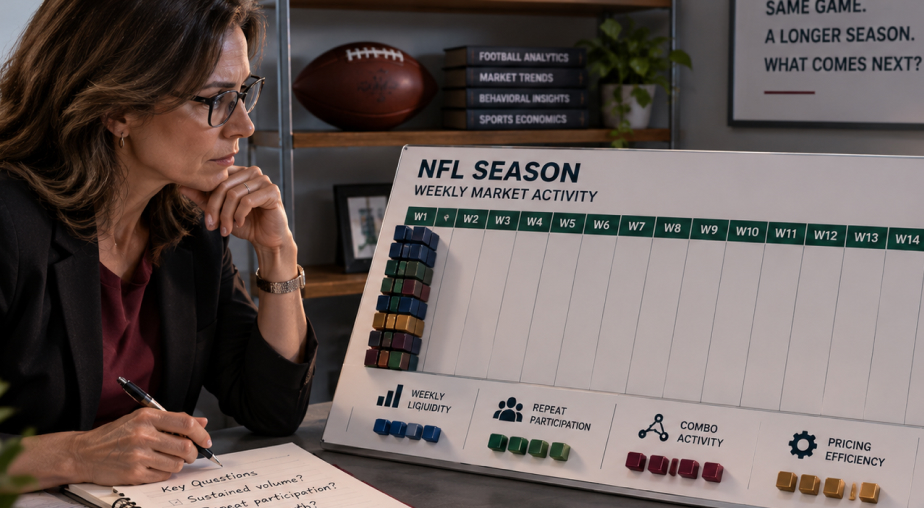
The NFL provides an unusually useful test because the experiment repeats almost every week.
Trading activity can be compared across September, October, November and December.
Market spreads can be tracked.
Combo participation can be measured.
Customer concentration can be observed.
And pricing can be compared against established sportsbooks.
The $5.83 Billion Record Needs Context More Than Hype
NFL Week 1 established that sports prediction markets can generate enormous reported trading activity.
It did not establish that $5.83 billion was actually wagered in the conventional sportsbook sense.
That difference is fundamental.
Notional trading volume, repeated contract transactions and complex combos all magnify the headline number.
At the same time, dismissing the record because of those mechanics would miss the larger development.
Kalshi generated consecutive daily records.
Competitors also reached new highs.
Straight NFL markets expanded year over year.
Professional liquidity is deepening.
And football has become one of the prediction-market industry’s primary engines.
The most important number may therefore not be $5.83 billion.
It may be 61%—the share of Kalshi’s weekend volume generated by combo contracts.
That figure shows how quickly prediction markets are evolving beyond simple binary event questions into products that increasingly resemble the complex sports markets offered by established sportsbooks.
As the 2026 NFL season continues, the central question will be whether these extraordinary opening-weekend numbers translate into sustained liquidity and competitive pricing—or whether Week 1 ultimately proves to be an exceptional peak.
Either way, prediction markets have reached a scale where their NFL activity can no longer be treated as a niche part of the U.S. sports-market landscape.