

NFL preseason football has traditionally been a difficult product to price.
Starters play limited snaps. Quarterback rotations can change hours before kickoff. Coaches prioritize evaluation over winning, and the players deciding the fourth quarter may be competing for the final spots on a 53-man roster rather than preparing to start in September.
In 2026, those familiar preseason variables are colliding with something newer: the rapid expansion of prediction markets into American sports.
Platforms such as Kalshi, Polymarket, DraftKings Predictions and FanDuel Predicts are increasingly offering event contracts tied to sporting outcomes. As the full NFL preseason schedule moves into action in August, those markets are being tested in an environment where information changes quickly and conventional team strength can be much less useful than during the regular season.
That makes preseason football an unusually revealing laboratory for prediction-market pricing.
The question is not simply whether a team will win. It is whether market participants can correctly value quarterback playing time, roster depth, coaching decisions and late lineup information quickly enough for contract prices to remain useful.
Prediction Markets Have Moved Directly Into NFL Games
Prediction markets are no longer limited to elections, economic indicators or major championship outcomes.
Sports have become central to their growth.
Polymarket, for example, has listed contracts for individual 2026 NFL preseason games. Its Carolina Panthers-Arizona Cardinals Hall of Fame Game market included contracts covering the game winner, point spreads and multiple scoring totals.
The Polymarket NFL preseason market opened July 9 for the August 6 game and used official NFL scores as its primary resolution source.
That structure immediately looks familiar to anyone accustomed to a sportsbook.
Instead of displaying only a conventional moneyline or point spread, prediction platforms generally express outcomes as contracts priced between zero and one dollar. A contract trading around 60 cents can be interpreted as the market assigning the outcome an implied probability near 60%.
The economic exposure can therefore resemble a conventional wager even though the trading structure and regulatory framework are different.
What makes preseason particularly interesting is how quickly that implied probability can become outdated.
Preseason Football Is Harder to Price Than the Regular Season
Regular-season NFL markets are built around relatively stable assumptions.
If a healthy starting quarterback is expected to play, sportsbooks can model an offense using established performance data. Defensive starters are expected to participate. Coaches are trying to maximize the probability of winning.
Preseason football breaks many of those assumptions.
A veteran quarterback might play one drive. Another starter might dress but never enter. A backup could receive an entire half before an undrafted rookie finishes the game.
The final score may depend heavily on players who will not make the opening-week roster.
That creates several sources of uncertainty:
- How long the starting quarterback will play
- Which offensive linemen will appear with each unit
- Whether veteran skill players are active
- How aggressively each coach uses established starters
- Which backup quarterbacks receive second-half snaps
- Whether players are being evaluated individually rather than within the normal system
A regular-season rating of the Detroit Lions or Cincinnati Bengals, for example, tells a market participant much less when Jared Goff or Joe Burrow is expected to play only briefly—or not at all.
Preseason prices therefore depend heavily on information that becomes available much closer to kickoff.
Quarterback Rotation Can Matter More Than Team Quality
Quarterback information is probably the clearest example.
Consider a hypothetical preseason matchup between a strong regular-season team and a weaker opponent.
If the stronger team rests its starting quarterback while the weaker team gives its starter several drives, the preseason matchup may be far more balanced than the regular-season power ratings suggest.
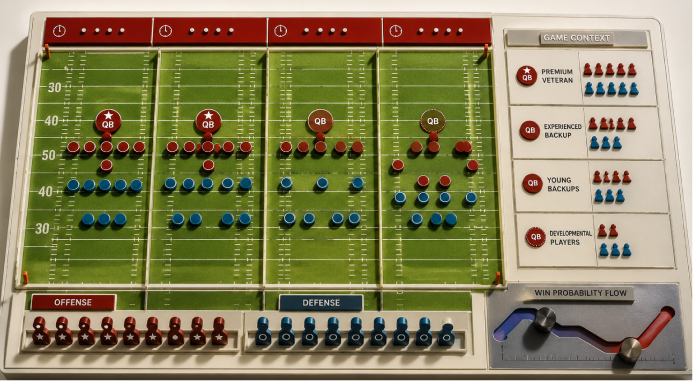
The equation changes again in the second half.
A team with an experienced backup quarterback may have an advantage after halftime against an opponent evaluating an undrafted rookie.
That creates an unusual price-discovery problem.
The market must estimate not one quarterback matchup but potentially three or four different ones across the same game.
A trader buying a contract six hours before kickoff may be pricing a completely different football environment from someone entering the same market 30 minutes before the opening kick.
This is one reason the site’s recent analysis of training camp injuries and NFL futures is relevant to preseason prediction markets. Training camp information affects not only season-long expectations but also which players are available for individual August games.
Thin Liquidity Can Amplify Preseason Uncertainty
Another important variable is liquidity.
Prediction-market prices become more informative when enough buyers and sellers are willing to trade on both sides of an outcome.
A heavily followed Super Bowl market can attract enormous participation.
An August preseason game may not.
Some early Polymarket preseason markets opened with very little trading volume. That does not make the contract meaningless, but it changes how confidently the displayed price should be interpreted.
Suppose an NFL contract shows a team at 58%.
If thousands of dollars are available around that level and many independent participants have traded the market, the price may reflect a meaningful collective assessment.
If only a few dollars have traded, 58% may represent little more than the position of a handful of participants.
This distinction is particularly important in preseason football because late information can move the true probability quickly.
One report that a starting quarterback will sit could justify a substantial adjustment. A thin market may move dramatically when even one informed participant reacts.
A deeper market should absorb that information more efficiently.
Prediction Markets Are Expanding While Sportsbooks Adapt
The preseason experiment is happening during a larger change in the U.S. betting industry.
FanDuel and DraftKings are both expanding into prediction markets rather than treating them solely as competitors.
A Financial Times report published August 11 described the move as a strategic response to the rapid growth of platforms such as Kalshi and Polymarket. The report placed Kalshi’s recent valuation around $22 billion and Polymarket’s around $15 billion while highlighting the appeal of event-contract products in jurisdictions where conventional state-regulated sportsbooks face restrictions.
The prediction-market pivot by FanDuel and DraftKings suggests that the distinction between sportsbook and prediction-market companies may become less obvious to customers.
DraftKings now operates both a conventional sportsbook and DraftKings Predictions.
FanDuel has taken a similar approach through FanDuel Predicts.
That convergence makes the NFL particularly important. Football remains the largest recurring sports-betting product in the United States, so any company attempting to build a major sports prediction platform eventually has to prove that its product works during NFL season.
Preseason provides an early test before the stakes increase in September.
Contract Prices and Sportsbook Odds Are Not Identical
A prediction contract and a sportsbook line can express similar probabilities, but they arrive at those prices differently.
A sportsbook posts odds and accepts customer wagers while managing its own exposure.
A prediction market generally allows participants to buy and sell contracts with one another through an exchange-style structure.
The distinction affects how prices move.
A sportsbook can change its line because its internal model changed, another operator moved first, significant wagers arrived or the trading team wants to reduce liability.
An exchange price changes as buyers and sellers alter what they are willing to pay.
That does not mean one structure is automatically more accurate.
Both can be wrong.
Both can react too slowly.
Both can overreact to public information.
And both depend on whether the underlying market has enough informed participation to produce efficient prices.
Preseason football is useful precisely because those weaknesses can become easier to see.
Late Information Creates an Important Test of Market Efficiency
One of the most valuable preseason signals is often not available when the first market opens.
Coaches may wait until game day to confirm who will play.
Joint practices can affect decisions about starter participation. A quarterback who received extensive work against another team during the week may receive fewer live-game snaps.
Minor injuries can also change plans.
This means a preseason contract may pass through several different information environments before kickoff.
The first price may rely on roster assumptions.
The next price may incorporate coach comments.
A later move may reflect confirmation that several starters will be inactive.
The final pregame price should theoretically contain the most complete available information.
Whether it actually does depends on participation and liquidity.
This makes preseason football a useful real-world test of the central prediction-market claim that trading can aggregate dispersed information into a meaningful probability.
Regulation Is Developing Alongside the Product
Sports event contracts are also expanding while their regulatory treatment remains contested.
The Commodity Futures Trading Commission regulates designated contract markets operating within the federal derivatives framework. In March 2026, the agency issued guidance emphasizing the obligations of exchanges listing prediction-market products, including responsibilities involving surveillance, product design and sports-related contracts.
In June, the commission went further by proposing a framework for evaluating contracts involving activities such as gaming.
The CFTC event-contract framework specifically acknowledges the growth of contracts referencing sporting events and proposes a structured process for reviewing whether certain products fall within categories that Congress directed the agency to scrutinize.
That debate matters for NFL markets because state regulators, sports leagues and prediction-market operators do not necessarily agree about how sports contracts should be classified.
Traditional sportsbooks operate primarily under state gaming systems.
Federally regulated prediction exchanges argue that qualifying event contracts belong under commodities law.
The legal boundaries remain the subject of active litigation and rulemaking, so nationwide availability should not be assumed simply because a contract appears on one platform.
NFL Integrity Concerns Become More Important as Markets Get Smaller
The NFL has another reason to pay attention: information integrity.
Preseason football contains large amounts of nonpublic information.
Coaches know how many snaps a quarterback is likely to receive before the general public does.

Medical staffs know whether a player is truly available.
Players and team personnel may know which backups are expected to receive extended opportunities.
Most of that information is ordinary competitive information rather than evidence of wrongdoing.
But when markets exist around games, nonpublic knowledge can become economically valuable.
This creates a surveillance challenge.
The smaller the market, the easier it can theoretically be for unusual trading to stand out—but the same lack of liquidity can also make innocent trades appear dramatic.
A large order in a thin preseason market may move the price significantly without indicating manipulation.
Market-monitoring systems therefore need context.
A sharp contract movement followed by a public announcement about quarterback playing time may be entirely explainable.
A similar movement occurring repeatedly before confidential team information becomes public could deserve closer review.
Preseason Markets Expose the Limits of Historical Statistics
Another reason these markets are interesting is that conventional statistics become less reliable.
Last season’s offensive efficiency matters little if most starters are on the sideline by the second quarter.
A team’s regular-season defensive ranking may not describe a fourth-quarter unit built from rookies and roster-bubble players.
Even previous preseason records can be misleading because roster composition changes every year.
That forces markets toward more specific information:
depth-chart quality, quarterback rotation, coaching philosophy and individual availability.
It is a different analytical problem from handicapping a regular-season matchup.
Someone relying only on last year’s win-loss record may be using the wrong dataset.
The same problem applies to prediction-market prices themselves.
A visible 65% probability is not automatically reliable simply because it is easy to understand.
The relevant question is what information and liquidity produced that price.
The Regular Season Will Be the Much Bigger Test
Preseason football provides useful experimentation, but September is where competition between prediction markets and sportsbooks becomes economically significant.
NFL regular-season games produce much larger audiences, deeper conventional sportsbook markets and more standardized information.
If prediction exchanges can attract meaningful liquidity during those games, customers will have another source for evaluating implied probabilities.
That creates potential price comparison.
A sportsbook moneyline may imply one probability while an event contract implies another.
The difference could reflect sportsbook margin, exchange liquidity, customer behavior or genuine disagreement about the underlying event.
In efficient markets, those differences should usually narrow as informed participants identify discrepancies.
Whether that happens consistently during an entire NFL season will reveal far more about prediction-market maturity than one high-profile contract.
Preseason is simply providing the first live stress test.
August Football Is an Ideal Market Laboratory
The 2026 NFL preseason may look like low-stakes football, but it creates unusually demanding conditions for sports-market pricing.
Information is incomplete.
Playing time is uncertain.
Quarterback rotations matter disproportionately.
Liquidity can be thin.
Team strength is harder to translate into final-score probability.
Those characteristics make preseason contracts more difficult to value than they initially appear.
They also make the market more informative to observe.
Prediction platforms are expanding precisely as established sportsbook companies move into the same business. Regulatory authorities are developing new frameworks. Sports leagues are paying closer attention to integrity and nonpublic information.
The NFL preseason places all of those trends into one environment.
The important question is not whether prediction markets can list football contracts. They clearly can.
The more meaningful test is whether those markets can attract enough informed participation, adapt quickly to late roster information and produce prices that remain useful under the uniquely unstable conditions of August football.

If they can, the regular season becomes a much larger opportunity.
If they cannot, preseason football may expose exactly where prediction-market expansion still has work to do.