

The U.S. tribal gaming industry entered 2026 from a position of record financial strength. It is also confronting an unusually complicated regulatory moment.
On July 21, the National Indian Gaming Commission reported that tribal gaming establishments generated $46.2 billion in gross gaming revenue during fiscal year 2025, an increase of $2.3 billion, or 5.3%, from 2024. The total came from 545 gaming establishments operated by 246 tribes across 29 states. Seven of the NIGC’s eight regions reported year-over-year growth. (NIGC FY2025 gaming revenue)
Yet the federal agency responsible for overseeing that industry has operated without a permanent or acting chair since January 13, 2026.
That leadership gap has taken on greater significance as tribal governments face another rapidly developing issue: sports prediction markets offered through platforms that argue they operate under federal commodities law rather than conventional state and tribal gambling regulation.
The result is a collision between three large systems: a $46.2 billion tribal gaming economy, a federal regulatory structure created nearly four decades ago, and a prediction-market industry expanding much faster than courts and regulators have been able to settle the underlying jurisdictional questions.
Tribal Gaming Set Another Revenue Record
The scale of tribal gaming is important to understanding why the current dispute matters.
The NIGC’s fiscal 2025 numbers show a sector that has continued expanding rather than a declining casino industry defending an old business model. Gross gaming revenue rose from $43.9 billion in FY2024 to $46.2 billion in FY2025.
That 5.3% increase exceeded the 4.6% growth recorded a year earlier.

NIGC defines gross gaming revenue as the amount wagered minus winnings returned to players. It is therefore an operator-revenue measure rather than total betting handle. The agency compiles the figures from independently audited financial statements submitted by tribal gaming establishments.
The economic significance also extends far beyond casinos.
Tribal governments use gaming revenue to finance healthcare, housing, education, infrastructure and other government services. Indian Gaming Association Chairman David Bean, a citizen of the Puyallup Tribe, emphasized that relationship while discussing the prediction-market dispute, arguing that gaming dollars flow back into essential tribal services.
That makes competition and regulation particularly sensitive. For many tribal nations, gaming is not simply another commercial industry. It is part of the economic framework supporting tribal government.
The NIGC Has Been Without a Chair Since January
The National Indian Gaming Commission was established under the Indian Gaming Regulatory Act of 1988.
Its structure is unusual. The commission has three full-time members: one chair appointed by the president and confirmed by the Senate, plus two associate commissioners appointed by the secretary of the Interior. The commissioners select a vice chair among themselves. (NIGC Commission structure)
Sharon M. Avery, a citizen of the Saginaw Chippewa Indian Tribe of Michigan, served as acting chair from May 15, 2024 through January 12, 2026. When that acting appointment expired, she returned to her position as associate commissioner. (NIGC leadership history)
The agency has not had another permanent or acting chair since then.
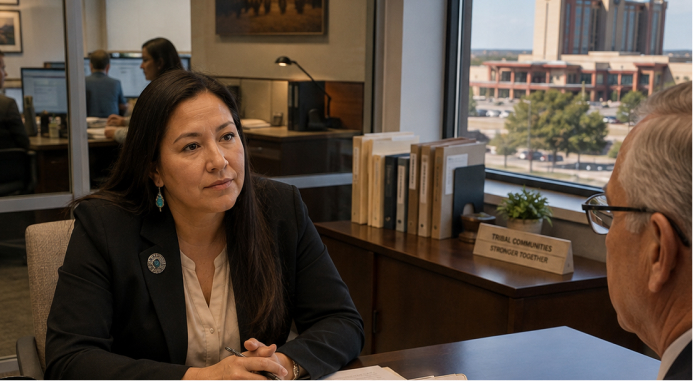
That is not simply a ceremonial vacancy.
Certain powers under the Indian Gaming Regulatory Act are specifically attached to the chair. Associated Press reporting on August 9 detailed how the vacancy has limited the commission’s ability to carry out functions including enforcement actions, approval of certain tribal gaming ordinances and certification of management agreements.
The timing is particularly difficult because the industry is simultaneously growing and facing new regulatory questions.
The Iowa Tribe Shows What the Vacancy Means in Practice
The consequences can be seen in Chandler, Oklahoma.
The Iowa Tribe of Oklahoma opened a new Harrah’s-branded casino there in April 2026. According to the AP, the property covers approximately 175,000 square feet and experienced such strong opening demand that cars backed up outside while the casino reached capacity.
Tribal Chairman Jacob Keyes had expected Harrah’s parent company to eventually take responsibility for day-to-day management.
That transition requires federal approval of the management arrangement.
Without an NIGC chair capable of exercising the necessary authority, the agreement has remained unresolved, leaving the tribe’s own government staff managing an operation it had planned to outsource.
This illustrates why regulatory certainty has commercial value.
University of Nevada, Las Vegas tribal gaming law expert Steven Light told the AP that stable processes and rules are important to functioning markets. A prolonged approval bottleneck can affect investment decisions, management partnerships and development timelines even when the underlying casino is performing strongly.
The issue is therefore broader than whether enforcement citations are temporarily delayed.
Regulation also provides businesses with predictable procedures.
Prediction Markets Are Arriving at the Same Moment
While the NIGC is operating without a chair, platforms such as Kalshi and Polymarket have dramatically expanded public awareness of event-contract trading.
Prediction markets allow participants to buy and sell contracts based on whether specified events occur. Sports markets can resemble familiar sportsbook products because a contract may ultimately depend on which team or player wins.
The legal structure is different.
The Commodity Futures Trading Commission explains event contracts as derivatives that are commonly structured as swaps and derive their value from an underlying event. CFTC-regulated prediction-market operators argue that their contracts fall within federal derivatives law rather than conventional state gaming frameworks.
Tribal organizations sharply dispute that interpretation when sports contracts are offered in tribal jurisdictions or in states where tribes have negotiated exclusive gaming rights.
The disagreement is central to the growing legal battle.
This is not merely an argument over whether a 60-cent event contract looks economically similar to a sportsbook moneyline. It is a dispute over which regulatory system controls the transaction.
Tribes Say Prediction Markets Threaten Gaming Exclusivity
State-tribal gaming compacts can provide tribes with varying degrees of exclusivity in exchange for negotiated obligations, including revenue-sharing arrangements.
Prediction markets potentially complicate those bargains.
A federally regulated trading platform may make sports contracts accessible through a mobile device without negotiating the same state-tribal compact, obtaining a state sportsbook license or participating in the same revenue-sharing framework.
Tribal leaders argue that this can weaken rights negotiated over decades.
The Indian Gaming Association made prediction markets a major topic at its March 2026 convention in San Diego. Sessions focused specifically on what the organization described as threats to tribal sovereignty and established regulated gaming structures. (Indian Gaming Association prediction-market discussions)
By August, the AP reported that at least eight tribes had sued prediction-market platforms, alleging that contracts were being offered from tribal lands or in jurisdictions where tribal gaming rights apply. The platforms dispute those claims and maintain that their products are federally regulated financial contracts rather than casino gambling or sportsbook wagers.
That distinction remains legally contested and should not be presented as settled law.
The Oversight Gap Weakens a Tribal Voice in Washington
The absence of an NIGC chair has another consequence that is harder to quantify.
The chair has traditionally served as a prominent federal voice on tribal gaming issues.
Former NIGC chairman Jonodev Chaudhuri, who led the agency from 2013 to 2019 and is a citizen of the Muscogee (Creek) Nation, described the present situation as one in which the commission is effectively operating with limited capacity at a particularly important moment for Indian gaming.
Former NIGC chief of staff Joe Valandra, a citizen of the Rosebud Sioux Tribe, similarly argued that the commission has been unusually quiet while federal officials consider how prediction markets should be regulated.
That matters because the CFTC itself is actively reconsidering the rules.
On June 10, the commission proposed a new framework for assessing event contracts involving activities such as gaming and conduct that may be unlawful under federal or state law. The proposal includes a structured review process for determining whether certain contracts fall within statutory categories requiring heightened scrutiny.
Tribal governments therefore have significant interests in a federal rulemaking process occurring while the federal agency dedicated specifically to Indian gaming lacks its chair.
The NIGC Still Has Commissioners and Staff
The leadership situation should not be overstated.
The NIGC has not stopped functioning.
William “Billy” Kirkland, an enrolled member of the Navajo Nation, joined the commission on May 29 and currently serves as vice chairman while also serving as assistant secretary for Indian Affairs at the Department of the Interior. Sharon Avery remains an associate commissioner.
Agency field staff and tribal regulators also continue their day-to-day work.
The NIGC itself has emphasized that tribal officials and its staff continue providing regulatory oversight despite the vacancy. The problem is that particular statutory authorities cannot simply be transferred to any employee or commissioner.
That distinction is important.
Describing the industry as “unregulated” because the chair position is vacant would be inaccurate. Tribal casinos remain subject to extensive tribal and federal regulation.
The issue is a gap in specific federal powers and leadership, not an absence of the entire regulatory system.
Tribal Regulation and Prediction-Market Regulation Follow Different Models
The conflict becomes easier to understand when the two systems are placed side by side.
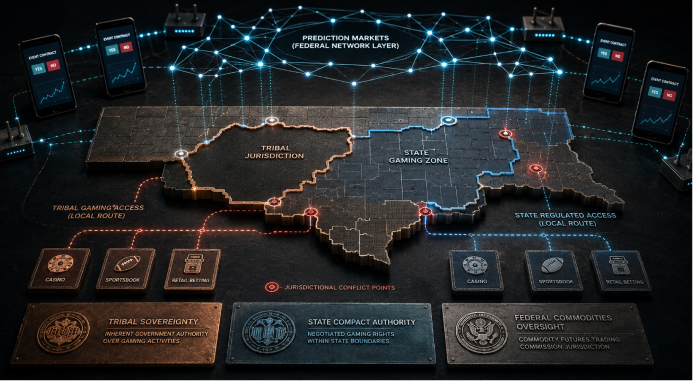
| Tribal Gaming Framework | Prediction-Market Framework |
|---|---|
| Built around the Indian Gaming Regulatory Act | Built primarily around the Commodity Exchange Act |
| Tribal governments are primary stakeholders | CFTC-regulated exchanges operate federally |
| State-tribal compacts can determine gaming rights | Operators argue federal derivatives law controls |
| NIGC has federal Indian-gaming responsibilities | CFTC oversees designated contract markets |
| Revenue supports tribal governmental functions | Platform economics center on trading activity and fees |
| Gaming exclusivity can be negotiated by compact | Nationwide contract availability can challenge geographic exclusivity |
The existence of different regulatory structures does not itself determine which side is legally correct in a specific lawsuit.
It explains why disputes are multiplying.
Prediction markets were designed around federal derivatives regulation. Tribal gaming developed through sovereignty, federal Indian law and state-tribal compacting.
Sports event contracts now place those systems in direct contact.
Pricing Similarity Does Not Resolve the Legal Question
From a customer’s perspective, a sports prediction contract can look surprisingly similar to a conventional bet.
A contract priced around 60 cents can be interpreted as a market-implied probability near 60%. A sportsbook expresses comparable information using moneyline odds.
But economic resemblance is not enough to determine regulatory classification.
The recent 1×2 Betting Pro analysis of prediction-market pricing across 23 million trades showed that event-contract prices can be analyzed much like other sports-market prices, including for calibration, liquidity and possible pricing bias.
That analytical similarity does not answer whether a sports event contract is legally a derivative, gambling product, or both for purposes of a particular state or tribal jurisdiction.
Courts and regulators are still working through that question.
For the betting industry, this distinction is crucial. Two products may give customers exposure to almost identical sporting outcomes while operating under entirely different licensing, taxation and consumer-protection systems.
Tribal Gaming Has More at Stake Than Market Share
It would be easy to frame the dispute only as competition between casinos and prediction-market companies.
That misses the larger issue.
Gaming income can finance tribal governments directly. A reduction in gaming revenue may therefore affect services rather than only corporate profit.
Indian Gaming Association leaders have repeatedly emphasized healthcare, education and housing when explaining why they view the expansion of prediction markets differently from ordinary commercial competition.
The history matters as well.
The Indian Gaming Regulatory Act established the modern federal framework in 1988 after years of litigation and political conflict over tribal sovereignty and gaming rights.
Nearly four decades later, the framework now oversees an industry generating more than $46 billion annually.
Prediction markets reached their current scale much more rapidly.
That speed is part of what makes the present conflict unusual: technology and financial-market products are evolving faster than the jurisdictional boundaries around them.
Regulatory Certainty Matters to Both Markets
Prediction-market operators also have a legitimate interest in clear rules.
A company operating through the federal derivatives framework needs to know whether a federally listed contract can also be restricted by a state, tribe or local jurisdiction.
Repeated litigation creates costs and uncertainty for exchanges, market makers and customers.
Tribes need equivalent certainty about whether compact rights and tribal jurisdiction remain enforceable when a competing sports product is structured as a financial contract rather than a sportsbook wager.
The federal government eventually needs to reconcile those positions more clearly.
Until then, businesses may face a patchwork in which similar contracts receive different treatment depending on geography and the federal court considering the dispute.
For customers, the safest interpretation is straightforward: availability on an app should not be assumed to mean that every jurisdictional question surrounding the product has been definitively resolved.
A $46.2 Billion Industry Is Waiting for Regulatory Clarity
The tribal gaming industry is not entering this regulatory fight from a position of economic weakness.
Fiscal 2025 produced another record: $46.2 billion in gross gaming revenue, 5.3% growth, 545 gaming establishments and operations spanning 29 states.
What the industry lacks is a fully empowered federal gaming commission at a moment when its regulatory boundaries are being tested.
The NIGC chair vacancy has already created practical consequences for the Iowa Tribe of Oklahoma’s casino-management agreement in Chandler. At the same time, tribal governments are challenging prediction markets that they believe encroach on rights established under federal law and state-tribal compacts.
The CFTC is developing its own event-contract framework. Prediction-market platforms continue to argue that federal commodities law governs their products. Tribal organizations are pursuing the opposite position through litigation and federal advocacy.
None of those disputes has produced one nationwide answer.
That is what makes the current oversight gap important.
The central issue is no longer simply whether prediction markets will compete with sportsbooks and casinos. It is whether the United States can clearly define how a new federally regulated sports-market model fits alongside a tribal gaming system built around sovereignty, compacts and nearly four decades of specialized law.
With $46.2 billion in annual tribal gaming revenue and increasingly large prediction markets on the other side of the dispute, regulatory uncertainty is becoming an economic issue in its own right.