

Professional tennis is becoming one of the clearest tests of how deeply prediction markets can integrate with live sports.
On August 4, 2026, Polymarket became an official prediction-markets partner of the ATP Tour in a multiyear agreement that goes considerably further than placing a logo beside a tennis court. The partnership includes prediction-market data, live-media integration and product development across both the ATP Tour and ATP Challenger Tour.
According to Axios, the arrangement potentially touches approximately 20,000 matches per season. Polymarket sports business development president Ari Borod described the opportunity as unusually broad from a product-development perspective because tennis supplies a continuous calendar rather than a handful of isolated marquee events.
That scale makes tennis particularly useful as a prediction-market experiment.
A football game may have a week between appearances. A major tennis tournament can produce dozens of matches in one day. Within a single match, every break point, medical timeout, service game and retirement can alter the probability of the final result.
The ATP partnership therefore gives Polymarket something more significant than additional sports inventory. It provides a high-frequency environment for testing how prediction-market prices interact with official data, live video, liquidity, settlement rules and rapidly changing match probabilities.
The ATP Deal Goes Beyond a Traditional Sponsorship
The partnership announced in August is notable because prediction markets are being integrated more closely with the viewing experience rather than operating as an unrelated product alongside the sport.
Axios reported that the agreement includes real-time prediction-market data integrated with official tennis match streams, as well as media rights and product integration across ATP Tour and Challenger Tour events. The approximately 20,000-match annual inventory means the partnership can operate across almost every level of professional men’s tennis rather than only during Grand Slams or ATP Masters 1000 events.
The Polymarket–ATP partnership therefore represents a different model from the traditional sports sponsorship in which a betting company buys advertising space without materially changing the information available during the event.
Tennis already has an extensive digital-data ecosystem. The ATP Stats Centre, ATP app and other digital services provide live scoring and performance information to fans, while ATP has continued expanding its digital engagement strategy through partnerships with companies such as Infosys.
Adding a prediction-market layer introduces another way to interpret that data.
A viewer no longer sees only that a player has just lost serve. A prediction market can immediately show how other participants collectively repriced the likelihood of that player winning the match.
That distinction is what makes the ATP deal analytically interesting.
Tennis Generates Constant Probability Changes
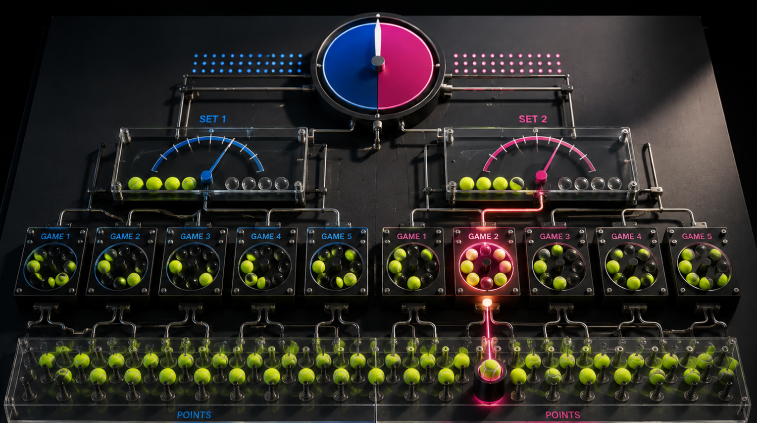
Tennis is unusually suitable for live probability markets because scoring occurs through a nested structure.
Points determine games. Games determine sets. Sets determine the match.
That means new information arrives continuously.
A favorite can begin a match with a high implied probability, lose an early service game and see that probability fall sharply. The same player can break back five minutes later and reverse much of the move.
The market may react to:
- Break points and service breaks
- First-serve effectiveness
- Double faults and physical deterioration
- Medical timeouts
- Weather delays
- Surface conditions
- Momentum across successive games
- Player retirements or defaults
Some of those events contain much more information than others.
Losing one point at 0-0 generally means little compared with losing a point at 30-40 while serving late in a deciding set. A strong prediction market should distinguish between those situations almost immediately.
That makes tennis useful for studying whether crowd-based prices incorporate context correctly rather than merely reacting to the latest point.
Match Prices Can Move Hundreds of Times
Unlike a pregame moneyline, a live tennis contract does not remain static.
Polymarket already lists individual ATP match markets in which contracts trade between zero and one dollar, with the price presented as an implied probability of the player winning.
A recent Generali Open match between Alexander Bublik and Tomas Martín Etcheverry, for example, generated approximately $571,775 in trading volume on Polymarket. Another Bublik match against Alex Molcan generated approximately $630,764.
Those amounts demonstrate that meaningful liquidity can develop even outside a Grand Slam.
The opportunity becomes larger when prediction-market data is connected directly to a live viewing product.
A user watching a match may see a price change after every important point. That creates an environment in which the efficiency of the market can potentially be evaluated repeatedly rather than only before and after the match.
If a player moves from an implied 55% probability to 70% after an early break of serve, analysts can ask whether the adjustment was reasonable given surface, opponent, return ability and remaining sets.
The resulting price history becomes a record of how participants processed information throughout the match.
Official Data Becomes Critical When Prices Move This Quickly
Prediction markets need reliable settlement information, but live tennis creates an additional challenge: speed.
When prices can change after individual points, delays or discrepancies in match data become increasingly important.
The ATP already maintains official scoring and match information, and existing Polymarket tennis contracts frequently identify ATP results as their primary resolution source. For example, Polymarket’s published rules for ATP match contracts specify how markets are resolved when a player advances and explain what happens when a match is canceled, delayed, abandoned or decided through retirement or disqualification.
That rule structure matters because tennis contains outcomes that are less straightforward than a normal final score.
A player can retire while trailing. Another can withdraw before the first point. A match can be interrupted by weather and resume a day later. A player can advance because of a default.
A conventional sportsbook publishes rules describing how those situations affect wagers. Prediction markets must do the same.
The difference is that a contract may continue changing hands until close to the moment when the relevant outcome becomes known.
The more tightly prediction prices are integrated with ATP content, the more important transparent settlement rules become.
Retirements Create a Particularly Difficult Tennis Market
Few sports illustrate the importance of contract wording as clearly as tennis.
Suppose a player wins the first set but retires with an injury during the second.
From a competitive standpoint, the opponent advances. But different betting products can apply different settlement rules depending on whether a certain number of points, games or sets were completed.
Polymarket’s ATP match rules currently state that when a match begins but is not completed and a player advances because of an opponent’s retirement, default or disqualification, the advancing player resolves as the winner. A pre-match walkover is handled differently.
That distinction can materially affect contract value.
It also creates an integrity concern because medical information can move a tennis market dramatically.
If one participant knows before the broader market that a player is struggling physically, that information could be economically valuable.
This is one reason the sport’s existing integrity framework matters as prediction markets expand.
Tennis Already Has a Formal Betting-Integrity System
Professional tennis operates under the Tennis Anti-Corruption Program, administered through the International Tennis Integrity Agency.
The 2026 Tennis Anti-Corruption Program is designed to protect professional tennis against corruption and betting-related offenses. It applies to players, coaches, officials and other covered persons and establishes rules intended to prevent improper efforts to influence matches or misuse privileged information.
The ITIA represents the ATP, WTA, International Tennis Federation and the four Grand Slam tournaments on integrity issues.
Prediction-market expansion does not replace that system.
Instead, it adds another category of market activity that integrity teams may need to understand.
Traditional sportsbooks already generate information that can help investigators identify unusual activity. Prediction exchanges can potentially add different signals because order flow, liquidity and price movement may reveal how participants respond before and during a match.
A sudden move alone does not prove corruption. It may reflect a legitimate injury report, weather development or informed reassessment.
The challenge is identifying when market behavior becomes sufficiently unusual to justify closer investigation.
Challenger Tennis Could Be the More Interesting Test
The ATP Tour attracts the biggest audiences, but the inclusion of the ATP Challenger Tour may ultimately be more revealing.
Major matches involving globally recognized players tend to attract large amounts of public attention and information. Thousands of viewers, journalists and analysts may be following the same contest.
Lower-profile Challenger events operate differently.
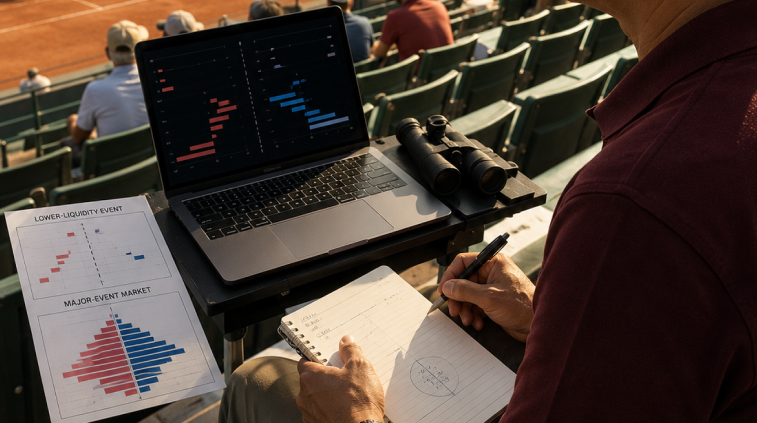
Audience size is smaller. Information may be less widely distributed. Liquidity may be thinner, and local knowledge can represent a greater portion of total market information.
The difference can be substantial.
A July 2026 Polymarket contract on the Winnipeg match between August Holmgren and Garrett Johns recorded approximately $154,387 in volume. Other lower-profile tennis markets have attracted much smaller amounts.
Liquidity matters because a displayed prediction-market price is only as meaningful as the market supporting it.
A 65-cent contract backed by substantial two-way trading does not necessarily contain the same information as a 65-cent contract in a market where only a handful of participants are active.
That makes the Challenger Tour an important test of whether prediction-market integration works consistently across both large and small events.
The Partnership Could Produce Better Price-Discovery Research
Tennis also offers researchers something rare: a huge number of repeated, structurally similar events.
Thousands of matches take place annually, and each match generates a sequence of measurable states.
Researchers could compare market behavior based on:
| Match Variable | Prediction-Market Question |
|---|---|
| Pre-match favorite | How accurately does the opening price forecast the winner? |
| Early service break | Does the market overreact to the first major swing? |
| Surface | Are adjustments different on clay, grass and hard courts? |
| Medical timeout | How quickly is new physical information incorporated? |
| Deciding set | Does liquidity improve as uncertainty becomes concentrated? |
| Challenger event | Are thinner markets less efficiently priced? |
| Retirement | How effectively do traders understand settlement rules? |
That does not mean Polymarket or ATP will necessarily publish data for every academic use. It illustrates why the underlying environment is unusually rich for examining market formation.
The site’s recent analysis of 23 million prediction-market trades showed why a market price should not automatically be interpreted as perfect probability. That research found that calibration varied over the lifecycle of sports contracts and that more complex multi-event products could display systematic pricing differences.
Tennis provides an environment where similar questions can be tested at a much more granular level.
Live Video Could Change How Quickly Information Reaches the Market
The live-media component of the ATP partnership may prove particularly important.
In a traditional betting environment, customers frequently rely on television broadcasts that may have a small delay relative to the actual event.
Even a brief delay matters when prices move point by point.
If prediction-market information and official video are placed within the same product ecosystem, synchronization becomes an important design issue. Participants need to understand whether the score, video and market price reflect approximately the same moment.
Otherwise, some users may appear to have superior forecasting ability when they simply receive information earlier.
This problem exists across live sports betting, but tennis magnifies it because scoring events occur frequently and markets can move immediately.
A break point can be worth far more than an ordinary point. A medical timeout can change expectations before another ball is struck.
As prediction markets become more tightly integrated with media, latency becomes part of market structure.
Prediction Markets Still Face a Developing U.S. Regulatory Framework
The ATP agreement is global, but U.S. sports prediction markets continue to operate within an evolving regulatory environment.
The Commodity Futures Trading Commission issued a prediction-markets advisory on March 12, 2026 reminding designated contract markets of their obligations under the Commodity Exchange Act and discussing issues that can apply specifically to sports event contracts.
The advisory emphasized responsibilities involving product review, manipulation risks and market surveillance.
Those questions become increasingly important as prediction companies establish direct relationships with sports organizations.
The regulatory debate is no longer theoretical. Prediction markets now overlap visibly with products traditionally associated with state-regulated sports betting, while states, federal regulators, exchanges and sports leagues continue to debate where legal authority should sit.
The ATP partnership therefore represents a commercial development inside a larger regulatory experiment.
A product can be innovative and still require strong controls around market integrity, customer access and settlement.
Traditional Sportsbooks Will Be Watching the Experiment
Sportsbooks have spent years improving live tennis betting.
Tennis is attractive because matches occur throughout the day across multiple time zones, creating substantial inventory outside traditional U.S. sports windows.
Prediction markets now introduce a competing pricing format.
Instead of seeing a player at -150, a customer might see a contract expressed near 60 cents. The underlying question is similar—what probability is the market assigning to the outcome?—but the interface and market mechanics differ.
That can make prediction markets appealing to users who prefer thinking directly in percentages.
It does not make the price automatically better.
Sportsbooks incorporate margin into their odds. Prediction markets can introduce other frictions through spreads between buyers and sellers, liquidity limitations and fees.
The important comparison is the effective price available when the customer actually enters the market.
For sophisticated users, ATP integration could make comparison easier because sportsbook odds and prediction-market probabilities may be visible alongside the same live event.
Twenty Thousand Matches Create a Real Test, Not a Marketing Experiment
The scale of the ATP agreement is what separates it from many prediction-market sponsorships.
A few branded tournaments would generate publicity.
Approximately 20,000 ATP and Challenger matches per season can generate enough repeated observations to reveal how the product behaves under many different conditions.
Highly liquid Masters matches can be compared with thin Challenger markets. Hard courts can be compared with clay. Early-round matches can be compared with finals. Pregame prices can be compared with point-by-point trading.
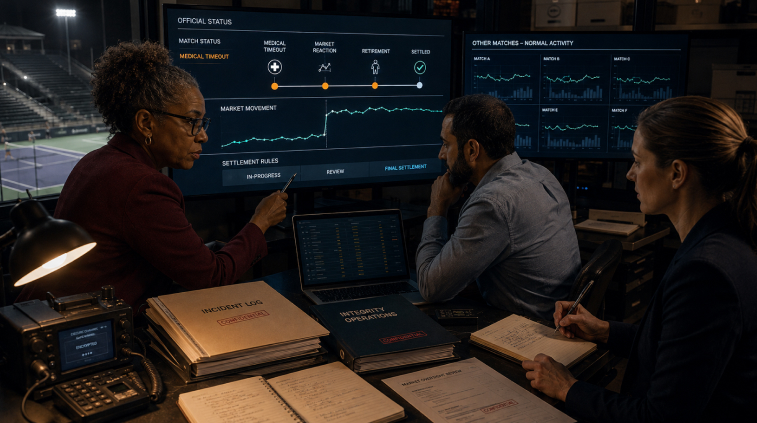
Most importantly, the partnership can test whether prediction markets improve the way fans interpret live probabilities or simply add another rapidly moving number to the viewing experience.
Tennis is well suited to that experiment because uncertainty changes constantly but remains mathematically structured.
Every point modifies the path to the next game. Every game changes the path to the set. Every set alters the probability of winning the match.
Polymarket now has access to a sports ecosystem where that process repeats thousands of times each season.
That makes the ATP partnership bigger than another prediction-market sponsorship.
It could become one of the clearest real-world laboratories for determining how sports prediction prices behave when official data, live media, market liquidity and rapid probability changes all operate at the same time.