

Prediction markets are beginning to resemble traditional sportsbooks in one increasingly important way: the questions available to trade.
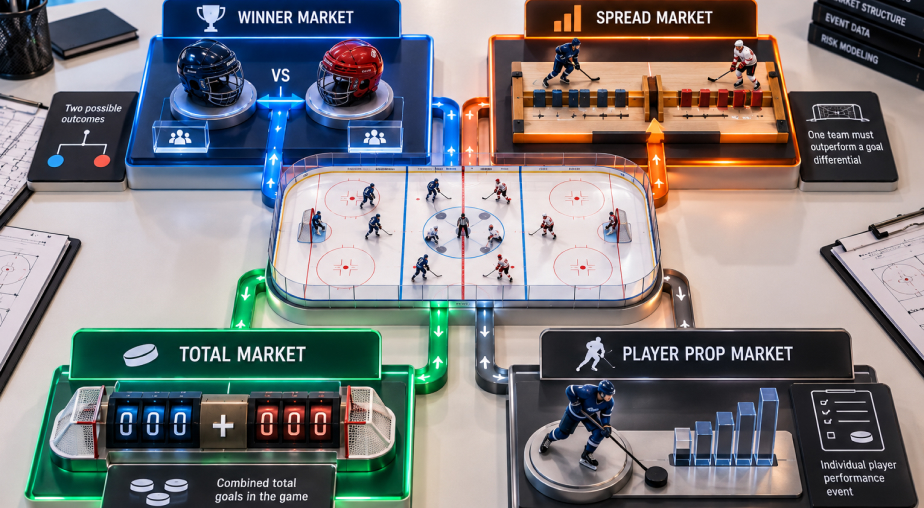
On September 22, 2026, LEX certified a new group of NHL event contracts with the Commodity Futures Trading Commission covering four familiar categories: Winner, Spread, Total and Prop.
The timing is significant. The 2026–27 NHL regular season begins September 29, giving the new contract structures a full 84-game season in which hockey prediction markets can move beyond basic questions about who wins.
That does not make a prediction exchange identical to a sportsbook.
The underlying economic structures can remain different. A sportsbook generally establishes prices and accepts wagers against its own book, while an exchange-style prediction market can allow participants to trade contracts whose prices move as buyers and sellers interact.
But the sports questions themselves are converging.
A hockey fan who recognizes winners, puck-line-style spreads, game totals and player propositions from conventional sportsbooks can increasingly encounter comparable outcomes expressed as binary event contracts.
That makes the NHL an important test of how far prediction markets can expand while maintaining a distinct market structure.
LEX Certified Four NHL Market Categories on September 22
The CFTC’s designated contract market product database lists multiple LEX NHL products certified on September 22.
They include:
- NHL WINNER
- NHL SPREAD
- NHL TOTAL
- NHL PROP
The filings classify the products as swaps in the Event category and Binary Option subcategory.
That regulatory description matters because it illustrates the difference between the product structure and the sports question being asked.
“Who wins this hockey game?” is familiar.
“Will the teams combine for more than a specified number of goals?” is familiar.
“Will a team outperform a specified scoring margin?” is familiar.
A contract involving a player’s statistical performance is familiar as well.
What is changing is the mechanism through which those questions can be expressed.
Instead of existing exclusively as conventional sportsbook wagers, increasingly similar sports outcomes are being structured as event contracts on federally regulated exchanges.
The NHL Season Arrives at an Ideal Time for the Expansion
The new products arrive immediately before an unusually large NHL season.
According to the official 2026–27 NHL schedule, the regular season begins Tuesday, September 29 and expands from 82 to 84 games per team.
The league will play an NHL-record 1,344 regular-season games across 194 days.
It is the first 84-game NHL season in more than three decades.
Opening night alone creates several prominent market tests.
The defending Stanley Cup champion Carolina Hurricanes host the Florida Panthers at Lenovo Center at 5 p.m. ET. The New York Rangers then visit the Boston Bruins at 8 p.m., followed by the Chicago Blackhawks at the Vegas Golden Knights at 10:30 p.m. on ESPN.
Montreal visits Toronto and Vancouver travels to Edmonton in the Canadian national schedule.
For prediction-market operators, that creates a large inventory of events from the opening night onward.

Winner Contracts Are the Simplest Starting Point
The easiest NHL prediction contract to understand is the winner market.
At its core, it asks whether a specified team will win.
That resembles the central question behind a traditional moneyline.
If a binary contract settles at $1 for Yes and $0 for No, its trading price can also be interpreted as a market-implied probability before fees and other market frictions are considered.
A contract trading at $0.60, for example, can loosely be interpreted as the market pricing the event around 60%.
But that interpretation requires caution.
A contract price is not a guarantee that the event has a mathematically “true” 60% probability.
Liquidity, spreads, transaction costs, participant behavior and information availability can all influence the price.
That distinction becomes even more important as exchanges move into narrower NHL markets.
Spreads Bring Prediction Markets Closer to Sportsbook Structure
The NHL spread product is more revealing.
Traditional hockey sportsbooks commonly use a goal-based handicap to change the condition a team must satisfy.
Instead of merely asking whether Team A defeats Team B, the relevant outcome can depend on whether a team wins by more than a specified margin or remains within a specified margin.
Prediction exchanges can translate the same basic question into binary form.
Conceptually, instead of presenting a traditional sportsbook line, a market can ask:
Will Team A outperform the specified goal differential?
Yes and No contracts can then trade around that condition.
The terminology changes.
The underlying sports event does not.
That convergence makes understanding conventional pricing increasingly relevant to prediction-market readers. Our explanation of how sportsbooks price favorites and underdogs provides useful background on how probability becomes market price in traditional wagering.
Prediction markets introduce a different mechanism for reaching that price, but both structures are ultimately trying to quantify uncertainty.
Totals Create Another Familiar Market in Binary Form
Totals provide an even clearer example.
A sportsbook can establish a threshold for combined goals.
A prediction contract can ask whether the combined score will finish above or below a specified level.
The sports question is almost identical.
The market architecture is not.
In a sportsbook, the operator typically publishes prices around the total while managing its exposure and margin.
In an exchange, participants can potentially buy and sell opposing sides of the contract, with price discovery emerging from the order book.
This distinction matters because the displayed price can respond differently to liquidity.
A heavily traded contract with many competing orders may produce relatively tight bid-ask spreads.
A thin market can behave very differently.
A theoretically attractive price means less if there is insufficient liquidity to execute at that price.
NHL Props Make the Expansion More Granular
The Prop category potentially pushes NHL prediction markets further into territory long associated with sportsbooks.
Props focus on narrower outcomes than the final game result.
In hockey, those can conceptually involve measurable player or game events, although the precise available contracts depend on the exchange’s specifications and listings.
CFTC records already show that sports prediction markets have been moving in this direction.
For example, the commission’s database lists NHL Hockey Player Statistic Contracts from ProphetX as certified on June 14.
That broader expansion matters because player statistics create substantially more potential contracts than game winners alone.
One NHL game has one final winner.
The same game contains many players and many measurable events.
Each additional statistical category can generate another potential market.
More Markets Also Mean More Fragmented Liquidity
That creates one of the central challenges for prediction exchanges.
More contract variety is not automatically better market quality.
Suppose one hockey game generates trading around:
game winner, spread, total goals, team totals, player goals, player assists, shots, saves and other statistical outcomes.
Every additional contract competes for attention and capital.
If enough participants trade each one, the broader catalog can work efficiently.
If activity becomes too fragmented, some markets may have shallow order books and wide bid-ask spreads.
This creates a balancing problem.
Prediction-market platforms have an incentive to offer enough variety to compete with sportsbook menus.
But an exchange also needs sufficient liquidity in each contract for meaningful price discovery.
Sportsbooks face a different version of this problem because they can post markets directly rather than waiting for two-sided exchange liquidity.
The 84-Game Schedule Creates an Enormous Testing Ground
The NHL’s schedule makes this particularly interesting.
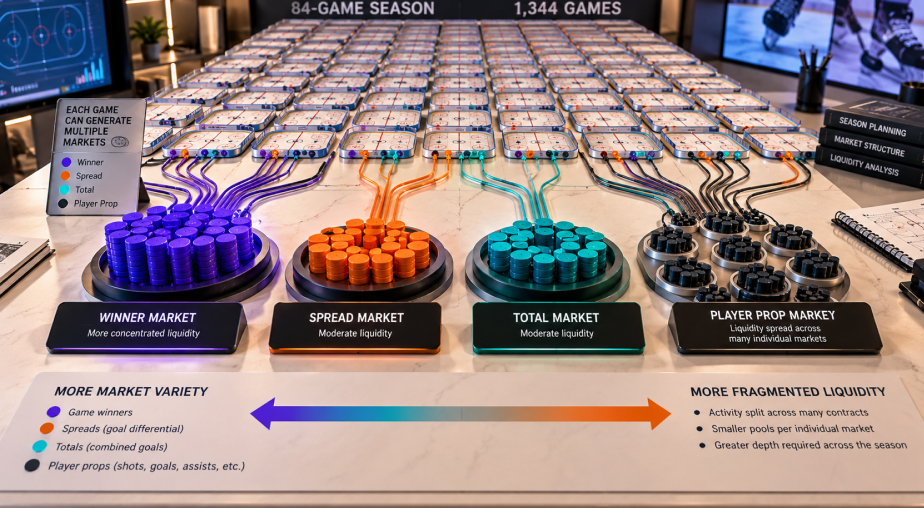
The league says the 2026–27 campaign contains 1,344 games, with every team playing 42 at home and 42 on the road.
The NHL’s schedule analysis notes that the season spans 194 days and includes 185 game days.
All 32 teams will play on October 13 and again on the April 10 regular-season finale.
That volume gives prediction exchanges thousands of opportunities to observe which NHL contracts attract sustained participation.
Winner markets may concentrate the most liquidity.
Spreads and totals may appeal to participants already familiar with sportsbook structures.
Props can create deeper engagement around individual players but may divide liquidity across many more outcomes.
The market itself will provide information about which formats participants actually use.
Hockey Creates Specific Pricing Challenges
NHL games are not simply lower-scoring versions of basketball or football.
The sport has characteristics that can affect market behavior.
Scoring is relatively infrequent.
Goaltenders have an unusually large influence on results.
Power plays temporarily change the number of skaters on the ice.
Empty-net situations late in games can rapidly change both the score and the total.
Overtime and shootout structures create additional settlement considerations depending on how a particular contract defines the final result.
That means seemingly simple contracts still require precise rules.
For a winner contract, participants need to understand what constitutes the settlement result.
For totals and spreads, the treatment of overtime can matter.
For props, the definition and official source of a statistic become particularly important.
Props Make Official Data More Important
Player-stat contracts depend heavily on reliable data.
A final score is generally straightforward.
Individual statistics can be corrected.
Shots can be reclassified.
Assists can change after official review.
Other statistics may depend on league definitions.
That makes the designated settlement source important.
A prediction market needs rules explaining which source determines the result and what happens if a statistic is corrected.
The issue becomes more significant as contracts become increasingly granular.
A game-winner market may need only the official final result.
A player-stat market can depend on the official classification of a specific event during the game.
The more precise the contract, the more precise the settlement rules need to become.
Prediction Markets and Sportsbooks Can Ask the Same Question Differently
The NHL filings demonstrate why the sportsbook-versus-prediction-market comparison is becoming more complicated.
Originally, the difference could appear obvious.
Sportsbooks offered sports bets.
Prediction markets offered event contracts.
That distinction becomes less intuitive when both products revolve around whether an NHL team wins, covers a specified scoring condition or exceeds a total.
The most important differences increasingly sit beneath the surface.
They include how prices are created, who provides liquidity, how fees work, what regulatory framework applies, how contracts settle and how market participants interact.
Two interfaces can therefore ask almost the same hockey question while representing different market structures.
Price Discovery Is the Key Structural Difference
In a traditional sportsbook model, the operator establishes the available price.
The sportsbook can adjust that price as information and customer activity change.
Its margin is incorporated into the market.
An exchange-style prediction market is designed around trading.
Participants can place orders at different prices.
Buyers and sellers interact.
The market price can move as new information changes their willingness to trade.
That does not automatically make one structure cheaper or more accurate than the other.
A liquid prediction market can potentially create competitive pricing.
A thin prediction market can produce a wide spread.
A sportsbook may offer a strong price in one market and a weaker one in another.
Meaningful comparisons therefore require examining actual executable prices and costs rather than assuming one product structure always produces better value.
Fees Matter as Much as the Headline Price
Prediction-market comparisons can become misleading when they look only at displayed probabilities.
Transaction fees can change the effective cost of a trade.
So can bid-ask spreads.
A sportsbook price similarly contains an implied margin.
The relevant comparison is therefore not simply:
prediction-market percentage versus sportsbook probability.
A more complete analysis considers the cost of entering the position, the cost of exiting when applicable, liquidity available at the displayed price and the rules governing settlement.
That becomes particularly important for props, where individual markets may attract less activity than headline winner contracts.
Opening Night Will Immediately Provide High-Profile Events
The September 29 opening schedule gives the new NHL season immediate national exposure.
The Hurricanes will raise their championship banner before hosting Florida.
The Rangers-Bruins game brings together two Original Six teams.
Chicago visits the Western Conference champion Vegas Golden Knights.
The NHL’s U.S. broadcast plan also creates substantial visibility throughout the season. The league says ESPN’s 2026–27 package contains 100 exclusive games, while NHL Power Play on the ESPN App will provide more than 1,050 out-of-market games.
That combination of a larger schedule and extensive streaming availability gives hockey prediction markets a significant number of nationally visible events.
It also creates more opportunities for markets to react rapidly to injuries, starting-goaltender decisions, lineup changes and other information.
The NHL Is Part of a Much Broader Expansion
LEX’s NHL filings should not be viewed in isolation.
The CFTC database shows the same exchange certifying Liga MX Winner, Total, Spread and Prop products on September 16.
Earlier filings cover comparable structures across other sports.
That suggests a broader product strategy: build a common family of winner, spread, total and prop contracts, then apply the framework across different leagues.
From a market-design perspective, that is significant.
Prediction exchanges do not need to invent an entirely new question for every sport.
They can increasingly translate familiar sports-market categories into standardized event-contract structures.
Familiar Markets Could Reduce the Learning Curve
One obstacle for prediction markets has been consumer understanding.
A Yes contract trading at a certain price may be intuitive to experienced exchange users but unfamiliar to someone accustomed to American odds.
Winner, spread, total and prop categories reduce part of that learning curve because the underlying sporting questions are already familiar.
A hockey fan may not immediately understand an order book.
But the fan probably understands the difference between predicting a winner and predicting whether the teams combine for more than a specified number of goals.
The market category is familiar even when the trading mechanism is not.
That could become important as prediction exchanges compete for sports-focused users.
Familiarity Does Not Eliminate Contract Complexity
The similarity can also create confusion.
A prediction contract that resembles a sportsbook total should not automatically be assumed to follow identical rules.
Settlement definitions may differ.
Fees may differ.
Availability may differ by platform or jurisdiction.
Trading may continue under different conditions.
Users therefore need to read the actual contract terms rather than assuming that a familiar label guarantees familiar mechanics.
That is particularly important with player props and statistical markets.
The word “prop” describes a broad category, not a universal settlement standard.
The New NHL Season Will Test Whether Depth Produces Liquidity
The September 22 filings represent another stage in the rapid expansion of sports event contracts.
The more important question will emerge after September 29.
Can prediction markets sustain meaningful trading across NHL winners, spreads, totals and props simultaneously?
If most activity concentrates in winner contracts, the sportsbook-style expansion may prove broader on paper than in actual market depth.
If spreads, totals and props develop consistently active order books, the distinction between the visible menus of prediction exchanges and sportsbooks will narrow further.
The structural differences underneath those menus will remain important.
Prediction markets rely on contract trading and price discovery.
Sportsbooks operate through bookmaker pricing and risk management.
But for the hockey fan looking at the screen, the categories are becoming increasingly recognizable.
The 2026–27 NHL season will therefore test more than a new group of hockey contracts.
It will test whether prediction markets can reproduce the depth of a sportsbook menu while still functioning effectively as markets.