

The 2026 US Open did more than crown new champions at the USTA Billie Jean King National Tennis Center in New York.
It also marked a significant change in how one of America’s biggest sporting events interacts with prediction markets.
On August 31, Kalshi announced a multi-year agreement with the United States Tennis Association that made the company the first official prediction-market partner of the US Open. The agreement began with the 2026 tournament and gives Kalshi exclusivity within the prediction-market category.
The partnership brought prediction markets directly into the commercial environment of a Grand Slam at a time when event contracts are becoming increasingly important across American sports.
It also established an integrity framework that may prove more consequential than the sponsorship itself.
Kalshi and the USTA agreed to restrictions on certain tennis markets, while Kalshi established a data-sharing relationship with the International Tennis Integrity Agency. The company says it will not offer US Open markets tied to umpire decisions, injuries or code violations.
That combination—commercial integration alongside explicit restrictions—makes the agreement an important case study for how prediction markets could become more closely connected with professional sports without treating every possible event as appropriate for trading.
Kalshi Became the US Open’s Exclusive Prediction-Market Partner
The agreement was finalized unusually close to the tournament.
Front Office Sports reported that the US Open had originally expected to explore prediction-market partnerships for 2027 and beyond, rather than sign one for 2026.
Those plans changed during the final stages of preparation for the tournament.
According to Front Office Sports’ reporting on the agreement, discussions with several prediction-market companies had focused heavily on match-integrity concerns. The eventual Kalshi agreement was not formally completed until after qualifying had concluded.
New USTA CEO Craig Tiley reportedly played an important role in getting the partnership completed for the 2026 event.
Kalshi formally announced the multi-year relationship on August 31.
The result was a notable first for the tournament: a prediction exchange became an official commercial partner while matches were already underway in Flushing Meadows.
The Partnership Goes Beyond Stadium Advertising
The agreement includes conventional sports-sponsorship elements.
Kalshi branding appeared on screens and signage around the US Open grounds, and the company received opportunities for fan activations and tournament-related content.
But the longer-term plans are more interesting from a market perspective.
According to Kalshi’s partnership announcement, the company plans to integrate real-time prediction-market information more deeply into US Open coverage.
Potential uses include match previews, draw analysis, daily recaps and tournament probability information.
That would move the relationship beyond sponsorship visibility.
Prediction-market prices could become another form of sports data presented alongside scores, statistics and conventional analysis.
Tennis Trading Volume Has Grown 25-Fold
Kalshi provided one particularly significant number when announcing the agreement.
The company said tennis trading volume on its platform had increased 25 times year over year.
That is a company-reported figure rather than independently audited industry-wide tennis volume, but it illustrates why prediction exchanges are increasingly interested in the sport.
Tennis has several characteristics that suit continuously traded event contracts.
Matches resolve relatively quickly.
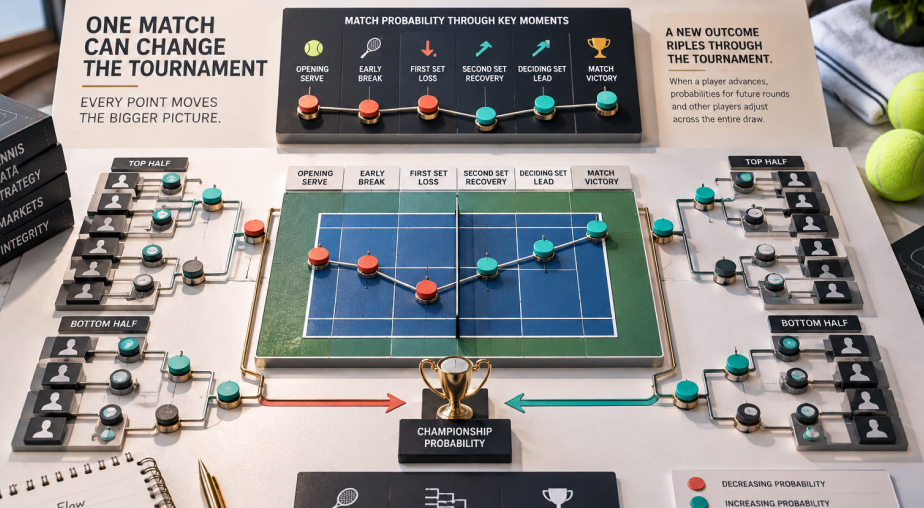
Major tournaments contain many simultaneous events.
Probabilities can change substantially during individual matches.
And every round alters the probabilities for tournament-level markets.
A Grand Slam effectively produces a constantly evolving network of related markets.
Tennis Is Naturally Suited to Live Probability Markets
Consider a tournament winner market.
Before the first round, dozens of players can have some probability of winning the title.
Then the tournament begins.
One contender loses unexpectedly.
Another struggles through five sets.
A leading player advances comfortably.
Weather changes playing conditions.
A player progresses into a more favorable part of the draw.
Every development changes the information available to market participants.
Prediction exchanges can process those changes continuously.
Instead of waiting for a bookmaker to publish another set of prices, participants place orders against one another and market prices move as buyers and sellers respond.
That makes tennis especially suitable for visible price discovery.
Every Point Can Change the Market
The process becomes even more dynamic within a match.
A player might begin as the favorite.
Losing an early service game can reduce that player’s implied probability.
Winning the next set can reverse the movement.
A deciding-set break can transform the market again.
Kalshi argues that these changing contract prices provide a continuously updated view of collective expectations.
That does not mean a prediction-market price is guaranteed to represent the true probability of an outcome.
Markets can be affected by liquidity, spreads, participant behavior and available information.
But sufficiently active markets can provide another real-time signal for interpreting how expectations change.
For readers comparing market prices, our explanation of how sportsbooks price favorites and underdogs provides useful context for understanding the relationship between price and implied probability.
The 2026 Tournament Provided Plenty of Probability Shocks
The 2026 US Open demonstrated exactly why tennis markets can change rapidly.
The tournament ended on September 13 with Alexander Zverev defeating American Ben Shelton 6-3, 7-6(2), 5-7, 6-2 in the men’s singles final.
Zverev’s victory gave him his second Grand Slam championship of 2026 after winning Roland Garros earlier in the year.
The women’s tournament produced another major result.
Elena Rybakina defeated Aryna Sabalenka 6-4, 5-7, 6-2 to win her first US Open singles championship.
Those finals were only part of a tournament filled with changing expectations.
The official US Open tournament statistics show that the event produced 71 deciding sets and 106 tiebreaks.
Twenty-eight men’s matches went to five sets.
That kind of volatility creates repeated opportunities for probabilities to move as matches develop.
The Integrity Agreement Is the Most Important Part
The commercial partnership attracted attention, but its integrity provisions may have greater long-term significance.
Tennis has spent years developing systems designed to identify suspicious wagering and protect competitions from manipulation.
Adding prediction exchanges creates another source of trading information that integrity organizations can potentially monitor.
Kalshi said its agreement with the USTA includes a framework based on data sharing, education and market surveillance.
The company also established a data-sharing agreement with the International Tennis Integrity Agency.
That means unusual market activity can potentially become visible to the organization responsible for protecting professional tennis from corruption.

Kalshi Agreed Not to Offer Certain US Open Markets
The agreement also establishes boundaries around what can be traded.
Kalshi said it will not offer markets tied to:
- umpire decisions,
- player injuries,
- code violations.
Those exclusions are important.
Prediction markets theoretically allow contracts to be constructed around an enormous range of measurable events.
But not every measurable event is equally appropriate for trading.
An umpire decision could involve an individual official.
A code violation could depend on discretionary enforcement.
An injury-related market could create uncomfortable incentives around sensitive information concerning a player’s physical condition.
By excluding those categories, the partnership acknowledges that expanding prediction markets does not require turning every possible tennis event into a tradable contract.
Tennis Already Has a Dedicated Anti-Corruption Framework
The US Open agreement does not begin with a blank regulatory slate.
Professional tennis already operates under the Tennis Anti-Corruption Program.
The International Tennis Integrity Agency administers the program to protect professional tennis against corruption and betting-related offenses.
Its rules apply to players, coaches, officials and other covered individuals.
The ITIA can receive information from betting operators, regulators and data suppliers when investigating suspicious activity.
Prediction-market data can therefore become another information source within an existing integrity structure rather than creating an entirely separate monitoring system.
Market Surveillance Matters More as Contracts Become Granular
The need for surveillance increases as prediction markets become more detailed.
A simple tournament-winner contract depends on a highly visible result.
Everyone knows who wins the US Open.
More granular markets can create different integrity considerations.
Individual sets, games and player-related events resolve more frequently and may involve information that is less widely distributed.
The closer a market moves toward highly specific events, the more important reliable data and surveillance become.
That is one reason the USTA-Kalshi agreement could serve as a useful model for future sports partnerships.
It combines access to markets with explicit limits.
The US Open Deal Could Be the First of Several Tennis Partnerships
Other American tennis tournaments were already receiving prediction-market interest shortly after the agreement was announced.
Front Office Sports reported on September 3 that officials associated with the Cincinnati Open, BNP Paribas Open at Indian Wells and DC Open had received interest or entered exploratory discussions involving prediction-market partnerships.
The timing was significant.
Those conversations became public only days after the US Open agreement.
Cincinnati Open tournament director Bob Moran told the publication that prediction markets were among several emerging commercial categories showing interest in the tournament.
A BNP Paribas Open spokesperson confirmed that the tournament was open to a prediction-market partnership and had begun exploratory conversations.
That suggests the US Open agreement may represent the beginning of a broader commercial trend rather than an isolated sponsorship.
Official Partnerships Can Give Exchanges More Than Branding
For prediction-market companies, sports partnerships provide several potential benefits.
The most obvious is visibility.
A Grand Slam provides global exposure.
But official relationships can also provide access to more reliable information, integrity cooperation and opportunities to integrate market data into sports coverage.
Those elements can be more valuable than a logo on a stadium screen.
Prediction exchanges depend on settlement accuracy.
If a contract settles using an official result, reliable data becomes essential.
Fast, authoritative information also matters for live markets because delays can create pricing discrepancies between participants.
That helps explain why prediction-market companies are increasingly building relationships not only with teams and tournaments but also with sports-data providers.
Kalshi Is Building a Larger Sports Infrastructure
The US Open partnership did not happen in isolation.
On August 5, Kalshi and Genius Sports announced a separate agreement covering official sports data, marketing and integrity services.
That agreement includes official real-time data across Genius Sports’ soccer portfolio, including competitions such as the Premier League, Serie A, Liga MX, Ligue 1 and Argentina’s Primera División.
Later in August, Kalshi announced partnerships with five Major League Baseball teams: the Atlanta Braves, Boston Red Sox, Los Angeles Dodgers, San Diego Padres and San Francisco Giants.
The US Open agreement therefore fits into a broader strategy.
Prediction markets are moving closer to the institutions that produce sports themselves.
Tennis Creates a Different Market From Team Sports
Tennis nevertheless offers something structurally different from baseball or football.
There are no permanent teams controlling the primary competitive unit.
Players move through elimination brackets.
One loss generally ends a singles player’s tournament.
That creates interconnected probabilities.
If a major contender is eliminated early, the championship probabilities of several remaining players can increase immediately.
The draw also matters enormously.
Two strong players positioned to meet in a quarterfinal create a different probability structure from the same players appearing on opposite sides of the bracket.
Prediction markets can reflect those changes continuously.
Tournament Futures and Match Markets Serve Different Purposes
A tournament winner contract can remain open for days or weeks.
A single-match contract resolves much faster.
Those products can attract different forms of participation.
Tournament futures involve longer-term expectations.
Match markets respond more directly to immediate information.
Live markets can change point by point.
This creates multiple layers of price discovery within one tournament.
For an event such as the US Open, all three can operate simultaneously.
That depth helps explain why Kalshi describes tennis as one of its fastest-growing sports categories.
The 2026 US Open Was an Enormous Commercial Platform
The partnership also occurred at an event with substantial economic scale.
The US Open awarded $108 million in prize money in 2026, according to official tournament figures.
The men’s and women’s singles champions each received $5.5 million, the largest singles winner payout in tournament history.
The previous year’s tournament had attracted 1,144,562 attendees, demonstrating the scale of the audience available to sponsors before the 2026 partnership was signed.
Fan engagement continued growing this year.
During 2026 Fan Week alone, US Open digital platforms recorded more than 6.3 million visits and 42.3 million page views, with page views increasing 35% year over year.
Official social channels generated 711 million interactions, up 276% from 2025.
For a prediction-market company seeking mainstream sports visibility, that audience is difficult to replicate.
Sponsorship Does Not Make Market Prices Certain
Greater visibility also makes responsible presentation important.
Prediction-market prices are estimates produced through trading.
They are not guarantees.
A contract priced as though an outcome has a 70% probability still represents an uncertain event.
Tennis makes that particularly obvious.
A heavily favored player can be eliminated.
Momentum can change rapidly.
Markets can also be wrong.
Liquidity and spreads affect how informative a displayed price actually is.
The US Open partnership should therefore not be interpreted as tournament endorsement of any particular prediction or trading outcome.
It is a commercial and integrity relationship between the USTA and Kalshi.
Prediction Markets Are Becoming Part of Sports Media
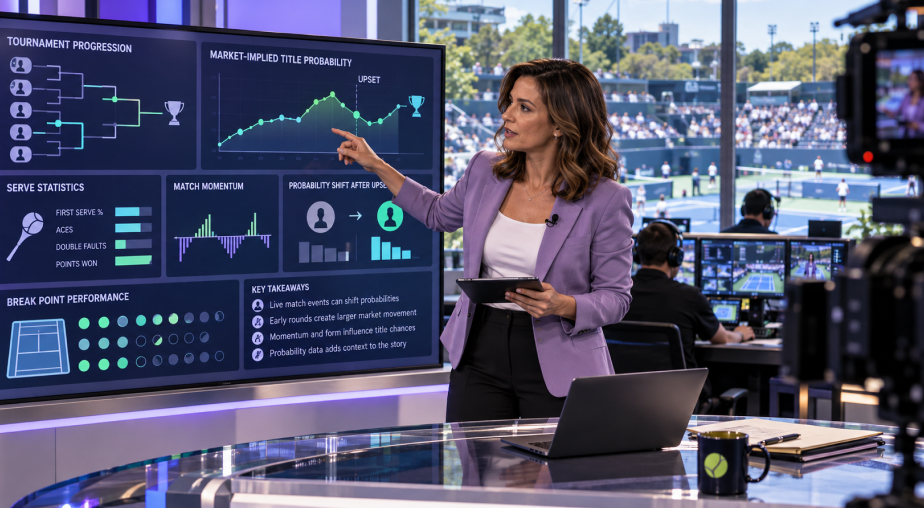
The next stage may involve market probabilities appearing more frequently inside sports coverage itself.
Kalshi has said that future US Open integrations could incorporate real-time market information into match previews, draw breakdowns and recaps.
That would put prediction-market prices alongside conventional statistics.
A broadcaster might discuss serve percentage, break points and historical head-to-head records while also showing how the market’s estimated probability changed during a match.
Used carefully, that information can function as another analytical signal.
Used without context, it can make financial speculation appear indistinguishable from ordinary sports statistics.
The distinction will become increasingly important as these partnerships expand.
Integrity Will Determine Whether the Model Spreads
The commercial incentive for prediction-market partnerships is clear.
Exchanges gain visibility.
Sports organizations gain another sponsorship category.
Fans receive additional data and interactive products.
But integrity remains the limiting factor.
Tennis has historically faced significant betting-related corruption risks, particularly outside its most visible tournaments.
Any expansion of tradable sports outcomes therefore creates legitimate questions about market surveillance, sensitive information and appropriate contract design.
The US Open agreement addresses those concerns directly by combining market restrictions with information sharing.
Whether that framework proves effective will matter well beyond Flushing Meadows.
The US Open Partnership Is a Test for the Rest of Tennis
Kalshi’s arrival at the 2026 US Open represents more than another sponsor entering Arthur Ashe Stadium.
It is a test of whether prediction markets can become an official part of professional tennis while operating within meaningful integrity boundaries.
The early signs already extend beyond New York.
Other U.S. tennis tournaments are discussing the category.
Prediction-market companies are investing in official sports data.
Exchanges are forming direct relationships with teams and leagues.
And tennis trading volume on Kalshi, according to the company, has increased 25-fold year over year.
The crucial development is therefore not simply that the US Open signed a prediction-market company.
It is the structure of the relationship.
Kalshi gained commercial access and visibility, but the agreement also excludes sensitive market categories and connects trading surveillance with the sport’s established integrity infrastructure.
That combination could become increasingly important as prediction markets move deeper into American sports.
The 2026 US Open has now provided one of the clearest examples of what that future could look like: prediction markets becoming part of the sports-data and sponsorship ecosystem while tournaments simultaneously define where the boundaries should be.