

The competitive structure of U.S. sports wagering is changing faster than it did during the first years after nationwide sports betting expansion began.
Traditional sportsbooks remain enormous. DraftKings, FanDuel, Fanatics, BetMGM and other state-regulated operators continue to process billions of dollars in wagers, particularly during football season.
But they no longer have the same share of the broader sports-wagering ecosystem.
According to data reported by Axios on September 21, 2026, traditional sportsbooks accounted for approximately 76% of U.S. sports wagering in 2023. During the first half of 2026, that share had fallen to roughly 64% as prediction-market platforms including Kalshi, Polymarket and Novig expanded their sports products.
The shift does not establish that prediction markets simply took 12 percentage points directly from sportsbooks. The two sectors measure activity differently, operate through different regulatory structures and have expanded during a period when the overall market has also changed substantially.
Still, the direction is significant.
Prediction markets are no longer a peripheral competitor to U.S. sportsbooks. They are becoming another major channel through which Americans interact with sports outcomes.
And the beginning of the 2026 NFL season is accelerating that competition.
Sportsbooks’ Share Fell From 76% to 64%
The most important number in the latest market data is the change in share.
Axios reported that sportsbooks represented approximately 76% of U.S. sports wagering in 2023.
By the first half of 2026, that figure had declined to approximately 64%.
That represents a 12-percentage-point change in three years.
The development coincides with the rapid expansion of sports event contracts on federally regulated prediction exchanges and other prediction-market platforms.
Kalshi has become particularly important.
Sports now account for the overwhelming majority of its activity. In a September 15 report on Kalshi’s partnership with the U.S. Hispanic Chamber of Commerce, Axios reported that approximately 80% of Kalshi’s trading volume since July 2024 has involved sports.
Prediction markets may have originated as tools for pricing elections, economics, weather and other public events, but sports have increasingly become their primary volume engine.
Prediction Markets Are No Longer Primarily About Elections
The popular image of prediction markets was shaped by politics.
Election contracts attracted media attention because they converted political expectations into constantly changing market probabilities.
Sports have changed the scale of the business.
Unlike presidential elections, NFL games happen every week.
Baseball produces games almost every day.
College football creates large Saturday slates.
Basketball and hockey produce months of recurring events.
Soccer can generate enormous activity around tournaments such as the 2026 FIFA World Cup.
Each event can also support several different contract structures.
A football game does not need to produce only one market asking which team wins. Platforms can create contracts around scoring totals, margins, player outcomes, quarters, halves and combinations of multiple events.
That creates far more opportunities for transactions.
Football Is Accelerating the Shift
The beginning of the 2026 NFL season demonstrated how important sports have become to prediction exchanges.
Kalshi generated record activity during the opening NFL weekend, including approximately $4.89 billion in reported trading volume across September 12 and September 13.
The wider prediction-market industry generated at least $5.83 billion during that opening weekend, according to Aldrin Research data reported by Barron’s.
Those figures should not be interpreted as sportsbook-equivalent handle.
Prediction contracts can change hands multiple times before settlement, and notional volume can become particularly large in complex combo products.
Nevertheless, the scale demonstrates substantial participation.
Football has given prediction markets a recurring source of high-volume events capable of attracting both retail participants and professional liquidity providers.
The Sportsbook Market Is Showing Signs of Maturity
Prediction markets are expanding at the same time conventional sportsbook growth is becoming more difficult.
The American Gaming Association estimated on September 4 that Americans will legally wager approximately $29.5 billion through state-regulated commercial sportsbooks during the 2026 NFL season.
Its estimate for the previous season was approximately $29.4 billion.
That implies essentially no year-over-year growth.
The AGA explicitly argues that prediction markets are diverting activity from the state-regulated sportsbook system. It estimates that sports event-contract platforms have displaced more than $1.3 billion in potential state gaming tax revenue since 2025.
That is the trade association’s estimate and policy position rather than a neutral measurement of proven substitution.
There are other explanations for slower sportsbook growth.
The U.S. regulated market is simply more mature than it was several years ago.
Many of the largest states that permit online sports betting already have established markets. Operators have accumulated large customer bases, and the explosive growth generated by opening entirely new jurisdictions becomes harder to reproduce.
Prediction markets are therefore entering the sports business at a moment when conventional sportsbooks are naturally moving into a more mature phase.
Market Share Does Not Automatically Prove Cannibalization
The distinction matters.
If sportsbook share falls from 76% to 64%, it is tempting to conclude that prediction markets took the entire difference.
That is too simplistic.
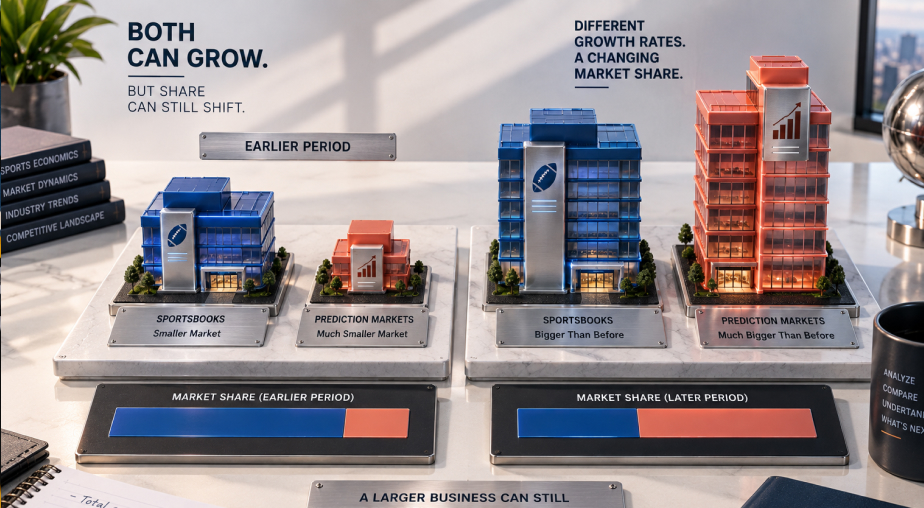
Market share can decline even when the underlying business continues growing.
Imagine a sportsbook sector increasing from $100 to $110 while a new prediction-market sector grows from $20 to $60.
The sportsbook is larger than before.
Its share of the combined market is nevertheless smaller.
That is why market-share data must be analyzed alongside absolute handle, revenue and customer activity.
The 64% figure demonstrates a changing competitive balance.
It does not independently demonstrate how many sportsbook dollars migrated to prediction markets.
Prediction-Market Volume and Sportsbook Handle Remain Different Metrics
Comparisons become even more difficult because the two industries do not measure activity identically.
Sportsbook handle generally represents money wagered.
A $100 conventional wager normally contributes $100 to handle.
Prediction markets operate through tradable contracts.
A participant can purchase a contract and later sell it to another participant. That contract can continue trading before the event resolves.
Each transaction can contribute to trading volume.
Multi-leg contracts create additional complications because a relatively small amount of committed capital can represent much larger notional exposure.
As a result, “$1 billion of prediction-market volume” and “$1 billion of sportsbook handle” do not necessarily represent the same economic activity.
This is particularly important when assessing claims about market share.
Kalshi Shows How Quickly Prediction-Market Scale Has Changed
Even after accounting for those measurement differences, Kalshi’s growth illustrates the structural shift.
Independent market-data tracking showed Kalshi approaching approximately $180 billion in year-to-date reported trading volume by September 20, although that figure includes categories beyond sports and is based on notional exchange volume rather than sportsbook-style handle.
Sports have consistently represented the largest component of activity.
The company’s category mix also includes politics, economics, weather, finance and entertainment, while combo-style products can fall into separate classifications depending on the dataset.
That matters because sports are not simply another vertical inside the prediction-market industry.
They increasingly appear to be the product category capable of producing the industry’s largest recurring volumes.
More Competition Is Emerging Around Kalshi
Kalshi’s scale does not mean the market is becoming a one-platform industry.
Competition is expanding.
Polymarket has continued building its U.S. presence.
Novig is marketing aggressively around sports.
DraftKings has entered prediction markets through its own exchange strategy.
Robinhood distributes event contracts through multiple underlying exchange relationships.
Fanatics has integrated prediction markets more closely with its broader sports betting ecosystem.
This creates a fundamentally different competitive structure from the early U.S. online sportsbook market.
The question is no longer simply whether FanDuel or DraftKings has the largest sportsbook share.
The customer can increasingly encounter similar sports outcomes through several different product architectures.
Fanatics Is Combining Betting and Prediction Markets
Fanatics provides one of the clearest examples.
On September 2, the company launched a unified Fanatics Sports & Casino application designed to combine sportsbook, casino and prediction-market access while changing available products according to the customer’s location and applicable law.
Existing customer information, balances, FanCash and Fanatics One status can carry across the integrated experience.
Fanatics Betting and Gaming CEO Matt King told Axios that prediction markets helped drive the decision to combine the products.
That is strategically important.
The competition between sportsbooks and prediction markets does not necessarily require companies to choose one side.
Major gambling operators can participate in both.
DraftKings Is Following the Same Broader Direction
DraftKings has also expanded beyond its conventional sportsbook model.
The company has developed prediction-market infrastructure while retaining its enormous state-regulated sportsbook operation.
That allows the business to address different geographic and regulatory environments.
In states with conventional mobile sports betting, the sportsbook remains central.
Prediction products can create additional opportunities elsewhere, subject to federal rules, exchange availability and continuing legal disputes.
This hybrid strategy may become increasingly common.
Rather than sportsbooks disappearing because prediction markets grow, established operators may simply absorb prediction-market products into larger sports-finance ecosystems.
Geography Is One of Prediction Markets’ Biggest Advantages
Traditional U.S. sportsbooks operate state by state.
A company needs regulatory approval in each jurisdiction, and sports betting remains unavailable or restricted in several major states.
Prediction exchanges operate under a different theory.
CFTC-regulated designated contract markets argue that event contracts fall under federal commodities jurisdiction rather than individual state sports-wagering laws.
That distinction has allowed sports event contracts to reach customers in places where conventional mobile sportsbooks cannot legally operate.
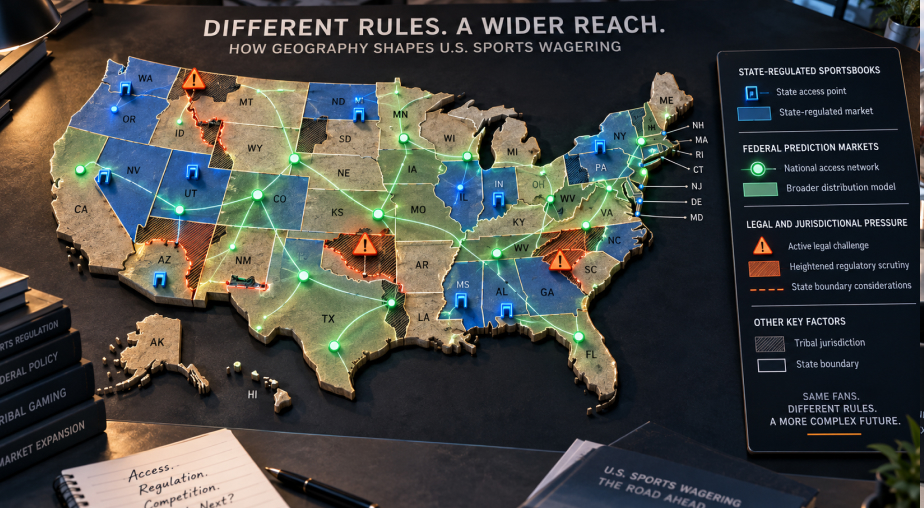
California is the obvious example.
The state has no legal statewide online sportsbook market.
Yet prediction-market sports contracts have been offered there under the federal framework.
For an operator trying to build national scale, that difference is enormously valuable.
The Geographic Advantage Is Also Under Legal Pressure
The same advantage creates prediction markets’ biggest risk.
States and tribal gaming interests have challenged the idea that federally regulated sports event contracts can bypass state and tribal gambling laws.
A major development came on September 16, when the U.S. Court of Appeals for the Ninth Circuit revived important claims brought by Blue Lake Rancheria and Chicken Ranch Rancheria of Me-Wuk Indians involving Kalshi’s activities on tribal lands.
The ruling did not produce a nationwide prohibition on sports prediction markets.
But it reinforced the unresolved conflict between federal commodities regulation, state gambling authority and tribal gaming rights.
That uncertainty means the prediction-market share gains reported today are not guaranteed to continue under the same regulatory conditions.
Sportsbooks Still Have Important Structural Advantages
Prediction markets have geographic reach and rapidly growing liquidity.
Sportsbooks retain advantages of their own.
The largest operators have mature risk-management systems, established customer bases and years of experience pricing complex sports products.
Same-game parlays are a particularly important example.
Recent NFL Week 1 analysis found that Kalshi could compete aggressively with FanDuel and DraftKings on some straight markets.
The same analysis found sportsbooks retaining stronger pricing on sampled multi-leg products.
That reflects years of investment in correlated-outcome pricing.
Sportsbooks also operate within established state gaming frameworks containing detailed rules covering advertising, consumer protection, responsible gambling, dispute resolution and operator licensing.
For many customers, those protections and familiar interfaces remain important.
Pricing Is Becoming a More Important Competitive Battleground
As the products become more similar, price becomes increasingly important.
The recent NFL Week 1 comparison from Citizens JMP found Kalshi’s blended implied vig at approximately 4.32% across a sample of moneylines and totals.
FanDuel measured approximately 4.44%.
DraftKings was approximately 4.51%.
Those differences were small.
That is exactly why they matter.
Prediction markets are now sufficiently liquid that comparisons with leading sportsbooks can come down to fractions of a percentage point in some categories.
For readers interested in how these margins develop, our analysis of sportsbook pricing for favorites and underdogs explains how implied probability and operator margin interact in conventional betting markets.
Customer Acquisition Is Becoming More Aggressive
Market competition is also appearing in advertising.
Prediction-market platforms are increasingly using the same strategies that helped sportsbooks build their U.S. customer bases after the 2018 Supreme Court decision that struck down the federal PASPA restriction.
Celebrity endorsements are becoming more visible.
Novig has launched advertising featuring Sydney Sweeney, while other prediction platforms have pursued sports partnerships, media integrations and high-profile ambassadors.
Axios described the current advertising push as resembling the promotional competition that followed the initial expansion of legal sportsbooks.
The strategy makes sense.
Liquidity depends on participation.
More customers create more orders.
More orders can attract market makers.
Deeper liquidity can improve pricing.
Advertising therefore contributes indirectly to market quality as well as customer acquisition.
Sportsbooks Are Responding Rather Than Retreating
The sportsbook industry is not standing still.
Operators can respond through improved promotions, loyalty programs, integrated wallets, better pricing and their own prediction-market products.
Fanatics’ unified application is one example.
DraftKings’ prediction-market expansion is another.
Flutter, the parent company of FanDuel, has also participated in prediction-market infrastructure through market-making activity.
These developments blur what previously looked like a clear dividing line.
A company can operate a sportsbook in one market, distribute prediction products in another and provide liquidity to an exchange at the same time.
The future may therefore involve convergence rather than a simple winner-takes-all battle.
Regulation Could Determine the Long-Term Market Split
Product quality alone will not decide the competition.
Courts, regulators and legislatures could be equally important.
The CFTC oversees federally regulated derivatives exchanges.
State gaming commissions oversee conventional sportsbooks.
Tribal gaming authorities and tribal nations have separate legal interests protected through federal law and gaming compacts.
These systems were not originally designed to overlap as extensively as they do today.
Sports event contracts have forced them together.
If courts ultimately establish broad federal authority for sports prediction markets, exchange-based products could maintain access to jurisdictions unavailable to sportsbooks.
If state or tribal challenges substantially restrict those contracts, the competitive balance could move back toward conventional gaming operators.
That makes regulatory uncertainty a central part of any market-share analysis.
Consumer Protections Are Part of the Competition
The debate also extends beyond economics.
The American Gaming Association argues that state-regulated sportsbooks operate under stronger gambling-specific consumer protections than prediction exchanges.
Prediction-market operators emphasize their federal regulatory status and argue that event contracts belong within the commodities framework.
Both positions reflect competing regulatory models.
For consumers, practical protections matter regardless of terminology.
Platforms offering sports-related products should make fees, settlement conditions and risks understandable.
Responsible-gambling controls become more important as trading frequency and product complexity increase.
This is especially relevant when sports products include rapid markets and large combinations capable of encouraging repeated participation.
The 64% Figure Is a Starting Point, Not a Verdict
The decline from approximately 76% sportsbook share in 2023 to 64% during the first half of 2026 is meaningful.
But it should not be interpreted as proof that traditional sportsbooks are collapsing.
They remain the dominant part of the U.S. sports-wagering ecosystem under the Axios measurement.
The AGA still expects approximately $29.5 billion in legal NFL sportsbook handle during the current season.
Prediction markets, meanwhile, are growing from a much smaller base and use different measurements of trading activity.
The important development is not that one model has replaced the other.
It is that the U.S. market now has two increasingly significant structures competing around many of the same sporting events.
The Next Battle Is Over the Customer Interface
That competition could ultimately become less visible to customers.
Fanatics is already combining products.
Robinhood presents event contracts through a brokerage interface while using multiple underlying exchange relationships.
DraftKings is developing both sportsbook and prediction-market businesses.
The logical endpoint is an application that determines which products are available based on location, regulation and market structure while keeping the customer inside one ecosystem.
That would represent a major shift.

Instead of customers choosing between “a sportsbook” and “a prediction market,” they may increasingly choose a platform that provides several forms of sports-market access.
The infrastructure underneath could become more complicated while the consumer experience becomes simpler.
Sports Wagering Is Entering a Hybrid Era
The fall in sportsbook market share from 76% to 64% captures something larger than a fight between Kalshi and DraftKings.
The structure of U.S. sports wagering is becoming more diverse.
State-regulated sportsbooks remain enormous.
Prediction markets are generating unprecedented sports trading activity.
Traditional betting companies are launching prediction products.
Brokerages are distributing event contracts.
Market makers are operating across both systems.
And customers increasingly encounter similar sports outcomes through products governed by different regulatory frameworks.
The biggest uncertainty is whether the current shift represents permanent market restructuring or a temporary period of regulatory arbitrage and rapid experimentation.
Football season will provide more evidence.
So will the courts.
For now, the most defensible conclusion is narrower but still significant: traditional sportsbooks still lead U.S. sports wagering, but prediction markets have become large enough that the competitive landscape can no longer be understood through sportsbook handle alone.