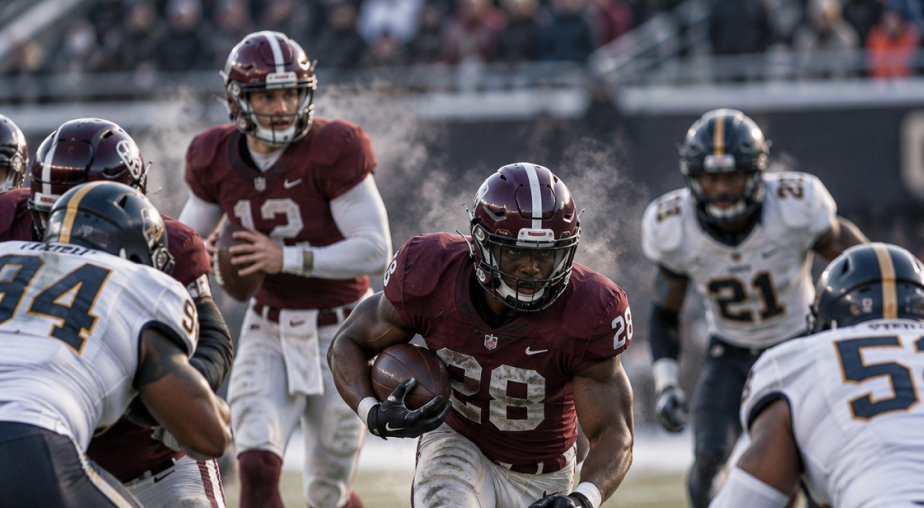
The 2026 NFL season began with a 13-10 defensive struggle between the Seattle Seahawks and New England Patriots.
Four days later, the league had produced one of the most explosive opening weeks in modern American football history.
By the time the Kansas City Chiefs completed a 31-10 victory over the Denver Broncos at Arrowhead Stadium on September 14, the NFL’s 32 teams had combined for 791 points in Week 1.
That total tied the Super Bowl-era Week 1 scoring record established in 2012.
Across 16 games, teams combined to average 49.4 points per contest. The 13 Sunday games were even more extreme, averaging 53.3 points, the highest figure for a Week 1 Sunday in league history.
The weekend included Chicago scoring 59, Baltimore reaching 41, Minnesota producing 39 and Buffalo scoring 36. Six Sunday games finished with at least 60 combined points.
Most extraordinary of all was the Chicago Bears’ 59-37 victory over the Carolina Panthers in Charlotte, a 96-point game that established another NFL Week 1 record.
One weekend cannot establish a season-long trend.
But after league scoring had already climbed from 21.8 points per team per game in 2023 to 23.0 in 2025, the extraordinary start to 2026 raises a legitimate question.
Is the NFL entering another offense-heavy period? Read here about our Live Betting Pricing Before Major Events report.
The 791-Point Record Has Stood Since 2012
The significance of 791 points comes partly from how long the previous record survived.
The 2012 opening week originally established the mark, surpassing the previous record of 788.
Fourteen seasons later, the 2026 schedule finally matched it.
According to NFL Research, teams entered the Monday night Denver-Kansas City game averaging exactly 50 combined points per contest.
The Chiefs and Broncos added 41 more, leaving the final average at 49.4.
What makes the total especially striking is the way the week started.
Seattle’s 13-10 win over New England in the Super Bowl LX rematch produced only 23 points.
The rest of the schedule had to compensate dramatically.
It did.
Chicago and Carolina alone produced 96.
Baltimore beat Indianapolis 41-23.
Buffalo defeated Houston 36-31.
Cincinnati beat Tampa Bay 33-27.
Detroit edged New Orleans 31-30 in overtime.
Minnesota defeated Green Bay 39-22.
Rather than one statistical outlier carrying the week, high-scoring games appeared throughout the schedule.

Chicago And Carolina Produced 96 Points By Themselves
No game captured the weekend better than Bears-Panthers at Bank of America Stadium.
Chicago scored 59 points, its highest total in a game since 1980.
Carolina scored 37 and still lost by 22.
The combined 96 points established the highest-scoring Week 1 game in NFL history, surpassing Tampa Bay’s 48-40 victory over New Orleans in 2018.
Chicago’s offensive balance was particularly revealing.
Quarterback Caleb Williams completed 21 of 29 passes for 269 yards, throwing two touchdowns without an interception. He also became the first player in Bears history to combine at least 200 passing yards, two passing touchdowns, 50 rushing yards and two rushing touchdowns in the same game.
The ground attack was even more destructive.
Chicago rushed 39 times for 291 yards and six touchdowns.
D’Andre Swift accounted for 124 rushing yards and three touchdowns on 18 carries, while Kyle Monangai also passed 100 yards.
Those numbers complicate the idea that an offense-heavy NFL necessarily means a pass-only NFL.
Chicago overwhelmed Carolina both through quarterback creation and an extraordinarily productive running game.
The full NFL Week 1 breakdown showed just how unusual the performance was.
Modern offense is becoming difficult to define by one method.
That may be precisely why it is becoming difficult to defend.
Baltimore And Buffalo Added Different Versions Of Offensive Pressure
Chicago was not alone.
The Baltimore Ravens opened their season with a 41-23 victory over the Indianapolis Colts at Lucas Oil Stadium.
Baltimore scored 31 points before halftime.
That kind of early production changes the entire tactical structure of a game. Opponents become less able to remain patient with the running game, defensive fronts can attack predictable passing situations and the leading offense gains greater control over tempo.
Buffalo’s 36-31 victory in Houston demonstrated another version of the modern NFL.
Josh Allen threw for more than 300 yards and two touchdowns without an interception while also rushing for two scores.
The ability of quarterbacks such as Allen and Baltimore’s Lamar Jackson to threaten defenses with both their arms and legs forces coordinators to defend more possibilities with the same 11 players.
Traditional defensive arithmetic becomes difficult.
Adding a defender to stop the run can create favorable passing matchups.
Playing lighter personnel to defend space can create opportunities on the ground.
Using aggressive pressure can expose lanes for mobile quarterbacks.
The league’s best offenses increasingly force defenses to choose which problem they are most willing to tolerate.
Minnesota Showed How Quickly Modern NFL Games Can Change
One of the most remarkable sequences occurred during Minnesota’s 39-22 victory over Green Bay.
The Vikings scored 22 points in 2 minutes, 46 seconds of game time during the fourth quarter.
That kind of scoring acceleration illustrates another feature of the modern league.
NFL games can change extremely quickly.
Explosive plays, turnovers, aggressive fourth-down decisions, quarterback mobility and sophisticated passing concepts can turn a competitive game into a multi-score margin within minutes.
This does not mean defenses have become irrelevant.
It means defensive mistakes have become more expensive.
When offenses are designed to attack space and create explosive plays, one missed assignment can be worth seven points rather than seven yards.
League Scoring Was Already Rising Before Week 1
The opening weekend did not occur in complete isolation.
Season-long NFL scoring had already been moving upward again after declining earlier in the decade.
According to Pro Football Reference’s season-by-season scoring data, teams averaged:
| Season | Points Per Team Per Game |
|---|---|
| 2022 | 21.9 |
| 2023 | 21.8 |
| 2024 | 22.9 |
| 2025 | 23.0 |
| 2026 Week 1 | 24.7* |
*The 2026 figure is based only on the opening week and should not be treated as a full-season average.
The broader trend is therefore more interesting than the Week 1 record by itself.
Scoring fell below the unusually offense-friendly 2020 season, when teams averaged 24.8 points per game, but began climbing again in 2024 and remained elevated in 2025.
Week 1 of 2026 pushed that direction further.
The important question is whether it will persist once defensive coordinators accumulate current-season film and begin adapting.
The Running Game Is Part Of The Offensive Evolution
For years, the NFL’s offensive revolution was often described primarily as a passing revolution.
That explanation is becoming less complete.
The 2025 season provided substantial evidence that rushing remained central to many successful offenses.
Buffalo recorded 30 rushing touchdowns. Indianapolis had 27. Baltimore produced 23, while Jacksonville and the New York Giants each reached 22.
Chicago then opened 2026 with six rushing touchdowns in one afternoon.
Kansas City offered another example on Monday night.
New Chiefs running back Kenneth Walker III rushed for a career-high 173 yards, including a 60-yard touchdown, in Kansas City’s 31-10 victory over Denver.
Walker also caught a two-yard touchdown pass from Patrick Mahomes.
The result suggests offensive innovation is not simply about throwing more often.
Modern teams increasingly use formation, motion and quarterback threats to manipulate defensive spacing before attacking whichever area becomes vulnerable.
Sometimes that produces a deep pass.
Sometimes it creates an enormous rushing lane.
Pre-Snap Motion Has Become A Language Of Its Own
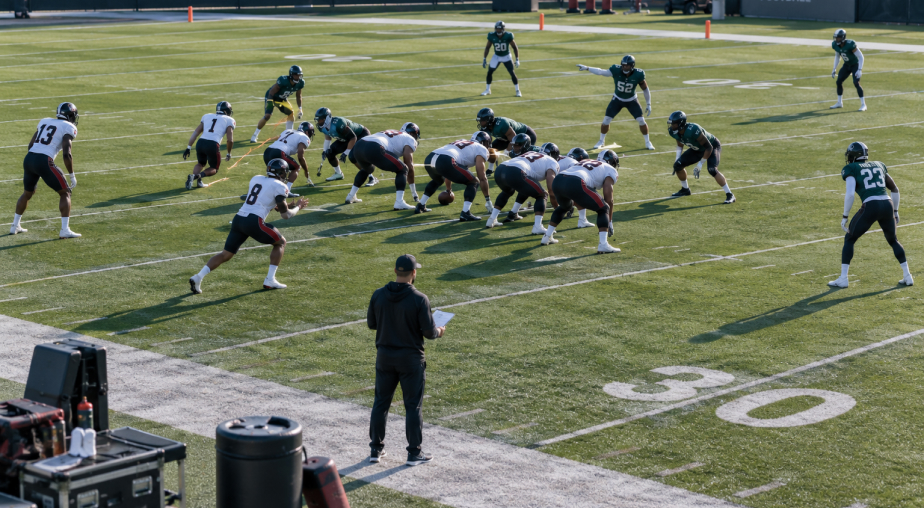
One reason NFL offenses have become increasingly difficult to diagnose is what happens before the ball is snapped.
The league’s Next Gen Stats program now classifies 19 advanced motion types, including jet, orbit, fly, glide and exit motion.
NFL data showed league-wide motion usage reaching a new high before the 2025 season.
That matters because motion serves multiple purposes.
It can reveal whether a defense is playing man or zone coverage.
It can force defenders to communicate immediately before the snap.
It can change leverage.
It can create favorable blocking angles.
It can move a receiver away from press coverage.
It can make one concept appear to be another.
The physical talent of NFL players has always been extraordinary.
The tactical challenge for defenses is that those athletes are increasingly being placed into advantageous situations before the play even begins.
Quarterback Mobility Changes The Mathematics
The traditional pocket passer has not disappeared.
But mobility is now integrated into far more NFL offenses.
That does not necessarily mean quarterbacks are running 15 times per game.
The threat itself can change defensive behavior.
A quarterback capable of escaping the pocket can punish man coverage when defensive backs turn their backs.
Zone-read concepts can force an edge defender to choose between the quarterback and running back.
Designed quarterback runs create an additional blocker because the offense does not need to account for the ball carrier in the same way as a conventional handoff.
Scrambling also transforms failed passing plays into first downs.
Allen and Jackson represent elite versions of that profile, but the influence extends much further across the league.
Williams’ performance against Carolina showed how damaging the combination can become.
Defenses were not simply trying to stop his passing.
They had to account for him as another rushing threat.
Offensive Coaches Are Attacking Space Rather Than Positions
Another important change is how NFL offenses conceptualize personnel.
Running backs catch passes.
Tight ends align in the slot.
Receivers move into the backfield.
Quarterbacks become rushing threats.
Multiple players can shift before the snap.
The objective is to force the defense to reveal its structure and then attack the resulting space.
That flexibility makes traditional positional labels less useful.
An offense might line up with what appears to be heavy personnel before spreading the same players across the formation.
A defense built to stop the run can suddenly find itself defending the entire width of the field.
The reverse can happen against lighter defensive personnel.
The NFL’s tactical competition increasingly revolves around creating those conflicts.
Defenses Will Have Their Response
There is an important reason not to overreact to 791 points.
It was Week 1.
Defensive coordinators entered the season with limited current film on new personnel combinations, new offensive coordinators and offseason schematic changes.
Offenses had months to prepare specific opening-game concepts.
Defenses now have evidence.
They can study Chicago’s running structure.
They can examine how Kansas City used Walker.
They can adjust coverage rules against motion.
They can change pressure packages.
They can identify tendencies that were invisible before the season began.
The NFL is a league of rapid adaptation.
An offensive concept that appears revolutionary in September can become much less effective by November once opponents understand its rules.
That is why Week 1 should be viewed as evidence, not proof, of a permanent scoring transformation.
The 2012 Comparison Is A Useful Warning
There is another reason for caution.
The league already scored 791 points in Week 1 once before.
That happened in 2012.
The existence of the previous record demonstrates that a spectacular opening weekend does not automatically represent a completely new form of football.
Scoring can be affected by matchups, turnovers, weather, defensive mistakes, injuries and unusual individual performances.
Chicago-Carolina alone contributed 96 points to the total.
Remove an extreme game like that and the overall picture becomes less dramatic.
But the record still matters because the scoring was distributed across several games rather than isolated entirely in Charlotte.
Six Sunday matchups reached at least 60 combined points.
That breadth makes the opening weekend more difficult to dismiss as one anomaly.
2020 Remains The More Important Season-Long Benchmark
If 2026 is going to become a genuinely historic offensive season, the more meaningful comparison may eventually be 2020 rather than 2012.
NFL teams averaged 24.8 points per game in 2020, one of the highest modern scoring levels.
The league then moved downward.
The average fell to 23.0 in 2021, 21.9 in 2022 and 21.8 in 2023 before recovering to 22.9 in 2024 and 23.0 in 2025.
That sequence demonstrates how quickly the balance between offense and defense can change.
A full season is long enough for injuries, weather and tactical countermeasures to reshape what works.
The 2026 opening weekend is therefore best understood as the first data point in a much larger test.
High Scoring Does Not Mean Defense Is Disappearing
The most interesting interpretation of Week 1 is not that defense no longer matters.
It may be the opposite.
When offensive systems become more efficient, defensive performance becomes more valuable because stopping an opponent becomes harder.
Seattle’s 13-10 victory over New England suddenly looks unusual beside the rest of the weekend.
Pittsburgh allowed only 13 points against Atlanta.
The Jets held Tennessee to 10.
Arizona allowed the Chargers 14.
Those performances existed during the same opening week that produced the scoring record.
That contrast reinforces the idea that the NFL is not uniformly offense-dominated.
Some defenses still controlled games.
The separation between effective and ineffective units may simply be becoming more visible.
Week 2 Will Begin Testing The Theory
The next stage is adaptation.
Detroit and Buffalo open Week 2 on September 17 after combining for 67 points in their respective opening games.
Chicago will face Minnesota after those teams scored 59 and 39 points in Week 1.
Baltimore hosts New Orleans.
Kansas City faces Indianapolis.
Those games will provide the first indication of whether the opening scoring surge can survive a week of defensive adjustments.
Nobody should expect another 791 points simply because it happened once.
But another unusually high-scoring slate would strengthen the argument that the league’s offensive direction is more than a one-week anomaly.
The NFL May Be Becoming More Offense-Heavy, but The Evidence Is Just Beginning
Week 1 delivered almost everything an offense-first league could produce.
There were 791 points.
There was a 96-point game.
Chicago scored 59.
Baltimore scored 41.
Minnesota scored 39.
Buffalo and Houston combined for 67.
Running backs produced explosive performances.
Mobile quarterbacks stressed defenses in multiple ways.
Pre-snap movement continued to complicate defensive identification.
And yet the season is only one week old.
The strongest conclusion is therefore not that defense has lost the NFL’s tactical battle.
It is that offenses opened 2026 with an unusually powerful demonstration of how many different ways they can attack.
Passing remains central, but it is being combined with quarterback mobility, revived rushing attacks, motion, formation flexibility and increasingly sophisticated methods of manipulating space.
Defenses will respond.
They always do.
Whether they respond quickly enough will determine if 791 points becomes a memorable opening-week anomaly—or the first sign that the NFL’s offensive evolution has entered another high-scoring phase.