

Prediction markets produced a remarkable headline in July 2026: $50.59 billion in combined monthly trading volume across Kalshi, Polymarket and Polymarket US.
It was an all-time high.
The total increased 7.8% from $46.95 billion in June, while Kalshi alone processed $37.7 billion. Polymarket US grew 54% month over month to $5 billion, providing another indication that event contracts are moving deeper into the American sports and financial mainstream.
Those numbers deserve attention.
They also require context.
July included the closing stages of the 2026 FIFA World Cup, which ended on July 19 after 104 matches across the United States, Canada and Mexico. The tournament became an extraordinary liquidity event for prediction markets, concentrating millions of users around globally recognized sporting outcomes.
Dune data shows that Kalshi and Polymarket generated approximately $19 billion in World Cup notional volume alone through July 20.
When the tournament ended, however, another metric moved sharply in the opposite direction.
Open interest fell.
That divergence between record turnover and declining outstanding positions makes July more complicated than a simple story of uninterrupted prediction-market growth.
The World Cup demonstrated that event exchanges can generate enormous sports activity. It did not establish that $50 billion months have become the industry’s new normal.
July Set a Prediction-Market Record
The headline figures are significant even after accounting for the tournament effect.
According to The Block’s July prediction-market data, Kalshi, Polymarket and Polymarket US combined for $50.59 billion in monthly trading volume.
The individual platforms moved in very different directions.
| Platform | July 2026 Volume | Change From June |
|---|---|---|
| Kalshi | $37.7 billion | +14% |
| Polymarket | $7.9 billion | -26% |
| Polymarket US | $5.0 billion | +54% |
| Combined | $50.59 billion | +7.8% |
Kalshi accounted for approximately 74.5% of the combined total.
That concentration is arguably as important as the record itself.
Prediction markets collectively became larger in July, but the growth was not evenly distributed across competing venues.
Kalshi strengthened its position substantially.
Polymarket’s international platform contracted.
Polymarket US grew quickly from a smaller base.
Those differences show why treating prediction markets as one homogeneous industry can obscure important changes occurring underneath the headline number.
$50.59 Billion Does Not Mean $50.59 Billion Was Deposited
The definition of volume is especially important.
Prediction-market trading volume is not directly comparable to customer deposits, company revenue or even conventional sportsbook handle without understanding how the metric is constructed.
Event contracts can change hands multiple times before settlement.
A participant can purchase a contract and later sell the same position. Another trader can acquire it and subsequently exit as well.
Each transaction contributes to turnover.
As a result, $50.59 billion in monthly trading volume does not mean customers deposited $50.59 billion of new money during July.
Nor does it mean prediction platforms earned anything close to $50 billion in revenue.
This distinction becomes increasingly important as prediction-market statistics enter mainstream sports coverage.
High turnover can demonstrate substantial activity and potentially strong liquidity.
It does not necessarily demonstrate an equivalent increase in new capital or unique customers.
The number is meaningful.
It simply measures something more specific than the headline can imply.
The World Cup Was an Extraordinary Liquidity Event
The 2026 World Cup helps explain why July became so large.
The tournament ran from June 11 through July 19 and created an almost ideal environment for event trading.
There were 104 matches.
Games occurred frequently.
National teams attracted enormous international audiences.
Every knockout-stage match carried immediate consequences.
Outright championship markets remained active while individual game markets continuously opened and resolved.
The result was extraordinary turnover.
According to Dune’s World Cup prediction-market analysis, Kalshi and Polymarket generated approximately $19 billion in combined World Cup notional volume through July 20.
Kalshi produced approximately $13.6 billion, around 2.5 times Polymarket’s $5.4 billion.
The platforms also showed different trading patterns.
Kalshi generated considerably more match-level volume, while Polymarket’s outright tournament-winner market became particularly large.
That difference is useful because it demonstrates that identical sporting events can produce very different market structures depending on the platform.
One World Cup Final Produced Extraordinary Turnover
The final between Spain and Argentina demonstrates how concentrated the activity became.
Kalshi’s market around the championship match reportedly generated approximately $1.9 billion in trading volume.
One game therefore accounted for a substantial amount of activity.
That is exactly why July needs to be interpreted carefully.
A major championship can create conditions that ordinary sports calendars rarely reproduce.
Millions of people are watching the same event.
The number of relevant markets contracts as the tournament advances.
Attention becomes increasingly concentrated.
Liquidity follows that attention.
By the final, prediction-market participation that had previously been distributed across dozens of national teams and games was focused on one championship event. This article is more than 1 month old
Fifa to announce record $15bn World Cup revenue, smashing expectations.
That is very different from a normal week in which users divide their attention among baseball, football, basketball futures, politics, economics, cryptocurrency and dozens of other event categories.
Open Interest Tells a Different Story
The most important counterweight to July’s record volume may be open interest.
Trading volume measures how much activity occurs.
Open interest measures positions that remain outstanding.
The two metrics answer different questions.
A market can generate enormous turnover while traders repeatedly enter and exit positions. Open interest provides another indication of how much exposure remains active at a particular moment.
During the World Cup, both increased.
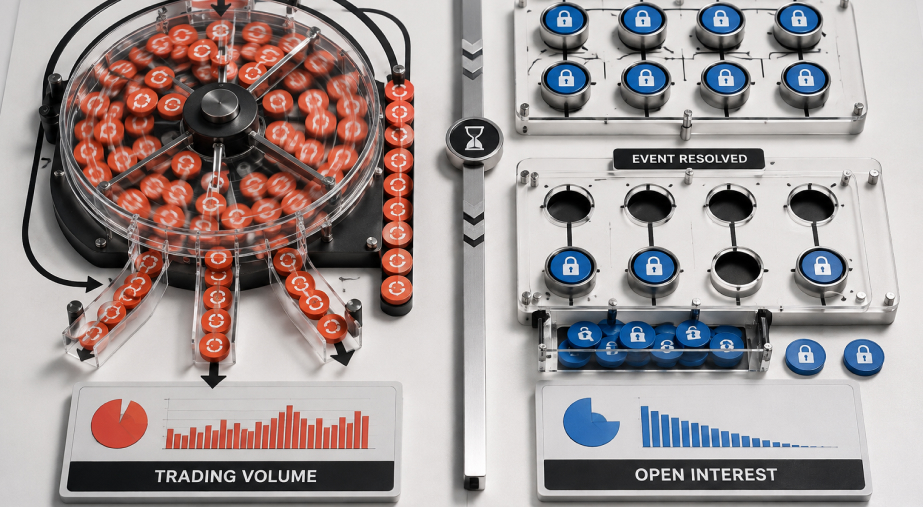
After the tournament ended, however, open interest declined.
Reporting based on The Block’s data showed combined open interest across the major prediction platforms falling from approximately $2 billion near the beginning of July to around $1.2 billion by the end of the month.
That is roughly a 40% decline.
Some of that decrease is entirely logical.
World Cup contracts had to settle when the tournament finished.
Outstanding positions tied to eliminated teams, individual matches and the eventual champion naturally disappeared.
The decline therefore does not demonstrate that prediction markets suddenly lost 40% of their underlying audience.
It does demonstrate something more important for interpreting the record: July contained an unusually large number of major contracts reaching resolution within a concentrated period.
The World Cup Created a Distortion, Not Fake Growth
Calling the World Cup effect a distortion does not mean July’s growth was artificial.
The trading occurred.
The liquidity was real.
The customers participating in those markets were real.
The distinction concerns extrapolation.
Suppose a retailer generates its highest monthly revenue ever during December.
The record is genuine.
But analysts would hesitate to multiply December revenue by 12 and describe the result as the company’s normal annual run rate.
Prediction markets face a similar problem after the World Cup.
July demonstrates what these platforms can process when global sports attention becomes exceptionally concentrated.
It does not tell us what an ordinary month looks like without that catalyst.
That question now becomes considerably more important.

Kalshi’s 74.5% Share May Be More Important Than the Record
One of July’s most revealing numbers is 74.5%.
That was approximately Kalshi’s share of the $50.59 billion combined total.
Its $37.7 billion represented a 14% increase from June.
That matters because prediction exchanges can benefit from liquidity concentration.
A market containing more buyers and sellers can potentially offer greater depth and tighter differences between available buy and sell prices.
Those characteristics can attract additional participation.
That creates a potential feedback loop:
more liquidity attracts traders, additional traders create more liquidity, and deeper markets can make the platform more useful.
Kalshi’s July performance therefore was not simply about generating the largest headline volume.
It potentially strengthened the platform’s competitive position heading into the next major American sports cycle.
The NFL season will test whether that advantage persists. Kalshi Brings Wall Street-Grade Data Feeds to Prediction Markets via DoubleZero.
Polymarket’s Two Platforms Moved in Opposite Directions
Polymarket’s July numbers tell a more complicated story.
The international platform generated approximately $7.9 billion, down 26% from June.
Polymarket US reached approximately $5 billion, up 54%.
Combined, the two operations generated about $12.9 billion compared with approximately $14 billion in June.
The overall Polymarket ecosystem therefore contracted despite strong U.S. growth.
That distinction matters.
Polymarket US operates within the U.S. regulated exchange framework and removed its initial waitlist restrictions earlier in 2026, expanding domestic availability.
The 54% monthly increase suggests substantial momentum.
But it came from a much smaller base than Kalshi.
The next several months will show whether Polymarket US can continue closing that gap once the World Cup effect disappears.
Prediction Markets Need a Post-World Cup Baseline
August becomes particularly informative because it is the first full month after the tournament.
The key question is not whether volume falls below July.
A decline would hardly be surprising.
The more useful question is where activity stabilizes.
If prediction markets retain a substantial portion of World Cup participation, the tournament may have permanently expanded their customer base.
If activity returns rapidly toward pre-tournament levels, July will look more like an exceptional sports cycle.
There is also a third possibility.
World Cup activity may decline temporarily before the NFL creates another major increase.
That would suggest prediction markets are becoming strongly seasonal around major sporting events rather than maintaining consistent activity throughout the year.
For sports-market analysts, that distinction matters.
Seasonal liquidity behaves differently from persistent liquidity.
The NFL Is the Next Major Experiment
The 2026 NFL season provides an unusually useful test.
Football is America’s most important recurring sports-betting product.
Unlike the World Cup, however, the NFL distributes attention across months.
A typical Sunday can contain more than a dozen games.
Thursday Night Football and Monday Night Football extend the weekly cycle.
Division, conference and Super Bowl markets remain open between games.
Player and roster developments can create additional event contracts.
That structure tests whether prediction markets can create habitual participation.
Our analysis of the 2026 NFL prediction-market arms race examines why Kalshi, Polymarket, DraftKings and FanDuel increasingly see football as the next major competitive battleground.
The NFL does not need to reproduce July’s $50.59 billion immediately to validate sports prediction markets.
More important would be consistent weekly liquidity from September through the playoffs.
World Cup Liquidity Was Highly Concentrated
Another issue is the distribution of activity within the tournament itself.
Not every World Cup market generated billions.
The largest games and championship markets attracted disproportionate attention.
That pattern matters when evaluating future sports categories.
A prediction platform can advertise hundreds of markets, but the presence of a market does not guarantee meaningful liquidity.
The real test is whether enough participants gather around both sides of an outcome to produce useful price discovery.
Major World Cup matches had that advantage.
Less prominent events may not.
This distinction becomes especially important when comparing prediction-market prices with sportsbook odds.
A liquid market can incorporate information rapidly.
A thin market can be moved substantially by relatively modest orders.
The displayed probability alone does not reveal the difference.
Volume and Price Quality Are Not the Same Metric
Record trading volume also does not automatically mean prediction markets produced better forecasts.
Volume measures activity.
Price quality is a separate question.
A market’s usefulness depends on factors including depth, bid-ask spreads, participant diversity, available information and how efficiently new information enters the price.
A heavily traded contract may produce strong price discovery.
But large turnover by itself cannot prove that.
This is particularly relevant in sports because markets can become heavily influenced by public attention.
Championship events attract recreational participants alongside sophisticated traders.
Popular teams can generate disproportionately high interest.
Breaking news can produce rapid repricing.
Evaluating prediction-market efficiency therefore requires looking beyond monthly volume totals.
Sportsbooks and Prediction Markets Measure Activity Differently
The World Cup also produced frequent comparisons between prediction-market trading and traditional sportsbook handle.
Those comparisons require caution.
Sportsbook handle generally represents money wagered with an operator.
Prediction-market notional volume measures contracts traded.
Because contracts can change hands repeatedly, the same underlying position can contribute to turnover more than once.
That does not make one metric superior.
It means they measure different market structures.
A direct headline comparison between $19 billion of prediction-market notional volume and a particular amount of sportsbook handle can therefore create a misleading impression unless those definitions are explained.
The important takeaway from the World Cup is not that prediction markets definitively became “bigger than sportsbooks.”
It is that event exchanges demonstrated the ability to process sports trading at a scale that would have appeared extraordinary only a few years earlier.
Regulation Still Sits Behind the Growth Story
July’s numbers also occurred while the legal status of sports prediction markets remained contested.
Kalshi and other regulated exchanges maintain that qualifying event contracts fall under the federal derivatives framework overseen by the Commodity Futures Trading Commission.
Multiple state gaming regulators have challenged that interpretation when contracts resemble conventional sports wagering.
Court decisions have not produced one uniform national answer.
That creates uncertainty around future growth.
A market can generate enormous volume today while still facing questions about where specific sports contracts may legally be offered tomorrow.
Prediction-market companies therefore have to grow liquidity while simultaneously defending the regulatory model that makes broad distribution possible.
That tension will continue through football season.
Responsible Participation Matters as Markets Scale
Record volume also means more people are interacting with products whose risks may not be familiar to conventional sports bettors.
Prediction contracts can look simple.
A contract priced at 60 cents appears to communicate a straightforward probability.

But users still need to understand settlement rules, transaction costs, available liquidity and the possibility of losing the full amount committed to a position.
The ability to sell before settlement can also create the impression that an exit will always be available at an attractive price.
That depends on market depth.
As sports prediction markets become more mainstream, clear risk disclosures and responsible-play controls become increasingly important.
Growth should not be measured only by turnover.
Market quality and consumer safeguards matter as well.
July Proved Scale, Not Sustainability
The July record should neither be dismissed nor accepted uncritically.
$50.59 billion in combined trading volume is substantial.
Kalshi’s $37.7 billion month demonstrates extraordinary growth.
Polymarket US increasing 54% to $5 billion shows meaningful expansion in the regulated U.S. market.
And approximately $19 billion in World Cup trading confirms that major sports can generate enormous event-contract liquidity.
But the simultaneous fall in open interest after the tournament provides an essential counterpoint.
The World Cup concentrated global attention into 104 matches and ended with one championship event capable of generating extraordinary turnover.
That environment cannot simply be projected across the rest of the calendar.
August, the NFL season and eventually Super Bowl LXI will provide more useful evidence about the industry’s underlying baseline.
If prediction markets retain World Cup users and build recurring football liquidity, July may eventually look like the beginning of a new scale for sports event trading.
If activity repeatedly rises and falls around major tournaments, the industry may instead develop into an event-driven marketplace whose biggest numbers depend heavily on exceptional sports moments.
Either outcome would still represent significant growth.
But they describe very different businesses.
July proved prediction markets can become enormous when the right event concentrates attention.
The next phase must prove they can remain large after the event disappears.