

The 2026 NFL season will take regular-season football farther from the United States than any previous campaign.
The league has scheduled a record nine international games across four continents, seven countries and eight stadiums. Melbourne, Rio de Janeiro and Paris will host NFL regular-season games for the first time, while London, Madrid, Munich and Mexico City return to the international rotation.
For sportsbooks and bettors, the expansion creates more than a collection of neutral-site games. It introduces unusually long travel, body-clock disruption, unfamiliar venues, altitude, different playing surfaces, compressed preparation windows and uncertainty about how much traditional home-field advantage should be included in a point spread.
These factors are real, but they are not automatic betting systems. Sportsbooks know where the games will be played and can adjust their models months before kickoff. The analytical challenge is determining which international variables materially affect team performance and which narratives receive more attention than their actual value supports.
The 2026 International Schedule Sets a New NFL Record
The NFL’s official international schedule begins on September 10 with the San Francisco 49ers and Los Angeles Rams meeting at the Melbourne Cricket Ground in Australia.
That Week 1 game will be followed by eight additional international matchups extending through November 22. Sixteen teams will participate, with San Francisco and Jacksonville each appearing twice.
| Week | Matchup | City and Venue | U.S. Eastern Kickoff |
|---|---|---|---|
| Week 1, September 10 | San Francisco 49ers vs. Los Angeles Rams | Melbourne Cricket Ground, Melbourne | 8:35 p.m. |
| Week 3, September 27 | Baltimore Ravens vs. Dallas Cowboys | Maracanã Stadium, Rio de Janeiro | 4:25 p.m. |
| Week 4, October 4 | Indianapolis Colts vs. Washington Commanders | Tottenham Hotspur Stadium, London | 9:30 a.m. |
| Week 5, October 11 | Philadelphia Eagles vs. Jacksonville Jaguars | Tottenham Hotspur Stadium, London | 9:30 a.m. |
| Week 6, October 18 | Houston Texans vs. Jacksonville Jaguars | Wembley Stadium, London | 9:30 a.m. |
| Week 7, October 25 | Pittsburgh Steelers vs. New Orleans Saints | Stade de France, Paris | 9:30 a.m. |
| Week 9, November 8 | Cincinnati Bengals vs. Atlanta Falcons | Bernabéu Stadium, Madrid | 9:30 a.m. |
| Week 10, November 15 | New England Patriots vs. Detroit Lions | FC Bayern Munich Arena, Munich | 9:30 a.m. |
| Week 11, November 22 | Minnesota Vikings vs. San Francisco 49ers | Estadio Banorte, Mexico City | 8:20 p.m. |
The scale is important because international scheduling is no longer a minor exception affecting one or two teams. Nine games represent more than half of a normal NFL week and create schedule-related questions across division, playoff and season-win markets.
International exposure also stretches beyond Europe. The 2026 schedule includes games in eight time zones, with Melbourne producing the most extreme adjustment ever required for a regular-season NFL matchup.
Melbourne Creates the Largest Body-Clock Challenge
The 49ers-Rams game in Melbourne is the most unusual matchup on the schedule.
The game will begin at 10:35 a.m. local time on Friday, September 11, but at 8:35 p.m. Eastern on Thursday night in the United States. The two West Coast teams must cross the International Date Line, adjust to a time difference of approximately 17 hours and prepare for an opponent from their own division in a completely unfamiliar environment.
Both teams face the same destination, but identical travel does not necessarily mean identical impact.
The timing of departure, sleep management, practice schedule and ability to adapt after arrival could influence preparation. One team may travel earlier and conduct several local practices, while another may prefer to remain on its normal routine for longer.
Sportsbooks cannot fully price those operational choices when opening numbers are first posted because teams do not always announce detailed travel plans months in advance.
The game is also a divisional matchup. San Francisco and Los Angeles know each other well, reducing uncertainty about schemes and personnel. That familiarity may partially offset the unusual location because neither team must spend the week preparing for a completely unfamiliar opponent.
The risk is that bettors overstate jet lag simply because the distance is unprecedented. Travel is an obvious narrative, but both organizations have access to sports-science staff, charter transportation and an extended planning window.
The location should influence analysis. It should not automatically determine which side offers value.

International Games Reduce Traditional Home-Field Certainty
NFL international games still designate one team as the home side, but that label does not produce the same conditions as playing in the team’s regular stadium.
The designated home team may lose familiar facilities, normal sideline routines, local weather knowledge and a crowd dominated by season-ticket holders. In exchange, it may retain control over certain operational details and attract support through existing international marketing rights.
Crowd composition is especially difficult to predict.
The Jacksonville Jaguars have built a long-term presence in London and will play their 15th and 16th international games in 2026. Entering the season, Jacksonville had a 7-7 international record, all in London. Trevor Lawrence was scheduled to make his seventh and eighth international starts, the most by any quarterback in league history.
That experience may make London feel less neutral for Jacksonville than it does for the Philadelphia Eagles or Houston Texans. The Jaguars understand the logistics, practice arrangements and venue environment better than most franchises.
However, familiarity is not the same as a fixed point-spread advantage. The opponent’s quality remains more important, and public bettors may overvalue Jacksonville’s international history after seeing it repeatedly highlighted in pregame coverage.
The broader issue is that a standard home-field adjustment becomes less reliable. The site’s guide to how home-field advantage changes by sport explains why venue value should be estimated from specific conditions rather than treated as a universal number.
For an international NFL game, bettors must consider crowd composition, travel, familiarity and venue quality separately.
Jacksonville’s Consecutive London Games Create a Different Test
Jacksonville will face Philadelphia at Tottenham Hotspur Stadium in Week 5 and Houston at Wembley Stadium in Week 6.
Playing consecutive games in the same city removes one of the largest disadvantages associated with international travel. The Jaguars can remain in London rather than flying back to Florida and then returning to Europe.
That should reduce travel strain before the second game, but it creates other questions.
The team will spend an extended period away from its normal training facility and personal routines. Players and staff must manage two separate opponents while remaining in temporary accommodation. The second game will also be played at a different stadium.
The Jaguars selected a Week 7 bye following the two London fixtures. The New Orleans Saints will take a bye after their Paris game, while the New England Patriots will rest after playing in Munich.
NFL historical analysis cited by the league found that teams which played immediately after an international game had a 27-21 record in the following matchup. Teams taking an immediate bye were 36-39-1 in their first game after returning.
Those records challenge the assumption that an immediate bye always produces a competitive advantage.
A broader academic analysis of NFL rest differentials also found no significant modern advantage from the standard bye week or mini-bye. The researchers concluded that the effect had declined following changes introduced by the 2011 collective bargaining agreement.
That does not prove rest is irrelevant. It indicates that bettors should be cautious about assigning a large automatic value to a post-international bye.
Mexico City Adds Altitude to the Travel Equation
The November 22 game between Minnesota and San Francisco will be played at Estadio Banorte in Mexico City.
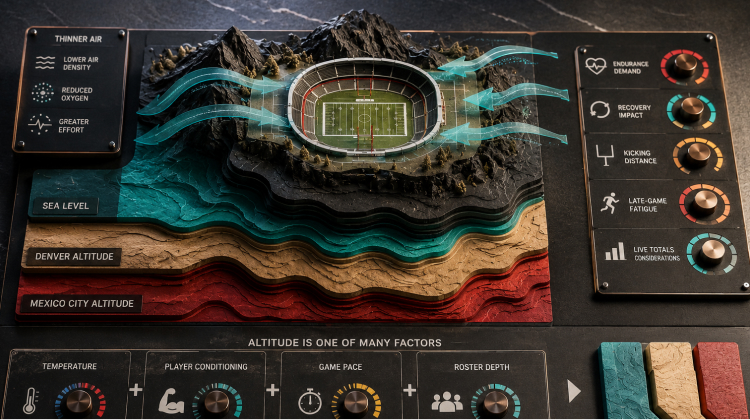
Altitude creates a physical variable that does not exist in London, Paris or Madrid. The stadium sits at approximately 7,382 feet above sea level, around 2,000 feet higher than the Denver Broncos’ home stadium.
Thinner air may affect endurance, recovery and kicking distance. Players who are not acclimated can experience greater physical strain, particularly during sustained drives or late in the game.
The potential betting effects are not straightforward.
Long kicks may travel farther, but reduced air resistance is only one part of field-goal probability. Snap quality, protection, footing and the kicker’s preparation remain important. Defensive fatigue could contribute to late scoring, but sportsbooks can adjust totals and live prices as the game develops.
San Francisco faces the additional complication of making its second international appearance of the season. The 49ers will have already traveled to Melbourne in Week 1 before heading to Mexico City in Week 11.
That experience could improve operational preparation, but the two environments are completely different. Australia creates extreme time-zone disruption; Mexico City presents altitude and a large crowd in a market where San Francisco has a strong following.
The Mexico City game also starts at 7:20 p.m. local time, reducing concerns about midday heat but not eliminating the physiological effects of elevation.
Altitude should be incorporated into player-prop, team-total and live-betting analysis. It should not be converted into a simplistic rule that every Mexico City game must produce more points.
Rio Introduces Climate and Surface Uncertainty
The Baltimore Ravens and Dallas Cowboys will meet at Maracanã Stadium in Rio de Janeiro on September 27.
The game will be the first NFL regular-season contest played in Rio. It also places two high-profile franchises in a venue primarily associated with international soccer.
Late September in Rio can produce warm temperatures and humidity. Those conditions may influence fatigue, hydration and substitution patterns, although weather forecasts available shortly before kickoff will be more useful than seasonal assumptions made months earlier.
Field preparation is another consideration.
NFL games require different markings, goalposts and playing specifications from soccer. The league and local organizers will prepare the venue for American football, but bettors should still monitor player comments, pregame reports and any evidence concerning traction or field consistency.
Surface concerns can matter for rushing efficiency, pass protection and injury risk. However, speculation about a soccer stadium being unsuitable should not replace verified game-week information.
Dallas may also attract substantial local support because of its global brand recognition. That could make the designated home-versus-away label less meaningful than expected.
The betting market will likely treat the matchup as a high-profile neutral-site event. Whether that creates value depends on how accurately the opening line reflects the location compared with a normal game in Baltimore or Arlington.
European Kickoff Times Change the U.S. Betting Cycle
Six of the nine international games begin at 9:30 a.m. Eastern or occur in unusual U.S. television windows.
For sportsbooks, that expands the active NFL betting day. Customers can begin wagering before the standard 1 p.m. Eastern slate and continue through Sunday Night Football.
It also changes information timing.
Injury updates, weather reports and inactive lists arrive earlier in the morning. Bettors accustomed to reviewing markets closer to noon may have less time to react. Lineups and inactives are typically confirmed 90 minutes before kickoff, meaning important information for London or European games can appear around 8 a.m. Eastern.
That creates operational pressure for bettors and sportsbooks alike.
Sportsbooks must maintain live traders and customer-support systems across a longer day. Customers may place wagers with incomplete information because they do not adjust their normal routine for the earlier start.
The difference can be especially important in player-prop markets. A questionable player who is inactive changes not only his own market but the expected usage of teammates.
Early games can also influence same-day customer behavior. A bettor who loses during the London window may be more likely to chase losses across the afternoon slate. Responsible bankroll and time controls become more important when the NFL betting day stretches across 12 hours or more.

Familiar Stadiums and New Venues Should Be Separated
Not every international stadium creates the same uncertainty.
Tottenham Hotspur Stadium was designed to host NFL football and includes a retractable soccer pitch with a separate artificial surface underneath for American football. Wembley has hosted numerous NFL games. Munich and Madrid also have recent experience managing the league’s operational requirements.
Melbourne, Rio and Paris are new regular-season markets in 2026.
A first-time venue creates more unknowns concerning locker rooms, sideline configuration, field conversion and crowd behavior. Those uncertainties may justify greater caution, but they do not automatically create a measurable team disadvantage.
Bettors should distinguish between venue familiarity and team familiarity.
The NFL may have confidence in a stadium’s operational readiness while both teams remain unfamiliar with the environment. Conversely, a team such as Jacksonville may be highly experienced in London even when playing at two different venues.
The market often compresses these distinctions into a generic “international game” label. A more useful approach evaluates each location independently.
International Games Can Affect Season-Long Futures
The record schedule matters beyond the nine individual point spreads.
San Francisco’s two international trips influence its season-win distribution, injury-management plan and preparation calendar. Jacksonville’s consecutive London games and later bye create a unique early-season sequence. Other teams surrender a traditional home game and may face fewer true home-field opportunities across the year. (Why you should watch Panthers-Cardinals in Hall of Fame Game, plus ranking the NFL’s top 10 play-callers)
These factors can influence division and playoff markets at the margin.
One international game is unlikely to justify a dramatic change to a season win total by itself. Multiple difficult travel spots, short recovery windows or concentrated injuries could matter more when combined.
The market impact depends on schedule context:
- Whether the international game follows a divisional matchup
- Whether the team has a bye immediately afterward
- How far the opponent must travel
- Whether the same team plays abroad more than once
- How many normal home games the designated host loses
- Whether the venue creates altitude, climate or surface concerns
Futures prices should reflect the entire schedule rather than treating each international game as an isolated novelty.
Sportsbooks Are Likely to Price the Obvious Variables Early
Travel distance, kickoff time and venue are known well in advance.
Sportsbooks can include those factors in opening spreads, totals and futures. Public discussion about jet lag or neutral-site conditions does not necessarily reveal information that the market has missed.
The remaining uncertainty comes from details that emerge closer to kickoff.
Those include travel dates, practice arrangements, injuries, local weather, field conditions and how coaches manage player recovery. These factors can create legitimate movement after the opening number is posted.
Bettors should therefore separate static information from new information.
Knowing that the 49ers must travel to Melbourne is not an edge by September because every sportsbook has known it since May. Learning that a key player experienced complications after travel or that a team changed its normal preparation schedule may be more relevant.
Even then, the market can react rapidly. The existence of a new variable does not guarantee that an available price is wrong.
The Record Schedule Expands Analysis, Not Certainty
The NFL’s 2026 international schedule creates the widest range of venue and travel conditions the league has ever placed into one regular season.
Melbourne introduces extreme time-zone change. Mexico City adds altitude. Rio and Paris create first-time venue uncertainty. Jacksonville’s London residency tests whether operational familiarity can reduce travel effects, while early European kickoffs extend the U.S. betting day.
Each factor deserves attention, but none should be used in isolation.
Historical evidence suggests modern NFL teams can manage rest and travel better than common narratives imply. Home-field advantage has also declined over time, partly because professional travel, replay systems and standardized operations have reduced some of the traditional benefits of playing at home.
The strongest international-game analysis will compare the actual point spread with a realistic estimate of travel, venue, rest and roster impact. (NFL News)
The 2026 schedule gives bettors more variables to study. It does not create an automatic advantage for the team traveling less, arriving earlier or carrying the home designation.
The relevant question remains the same as in every betting market: has the sportsbook already priced the information, and does the available number still misstate the underlying probability?