

The 2026 FIFA World Cup gave U.S. sportsbooks something more valuable than a temporary increase in soccer wagers. It delivered a large pool of newly active customers only weeks before the most commercially important period on the American betting calendar.
The tournament ran from June 11 through July 19, creating a direct bridge into NFL training camps, preseason betting and the opening weeks of the 2026 regular season. Sportsbooks collected information about which customers opened accounts, how often they placed wagers, which markets they preferred and whether they responded to promotions, live betting or event-based notifications.
That information is now shaping NFL sportsbook strategy.
Operators are not simply asking whether World Cup bettors will place football wagers. They are analyzing which soccer customers are likely to remain active, what types of NFL markets resemble their World Cup behavior and how much promotional spending is justified to keep them engaged.
The World Cup expanded the audience, but it also revealed a central challenge: a large acquisition spike does not automatically create a valuable long-term customer base.
The World Cup Produced a Major Acquisition Window
The first North American men’s World Cup since 1994 attracted many bettors who were not previously regular sportsbook users.
Optimove Insights analyzed aggregated activity from approximately 19 million monthly active sports bettors across the United States, Europe and Latin America. Its July 10 report found that first-time depositors in the U.S. peaked at 171% of the April-May 2026 baseline during the World Cup group stage. The increase in new depositors was significantly larger than the growth in the broader bettor population. (World Cup bettor acquisition data)
That distinction matters for NFL strategy.
A first-time depositor is more commercially significant than a previously registered customer who returns for one match. The sportsbook has acquired an account, completed identity and payment verification and established a direct communication channel through its app, email system or push notifications.
The World Cup therefore reduced part of the acquisition work sportsbooks would otherwise need to perform before the NFL season. Instead of beginning August with only their existing football audience, operators entered the preseason with a broader database containing soccer-focused and event-driven customers.
Covers reported on July 11 that sportsbooks intended to use World Cup customer information to plan NFL marketing. Matt Bakowicz, director of the Sports Management Program at American University’s Kogod School of Business, described the NFL season as the industry’s prime period and said the tournament gave operators a larger population to target with football-related messaging.
More Bettors Did Not Mean Larger Average Wagers
The Optimove findings also contained a warning for sportsbook operators.
Although more people participated during the World Cup, the average wager amount per player decreased across the U.S., Europe and Latin America. Individual customers also placed fewer wagers on average than during the pre-tournament baseline.
This suggests that much of the growth came from casual or event-driven users rather than established high-frequency bettors.
For NFL marketing teams, that changes the calculation.
A sportsbook could spend heavily trying to convert every World Cup registrant into a regular football customer. However, many of those users may have joined because the tournament was held in North America, the United States was competing or their national team had reached a high-profile match.
The NFL is a different product. It uses point spreads, totals, moneylines, player props and futures rather than soccer’s regulation-time 1X2 structure. Its weekly rhythm is also different from a World Cup that offered multiple matches almost every day.
The most valuable task for operators is therefore segmentation rather than blanket promotion.
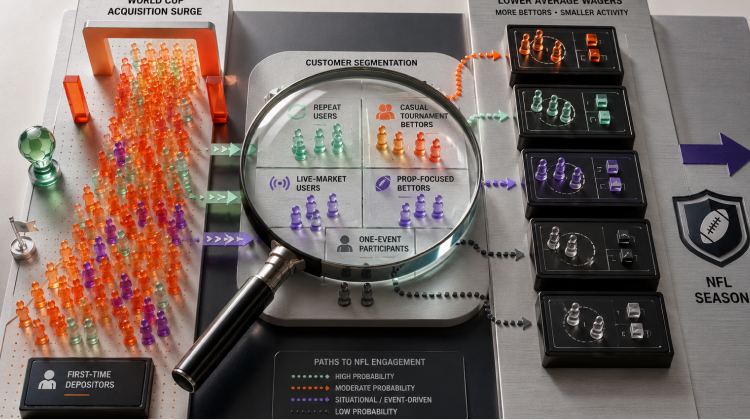
| World Cup Customer Signal | Possible NFL Strategy |
|---|---|
| Repeated live soccer wagers | Emphasize NFL in-play and drive-based markets |
| Frequent match-winner wagers | Introduce NFL moneylines and point spreads |
| Heavy prop-market activity | Highlight quarterback, receiver and touchdown props |
| Occasional national-team betting | Use major standalone NFL games rather than constant messaging |
| Low average wager and limited activity | Reduce costly incentives and use lower-frequency communication |
| Consistent deposits across the tournament | Consider broader season-long and futures engagement |
These categories do not guarantee future behavior. They give operators a more informed basis for deciding which offers, messages and markets are most relevant.
The NFL Offers a Longer Customer-Retention Window
The World Cup was an intense but limited event. The NFL provides a longer and more predictable engagement cycle.
The regular season extends across 18 weeks, followed by the playoffs and Super Bowl. Each week includes Thursday, Sunday and Monday windows, while injury reports, depth-chart changes and weather forecasts create new market information throughout the schedule.
That structure gives sportsbooks more opportunities to retain customers than a knockout tournament does.
A casual World Cup customer might place one or two wagers on the United States and then disappear. An NFL customer can be re-engaged every week through team-specific markets, survivor contests, fantasy-related props and nationally televised games.
Dimi Katsavelis, a senior client partner at Sportradar, argued before the end of the World Cup that retention would be more important than raw acquisition totals. His central point was that the strongest operators would not necessarily be those that signed up the most customers, but those that used personalization and customer-management systems effectively after the tournament. (Post-World Cup sportsbook retention)
The NFL gives operators time to test that approach. They can observe whether a customer responds to preseason content, opening-week markets or specific teams before increasing promotional spending.
Soccer Behavior Can Inform NFL Market Selection
World Cup betting behavior can help sportsbooks decide which NFL products to present first.
A customer who regularly used the 1X2 market was focused on the basic result of the match. The closest NFL equivalents are the moneyline and point spread, although neither is identical.
A soccer draw has no direct standard equivalent in an NFL moneyline market because regular-season football games rarely finish tied. The point spread also adds a margin-of-victory requirement that does not exist in a basic 1X2 selection.
The sportsbook must therefore educate rather than assume.
An operator that immediately pushes complex same-game parlays to a customer who placed only simple World Cup match-result wagers may create unnecessary friction. A cleaner progression would start with basic NFL moneylines, spreads and totals.
The site’s guide to how sportsbooks price favorites and underdogs provides relevant context for understanding how operator prices reflect probability, customer demand and liability.
World Cup customers who used player props may be easier to transfer into NFL betting. Soccer markets involving shots, goals, cards and corners share some structural similarities with football props involving passing yards, receptions, touchdowns and sacks.
Live bettors represent another important group. A user comfortable reacting to match flow, substitutions and score changes may be more likely to explore NFL markets that update after each possession.
That does not mean the same analytical framework transfers perfectly. Soccer is continuous, while the NFL is divided into plays, drives and scheduled stoppages. The pricing rhythm is different, but the willingness to make decisions during an event may carry across sports.
Sportsbooks Learned Which Promotions Generated Real Activity
The World Cup also gave operators a large test of promotional design.
FanDuel used tournament advertising featuring former U.S. international Landon Donovan and offered event-linked incentives. BetMGM connected promotional credits to goals scored by the United States, while Fanatics used FanCash tied to American goals. DraftKings used its combined sportsbook and prediction-market strategy to extend its potential reach beyond states with conventional online sports betting.
The NFL season allows those operators to evaluate which World Cup campaigns generated more than a one-time response.
A promotion can produce registrations without producing durable betting activity. Customers may join, claim an incentive and stop using the platform once the event ends.
For NFL planning, sportsbooks can compare several signals:
- Whether the customer continued betting after the initial incentive
- How many separate World Cup matchdays generated activity
- Whether the customer used cash wagers after promotional credits expired
- Which markets produced repeat engagement
- Whether the customer responded to team-specific or event-specific messages
Operators can then avoid spending the same amount on every account.
This is especially important because aggressive promotional spending can reduce the value of acquisition. A sportsbook may appear to gain market share while generating little return if customers are active only when incentives are available.
Team USA Created Valuable Behavioral Data
The United States’ World Cup run gave sportsbooks a concentrated view of patriotic betting behavior.
Covers reported that more than 80% of the money at multiple operators backed the United States to defeat Belgium and advance to the quarterfinals. Caesars Sportsbook also faced significant exposure in the outright tournament market after the U.S. had opened at approximately +6000 and later shortened as low as +2500.
That pattern is relevant to the NFL because local and regional loyalty plays a major role in football betting.
World Cup customers who heavily supported the U.S. may respond to familiar emotional triggers around hometown NFL teams, nationally televised games or high-profile rivalries. Sportsbooks can identify where team loyalty appears to matter more than price sensitivity.
However, operators must be careful about assuming that patriotic soccer behavior predicts regular NFL activity. A bettor in New York who backed the United States may not automatically become a Jets, Giants or Bills customer. The World Cup may have represented national identity rather than established sports-betting behavior.
The data is useful as a marketing signal, not as proof of long-term value.
The NFL Calendar Changes the Timing of Promotions
The World Cup produced a dense daily schedule. The NFL concentrates most activity into several weekly windows.
That changes how sportsbooks use notifications and offers.
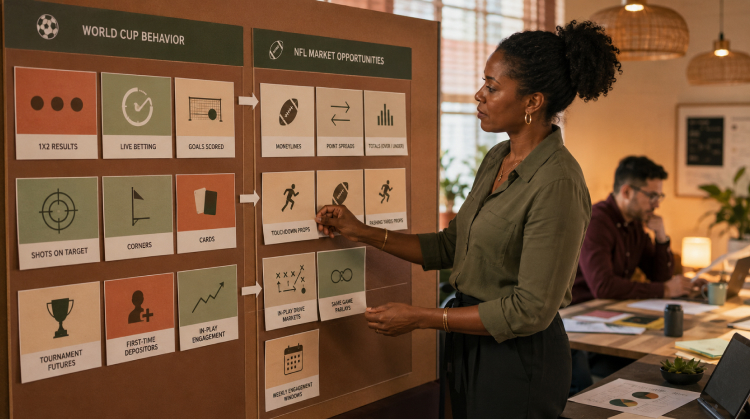
During the World Cup, an operator could send morning match reminders, live-market updates and evening results across consecutive days. NFL campaigns must account for a more segmented week.
Monday and Tuesday may focus on opening spreads and injury review. Wednesday and Thursday bring practice reports and the first standalone game. Friday and Saturday can emphasize final roster information, while Sunday contains the largest concentration of pregame and live activity.
World Cup data can help determine when each customer is most likely to respond.
A bettor who consistently wagered shortly before soccer kickoff may receive NFL messages closer to game time. A customer who placed futures or group-stage qualification wagers days in advance may be more receptive to early weekly lines or season-long markets.
The goal is not to maximize the number of notifications. It is to improve relevance while reducing the risk that users disengage from excessive promotion.
Prediction Markets Add Another Competitive Pressure
Traditional sportsbooks are not the only companies attempting to retain the audience created by the World Cup.
Prediction markets captured an estimated 27% of legal U.S. World Cup sports activity, according to H2 Gambling Capital data cited after the tournament. Kalshi also reported adding approximately three million users during the event.
Those platforms now have their own newly acquired audience entering the NFL season.
For conventional sportsbooks, this increases the importance of product quality. A customer may compare an NFL moneyline or spread with an event contract offered through a prediction platform. The decision can depend on price, liquidity, fees, interface design and whether the product is legally available in the customer’s location.
DraftKings and FanDuel are positioned on both sides of that shift because each company has developed event-contract products in addition to its state-regulated sportsbook operations.
The post-World Cup NFL strategy is therefore not only about converting soccer bettors into football bettors. It is also about preventing those customers from moving to competing platforms.
Responsible-Gambling Controls Must Follow the Customer
Cross-sport retention creates a responsible-gambling obligation.
A customer who joined for several World Cup matches may suddenly receive repeated NFL promotions, futures offers and live-betting notifications. That transition can substantially increase the frequency of betting opportunities.
Operators should apply the same customer data used for marketing to risk monitoring. Changes in deposit frequency, session duration, chasing behavior or attempted limit increases can indicate that engagement is becoming harmful.
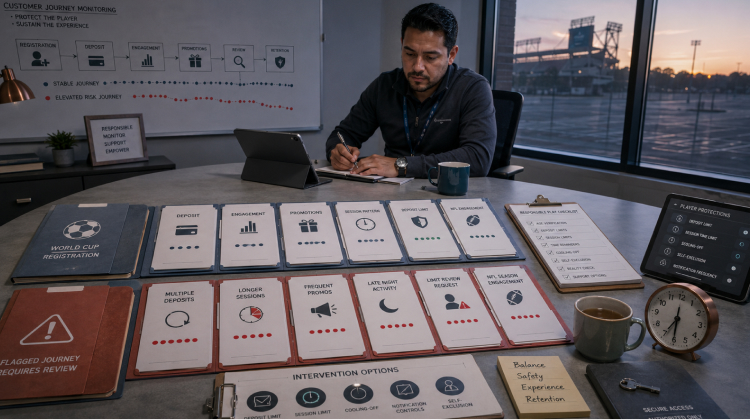
The National Council on Problem Gambling emphasizes the importance of prevention, education and access to support. Sportsbooks also provide tools such as deposit limits, time limits, cooling-off periods and self-exclusion, although specific requirements vary by state.
Retention should not mean pushing every customer toward higher wagering volume. A sustainable strategy must distinguish between relevant engagement and excessive pressure.
The Real Test Begins After Week 1
The World Cup gave U.S. sportsbooks a larger audience and a valuable dataset. The NFL season will reveal how valuable that audience actually is.
The most important numbers will not be the number of accounts opened during June and July. Operators will watch how many of those customers place a preseason wager, return for Week 1, remain active through the middle of the season and continue using the platform without constant incentives.
The World Cup showed that major events can sharply increase first-time deposits. It also showed that the new audience tended to place smaller average wagers and participate less frequently than established bettors.
That combination explains the direction of NFL sportsbook strategy in 2026. Operators have more people to contact, but they must be more selective about how they contact them.
The winners will be the sportsbooks that correctly identify which World Cup users are interested in football, introduce them to appropriate NFL markets and retain them without relying on reckless promotional pressure.
The tournament created the opening. The NFL season will determine whether that opening becomes durable customer growth or a short-lived acquisition spike.